
Great caddis fly
Phryganea grandis
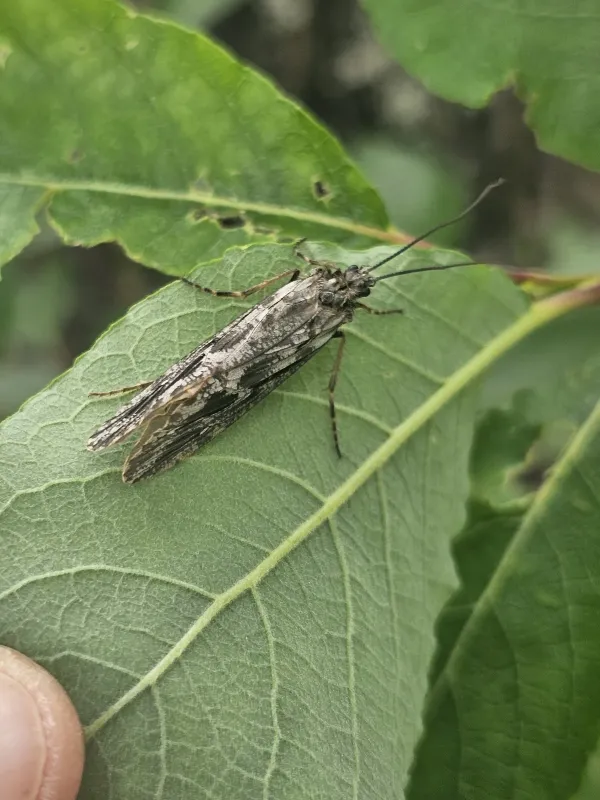
Description
How to identify
The great caddis fly (Phryganea grandis) is an insect species belonging to the order Trichoptera and the family Phryganeidae. It is characterized by a wingspan reaching up to 70 mm and wings featuring a distinct brown, net-like pattern.
Adult caddis flies are primarily nocturnal. Their mouthparts are highly reduced, meaning they do not consume solid food and therefore do not cause direct mechanical damage to field crops.
The larval stage, however, is aquatic and well-known for building portable protective cases. These cases are constructed from small twigs, leaves, and sand grains, providing essential protection from aquatic predators.
The lifecycle follows a complete metamorphosis: egg, larva, pupa, and adult. The development typically spans one year, with the majority of the time spent as a larva in a water-based environment.
These insects thrive in stagnant or slow-moving water bodies with dense vegetation, which can sometimes overlap with irrigated agricultural land or paddy fields.
What it damages
The great caddis fly is not typically classified as a primary agricultural pest. However, in specific aquatic farming systems, such as rice paddies or lotus cultivation, it may pose minor risks.
Larvae primarily feed on organic detritus, but during periods of high population density or food scarcity, they may feed on young, succulent plant tissues, causing damage to seedlings.
Mechanical damage often occurs when larvae harvest parts of living crop stems or leaves to construct or repair their cases, leading to shredded foliage and stunted plant development.
In heavily infested waterlogged areas, the accumulation of larvae can disrupt the growth of young plants, making them more susceptible to other secondary infections or stress factors.
While the overall economic impact is generally low, monitoring is recommended in regions where aquatic crops are grown in close proximity to natural wetlands or stagnant ponds.
When it appears
Adult flight usually occurs during the warmer months, typically peaking between May and August. During this time, mating occurs and eggs are deposited in or near water.
Larvae are active throughout most of the year. They are well-adapted to overwintering on the bottom of water bodies, often slowing their metabolism to survive cold temperatures.
The peak feeding activity of larvae coincides with the spring and summer growth phases of aquatic crops, making this the period of highest risk for mechanical plant damage.
Pupation takes place toward the end of the growth season. Before emerging as adults, pupae actively move through the water column to reach suitable vegetation for the final molt.
Monitoring for adults near agricultural buildings or field edges at dusk can provide early warning signs of a strong reproductive cycle and potential larval presence in the following season.
Signs of infestation
The most visible indicator of larval activity is the presence of floating or stationary "cases" made from plant debris, which are easily spotted on the water surface or attached to submerged stalks.
Irregular, ragged holes or nibbled edges on leaves that are submerged or growing near the water line are common indicators of larval feeding activity.
Stunted growth or poor establishment of young seedlings in submerged areas can suggest that larvae are interfering with the root or stem development of the crop.
Mass appearance of adult caddis flies near farm irrigation systems or light sources indicates a significant population, warranting closer inspection of water quality and plant health.
- Floating cases constructed from twigs and leaves.
- Ragged feeding damage on submerged leaf tissue.
- Reduced vigor or patchy stand density in aquatic crops.
Control measures
Since the great caddis fly is rarely a major pest, chemical control is seldom necessary. Integrated pest management (IPM) focuses on environmental and physical controls.
Managing water levels in flooded fields is an effective way to disrupt the larval habitat, forcing them to move or reducing their survival rate by limiting their access to food sources.
Regular maintenance of irrigation canals and removal of excess aquatic weeds significantly reduces the availability of building materials for larvae and curtails their population growth.
Encouraging biological control by maintaining populations of fish that prey on aquatic larvae is a sustainable approach for managing insect levels in semi-closed water systems.
If insecticides must be used as a last resort, they should be chosen carefully for minimal impact on aquatic life and applied in accordance with regional environmental protection standards.
Taxonomy
- Latin name
- Phryganea grandis
- Family
- Phryganeidae
- EPPO code
- PRYGGR
Discussion
No discussions yet — be the first.