
Red date scale
Phoenicococcus
Description
How to identify
The Red Date Scale (Phoenicococcus marlatti) is a specialized insect belonging to the family Phoenicococcidae that infests date palms.
Adult females are characterized by their distinct reddish-brown color and small, circular, flattened bodies, usually measuring about 1 mm in length.
They secrete a protective white waxy substance that covers their bodies, making them highly resistant to environmental changes and many chemical treatments.
Unlike other scale insects, this species is relatively stationary throughout its life cycle, typically remaining fixed in one location once it settles.
Males are rarely observed and possess wings, but they contribute little to the visible infestation level compared to the numerous and persistent females.
What it damages
The primary host for this pest is the date palm (Phoenix dactylifera), though it can also infest other Phoenix species used in landscaping.
The insect feeds by inserting its stylets into the plant tissues and sucking out sap, which causes significant stress to the host tree.
Infestation sites are typically found in protected areas, such as the base of fronds, deep within leaf axils, and under fibrous layers of the palm bark.
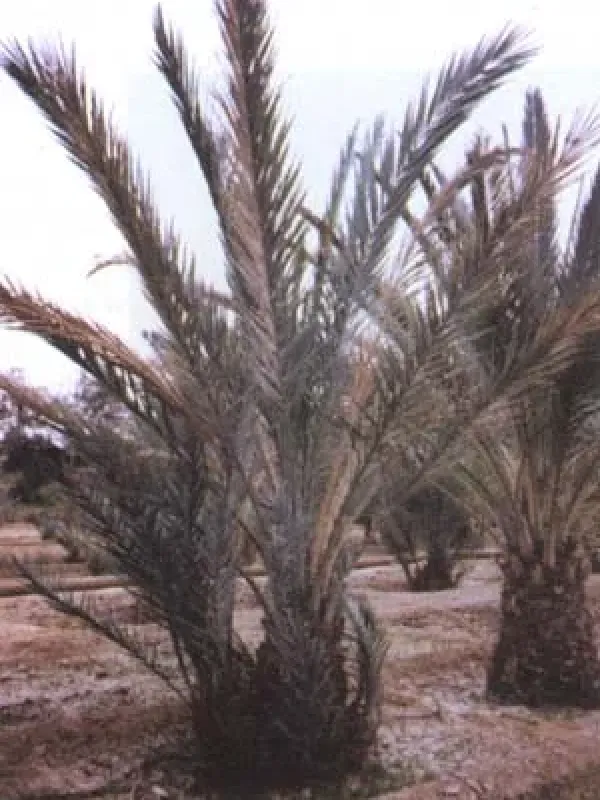
Heavy feeding by large colonies leads to leaf chlorosis, premature drying of fronds, and in severe cases, the overall decline and stunting of the palm tree.
The damage caused by these scales often creates entry points for secondary pathogens, potentially leading to additional fungal infections in the palm trunk.
When it appears
The Red Date Scale thrives in warm climates where the date palm is cultivated, allowing for year-round reproductive activity.
Populations tend to increase rapidly during the hottest and most humid months of the year, which favor the development of crawlers.
These crawlers are the mobile stage of the pest and are responsible for spreading the infestation to new parts of the same tree or neighboring palms.
Because generations often overlap, one can find all life stages of the insect present on a tree at any given time throughout the year.
The reproductive rate is strongly correlated with temperature; warmer conditions lead to faster maturation and a higher number of annual generations.
Signs of infestation
Identification of the pest is often difficult because they blend into the natural texture and color of the palm tree's fibrous bark.
Early signs include the presence of reddish patches or white, crusty waxy residues appearing in the grooves of the palm frond bases.
General tree health decline, such as yellowing leaves or failure of new growth to expand properly, is a common symptom of a long-term infestation.
An inspection with a hand lens is usually required to distinguish these scales from the natural debris trapped in the crevices of the palm.
Significant amounts of loose, dead bark or dry, brittle leaf bases may indicate that the palm is heavily infested with these scale insects.
Control measures
Systemic insecticides are the most effective method for controlling Red Date Scale, as they are absorbed by the plant and reach the insect through the sap.
Applications should be thorough, targeting the dense populations tucked away in the deep, fibrous sections of the trunk and leaf bases.
Sanitation practices, such as pruning and removing old, dry leaf fronds, significantly reduce the available habitats for the scale population.
The use of horticultural oils can be beneficial as they create a suffocating layer over the wax-covered bodies of the insects, killing them upon contact.
Strict quarantine and inspection of imported palms are essential to prevent the introduction of this pest into non-infested regions.
Taxonomy
- Latin name
- Phoenicococcus
- Order
- Hemiptera (bugs, aphids, leafhoppers)
- Family
- Phoenicococcidae
- EPPO code
- PHOESP
Discussion
No discussions yet — be the first.