
Angle Shades
Phlogophora meticulosa
Description
How to identify
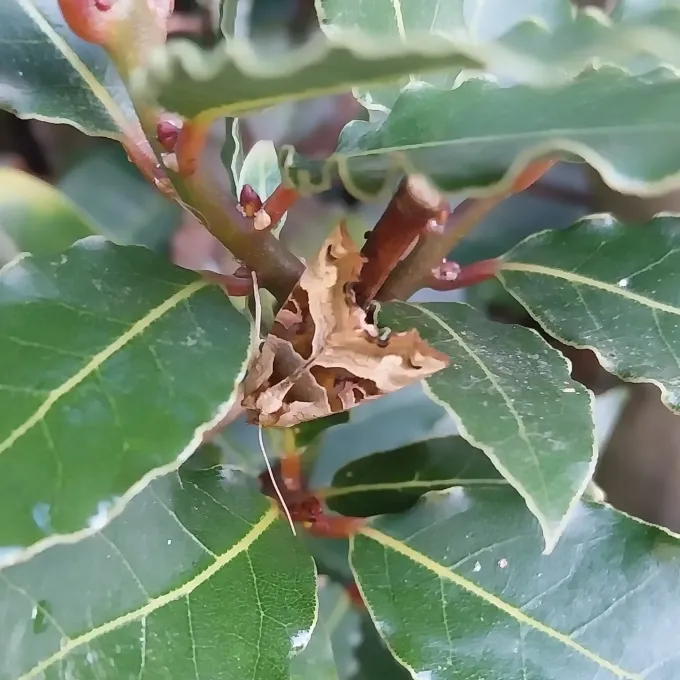
The Angle Shades moth (Phlogophora meticulosa) belongs to the Noctuidae family, order Lepidoptera. The adult moth is easily identified by its triangular, yellow-brown central wing marking and deeply scalloped wing edges, giving it the appearance of a withered leaf.
The wingspan of the adult ranges from 45 to 50 mm. When at rest, the moth folds its wings in a distinct triangular tent shape, allowing it to camouflage perfectly among dead leaves and plant debris.
The larvae (caterpillars) grow up to 45–50 mm long and exhibit green or brown coloration. They possess faint diagonal stripes and small spots, with a characteristic small hump on the final abdominal segment.
The pupa is reddish-brown, about 20 mm long, and typically found in the soil or within thin silk cocoons hidden among foliage. The life cycle varies based on climate, with the potential for multiple generations per year.
The eggs of Phlogophora meticulosa are small, hemispherical, and initially pale, darkening as they mature. Females deposit them in batches, primarily on the undersides of host plant leaves.
What it damages
This species is a generalist feeder (polyphage) known for damaging a wide range of agricultural crops, including tomatoes, cucumbers, lettuce, cabbage, potatoes, and beets.
Ornamental plants are also highly susceptible, with significant damage often reported on chrysanthemums, geraniums, and various greenhouse flowers. It causes economic losses in both open fields and greenhouses.
Young larvae feed primarily on the underside of leaves, creating window-like skeletonized spots. As they grow, they consume entire leaf tissues, leaving only the tougher veins intact.
In greenhouses, the pest can devastate young shoots and floral buds, leading to a total loss of commercial value for ornamental crops and significant yield reduction in vegetables.
The severity of infestation increases in controlled environments where the lack of natural predators and stable temperatures allow the population to thrive year-round, causing constant pressure on crops.
When it appears
The first generation of adults usually emerges in late spring to early summer (May–June). A second generation appears in late summer and remains active until late autumn.
These moths are highly mobile and capable of long-distance migration, which explains why sudden infestations can occur on healthy plots. In southern regions, the reproductive cycle can be nearly continuous.
Larvae are primarily nocturnal, hiding at the base of plants or in the topsoil during daylight hours, which often leads to delayed detection during standard field inspections.
Overwintering occurs in the pupal or larval stage within the soil surface, under plant debris, or in protected gaps of greenhouse structures, ensuring survival through the colder months.
Population peaks coincide with the active growth phase of host plants, particularly during flowering and fruit setting, making timely monitoring critical for successful crop protection.
Signs of infestation
Initial signs of infestation include skeletonized leaf areas with jagged edges, caused by early-stage larval feeding patterns on the leaf parenchyma.
The presence of dark-colored frass (droppings) on leaves beneath feeding sites is a reliable indicator that caterpillars are actively present in the plant canopy.
Wilting shoot tips or damaged flower buds often indicate that larvae have moved to more nutritious plant parts and are actively destroying growth points.
Observing the caterpillars themselves, which are well-camouflaged and typically hide in leaf axils or soil crevices during the day, confirms an active infestation.
- Irregular feeding holes and skeletonized leaf surfaces.
- Accumulation of frass on foliage and soil.
- Destruction of buds and floral structures.
- Presence of pupae in loose topsoil or litter.
Control measures
Cultural control methods include deep autumn plowing to expose and destroy overwintering pupae, as well as rigorous weed management to eliminate alternative host plants.
In greenhouse settings, light traps and pheromone traps should be deployed to monitor moth activity and reduce the overall population before large-scale egg-laying occurs.
Biological control options involve the application of Bacillus thuringiensis, which is highly effective against larvae while maintaining the safety of beneficial insects.
Chemical control requires the use of stomach-contact insecticides, applied precisely when larvae are newly hatched, as they are most susceptible to treatment at this stage.
Maintaining a strict rotation of chemical classes is essential to prevent the development of pesticide resistance, while strictly adhering to harvest intervals is required for consumer safety.
Taxonomy
- Latin name
- Phlogophora meticulosa
- Order
- Lepidoptera (butterflies)
- Family
- Noctuidae
- EPPO code
- BROTME
Discussion
No discussions yet — be the first.