
Pheidole guineensis
Pheidole guineensis
Description
How to identify
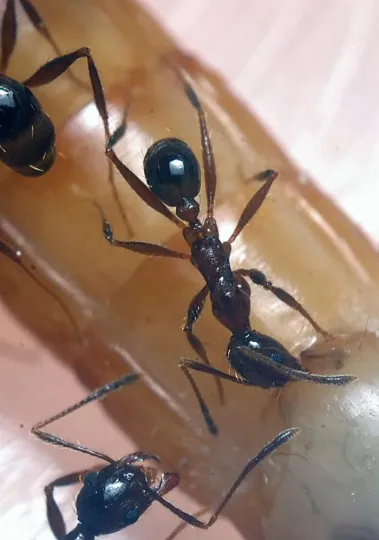
Pheidole guineensis is a species of ant belonging to the family Formicidae and subfamily Myrmicinae. This species exhibits distinct polymorphism, featuring both smaller worker ants and larger, major workers known as soldiers with enlarged heads.
The body color ranges from yellowish-brown to dark brown. A key identifying characteristic is the two-segmented pedicel between the thorax and abdomen, which is a hallmark of the Myrmicinae subfamily.
The antennae consist of 12 segments, ending in a distinct three-segmented club. The soldiers possess massive heads adapted for defensive purposes and crushing hard seeds.
Colonies of this species are often polygynous, meaning they possess multiple queens, which facilitates rapid colony growth and efficient expansion into new agricultural areas.
These ants are highly adaptive, invasive, and frequently found in tropical and subtropical agroecosystems, posing a challenge to biodiversity and crop production.
What it damages
The primary damage caused by Pheidole guineensis involves the destruction of seeds and seedlings, often leading to reduced plant density and economic losses in row crops.
These ants are notorious for their mutualistic relationship with honeydew-producing insects such as aphids, mealybugs, and scale insects. They provide protection to these pests, leading to their rapid proliferation.
By protecting aphids and other sap-sucking insects, the ants indirectly cause stunted plant growth, leaf deformation, and the transmission of viral plant pathogens.
In some crops, these ants may directly damage fruits and roots by feeding on tissues to obtain moisture and nutrients, especially during dry seasons.
The accumulation of honeydew and the resulting growth of sooty mold on leaf surfaces further impede photosynthesis and overall plant health.
When it appears
The activity of these ants is highly dependent on environmental temperature. In tropical regions, they remain active throughout the year, causing continuous pressure on crops.
Foraging activity peaks during spring and summer months when colonies are actively raising brood and require significant amounts of protein and carbohydrates.
In irrigated farming systems, moisture availability allows these ants to sustain high activity levels even during periods that would otherwise be limiting for local species.
Seasonal fluctuations in temperature may drive colonies deeper into the soil or toward warmer microhabitats, such as greenhouses or mulched field areas.
The activity patterns are strictly aligned with the population cycles of the honeydew-producing insects they tend, creating a prolonged period of pest pressure.
Signs of infestation
Visible nests near the root zones of crops and soil disturbance in fields are primary indicators of a Pheidole guineensis infestation.
The presence of distinct foraging trails leading up to plant stems, especially where aphids are colonizing, is a reliable diagnostic sign.
Seedling failure or thinning patches within a field, often accompanied by unearthed seeds, are typical damage symptoms for early-stage crops.
Sticky honeydew secretions on leaves, followed by the appearance of black sooty mold, indicate that ants are actively farming sucking pests on the plants.
- Ant trails on stems and branches.
- Presence of aphids or mealybugs on young plant tissue.
- Root disturbance and small mounds around the base of plants.
Control measures
The most effective strategy involves the use of slow-acting toxic baits. The workers transport the poison to the colony, ultimately eliminating the queens.
Controlling the honeydew-producing pests, such as aphids and scale, is crucial. If these pests are managed, the habitat becomes less attractive to the ants.
Agrotechnical practices like regular soil tillage and cultivation disrupt nests and minimize the ants' ability to establish stable foraging routes.
Barriers such as sticky bands on tree trunks or the application of diatomaceous earth can protect individual crops from being exploited by the ants.
Integrated Pest Management (IPM) strategies, including biological control and targeted use of insecticides, should be implemented to minimize damage while protecting beneficial organisms.
Taxonomy
- Latin name
- Pheidole guineensis
- Order
- Hymenoptera
- Family
- Formicidae
- EPPO code
- PHEIGU
Discussion
No discussions yet — be the first.