
Maritime bristle-tail
Petrobius maritimus
Description
How to identify
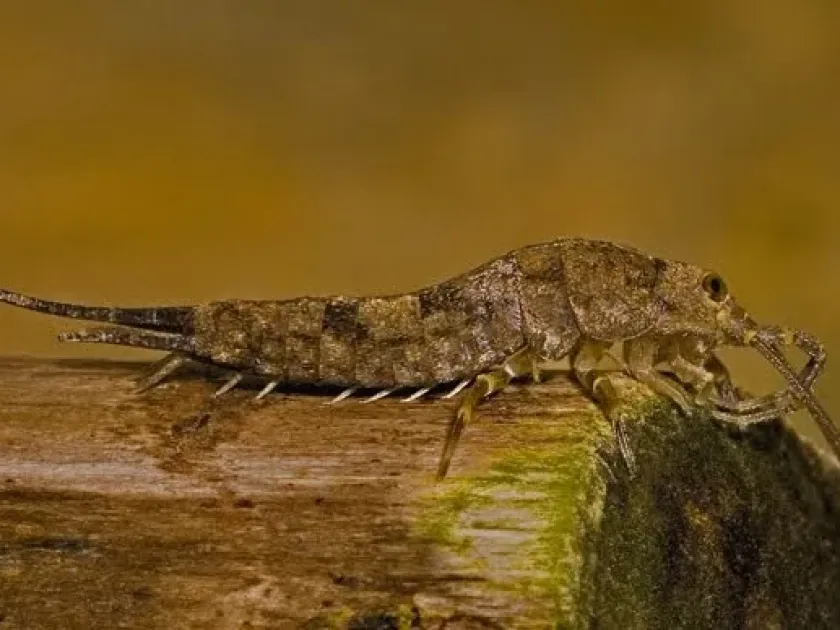
The maritime bristle-tail (Petrobius maritimus) belongs to the order Archaeognatha and the family Machilidae. It is a primitive, wingless insect characterized by a spindle-shaped body covered in scales.
These insects typically grow to 10–15 mm in length and possess long, thread-like antennae that serve as vital sensory organs for navigating their environment.
The most distinctive morphological features include three long caudal filaments extending from the abdomen, with the central one being noticeably longer than the lateral ones.
Their coloration ranges from grey to brownish, providing excellent camouflage against the rocky cliffs and maritime debris where they naturally reside.
They undergo ametabolous development, meaning the nymphs resemble miniature adults, gradually maturing through a series of molts without undergoing a pupal stage.
What it damages
In its natural habitat, Petrobius maritimus primarily feeds on lichens, algae, and organic detritus accumulated in coastal zones.
However, when crops are planted in close proximity to the shore, these insects may occasionally shift their diet to include young shoots, leaves, and seedlings of ornamental and vegetable plants.
The damage manifests as surface scraping of the leaf epidermis, which can stunt the growth of young plants and cause significant aesthetic damage to leafy crops.
Seedlings are particularly vulnerable, as repeated feeding by large populations can lead to complete desiccation and death of the tender plant tissue.
While they are not considered major agricultural pests on a global scale, their high local density in seaside gardens can lead to localized economic loss.
When it appears
The maritime bristle-tail is active throughout the growing season, with activity levels fluctuating based on local temperature and humidity conditions.
Peak activity is generally observed during the warmer summer months, which coincide with the most favorable conditions for their reproduction and larval growth.
They are primarily nocturnal or crepuscular, spending the daylight hours hiding in deep rock crevices, under stones, or beneath dense layers of organic debris.
As autumn progresses and temperatures drop, their metabolic rate decreases, and they seek sheltered overwintering sites to survive the cold months.
Their life cycle is inextricably linked to the humid microclimate of the coast, which provides the necessary moisture for their survival.
Signs of infestation
The earliest signs of infestation are superficial, scraped lesions on the leaf surface, which often turn necrotic and yellow over time.
One may observe discarded exuviae (molted skins) near the base of plants, which serves as a definitive indicator of a residing population.
At night, using a flashlight in coastal gardens often reveals the presence of these insects, as they are highly active and will jump away rapidly when disturbed.
Weakened, wilting seedlings that show signs of epidermis loss are frequent indicators that the pests are feeding nearby.
Large quantities of small, pellet-like frass on the soil surface under stones or mulch are another clear sign of their presence and feeding activity.
Control measures
Integrated pest management for the maritime bristle-tail focuses on modifying the habitat to make the environment inhospitable for the insects.
Removing potential daytime shelters such as piles of stones, loose debris, and decaying organic matter is the most effective preventative strategy.
Physical barriers, such as applying a ring of diatomaceous earth or wood ash around the base of vulnerable plants, can effectively deter these insects.
If population levels reach an economic threshold, approved contact insecticides can be applied during the evening when the insects are most active.
- Maintain a clear perimeter around garden beds.
- Manage irrigation to prevent excess moisture at the soil surface.
- Manual removal and monitoring during the nighttime hours.
Taxonomy
- Latin name
- Petrobius maritimus
- Family
- Machilidae
- EPPO code
- PTRBMA
Discussion
No discussions yet — be the first.