
New Zealand grass moth
Persectania aversa
Description
How to identify
The New Zealand grass moth (Persectania aversa) is a member of the Noctuidae family, belonging to the order Lepidoptera. It is a known agricultural pest in its region, characterized by its nocturnal habits and specific life cycle phases.
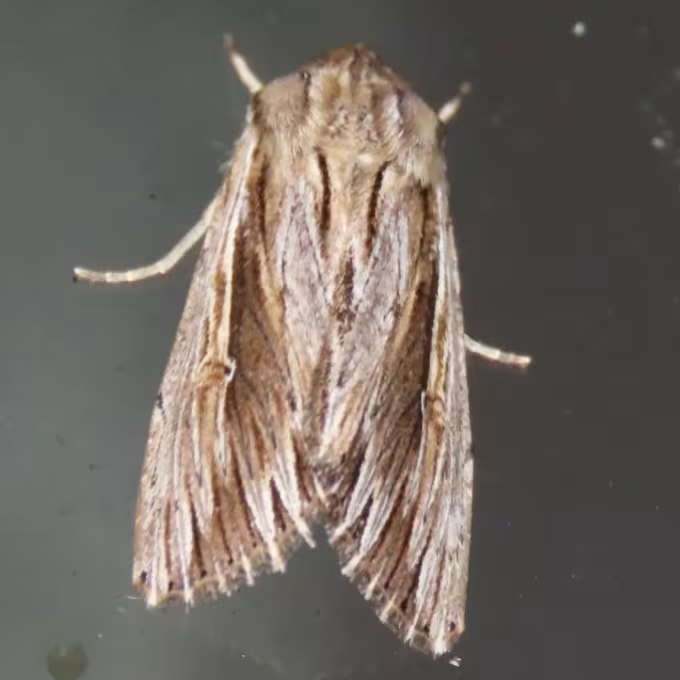
The adult moth has a wingspan of approximately 35–45 mm. The forewings are mottled with shades of grey and brown, providing excellent camouflage against dead foliage and soil backgrounds during their resting phase.
The larvae, or caterpillars, develop through several instars. When fully grown, they measure up to 40 mm in length and exhibit longitudinal stripes, which help them blend in with the stems of grasses and cereal crops.
Pupation typically takes place within the soil or in organic debris near the base of host plants. The pupae are protected within a silken cocoon mixed with soil particles, allowing them to survive environmental fluctuations.
The life cycle involves multiple generations per season, depending on the temperature and local climate conditions. The survival and reproductive rate of this species are significantly influenced by seasonal moisture levels.
What it damages
This species primarily targets cereal crops, causing economic damage to wheat, barley, and oats. The larvae feed on the green vegetative tissues, which hinders the plant's ability to develop strong stalks.
In addition to small grains, the pest is a significant threat to pasture grasses, including ryegrass. This can have a detrimental effect on the availability of feed for livestock in affected agricultural regions.
The physiological damage manifests as reduced photosynthesis due to leaf area loss. When the plant is weakened, its overall resistance to other environmental stresses and diseases is significantly lowered.
During the grain-filling stage, the larvae may feed on the developing heads of the crops. This direct destruction of reproductive parts can lead to substantial yield losses and reduced grain quality.
When populations reach high levels, the caterpillars can strip large areas of a field, leading to severe financial losses for farmers if intervention measures are not taken in a timely manner.
Signs of infestation
Initial signs of infestation appear as small, semi-transparent windows on the leaf surfaces, caused by young larvae grazing on the soft tissue while leaving the epidermis intact.
As the larvae mature, their feeding habits change to consuming the entire leaf tissue. They often graze from the edges of the leaves inward, eventually leaving behind only the tough midribs.
The presence of frass (caterpillar excrement) on the soil surface or trapped in the leaf axils is a clear indicator of active feeding in the crop canopy.
Because the moths and larvae are nocturnal, inspections should be carried out at night or during twilight. During the day, they remain hidden in the dense base of the plants or buried in the topsoil.
Visible damage to the ears of cereal plants, including fallen grain fragments and notched glumes, confirms the presence of the pest during the critical maturation phase of the crop.
Control measures
Management begins with rigorous monitoring using pheromone traps to track the flight patterns of adult moths and predict the timing of subsequent larval emergence.
Cultural control measures, such as field sanitation and the removal of weeds that act as alternate hosts, are essential to disrupt the life cycle and reduce overwintering habitats.
Chemical control should be implemented based on economic thresholds. Approved insecticides should be applied when larval counts reach a point where yield loss is projected to exceed the cost of treatment.
Crop rotation is a highly effective strategy for controlling the New Zealand grass moth. Planting non-host crops interrupts the pest's life cycle and prevents the build-up of local populations.
Biological control, including the protection and encouragement of natural predators like parasitoid wasps and ground beetles, is a sustainable way to manage populations as part of an Integrated Pest Management program.
Taxonomy
- Latin name
- Persectania aversa
- Order
- Lepidoptera (butterflies)
- Family
- Noctuidae
- EPPO code
- PERSAR
Discussion
No discussions yet — be the first.