
Amur sleeper
Perccottus glenii
Description
How to identify
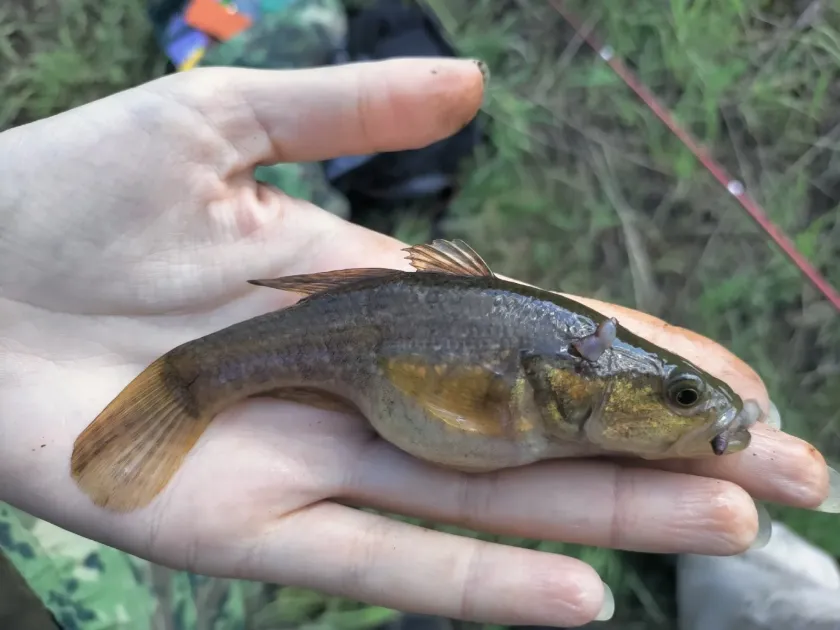
The Amur sleeper (Perccottus glenii) belongs to the Odontobutidae family. It is a highly resilient, medium-sized fish with a large head, a wide mouth, and a stocky body covered with relatively large scales.
Its coloration is highly variable, usually ranging from dark brown to black with mottled spots, which helps it blend perfectly into muddy or vegetated aquatic environments.
The species lacks a lateral line, which is a key identification feature. It is famous for its extreme physiological tolerance, capable of surviving in water with very low oxygen levels or even in water-logged mud.
Biological plasticity allows the Amur sleeper to thrive in diverse habitats, including marshes, ponds, and slow-flowing rivers where other fish species would typically suffocate.
It is an ambush predator that remains motionless for extended periods, conserving energy until a prey item enters its strike zone, at which point it displays explosive agility.
What it damages
The primary economic damage caused by the Amur sleeper is the predation of eggs, larvae, and fry of commercial fish species like common carp, crucian carp, and tench in aquaculture facilities.
In stocked ponds, the Amur sleeper acts as a severe competitor for limited food resources, directly reducing the total biomass production of the desired commercial species.
The species significantly disrupts the natural ecological balance by preying on amphibians, aquatic insects, and zooplankton, which are essential components of the pond food web.
Due to its high reproductive rate and lack of natural predators in many introduced areas, it can rapidly dominate a pond, making it difficult to maintain profitable aquaculture production.
Furthermore, the Amur sleeper is a known vector for various fish parasites and diseases, providing a reservoir for pathogens that can lead to large-scale outbreaks in commercial fish populations.
When it appears
Activity begins in early spring, as soon as water temperatures reach 5–8 degrees Celsius, as the fish emerge from winter dormancy and immediately begin feeding to regain condition.
Spawning occurs throughout late spring and early summer, typically when water temperatures are between 15 and 20 degrees Celsius. Males exhibit parental care, guarding eggs attached to vegetation.
Peak impact on aquaculture occurs during the summer months when juvenile commercial fish are most vulnerable to predation by the sleeper's rapidly growing population.
As autumn approaches and water temperatures drop, the Amur sleeper continues to feed aggressively to store fat, which is vital for its survival during the upcoming winter season.
During winter, the fish becomes less active, but its unique ability to survive in near-anoxic conditions allows it to outlive other species, ensuring it dominates the pond after the winter thaw.
Control measures
The most effective management strategy is complete pond drainage and allowing the bottom to freeze thoroughly during winter, which eradicates all developmental stages of the Amur sleeper.
Installing fine-mesh screens and physical barriers at water intakes is crucial to prevent the introduction of eggs or fry from wild, contaminated water sources into the pond system.
Biological control can be achieved by introducing larger predatory fish, such as Northern pike, which can significantly reduce the Amur sleeper population through active predation.
Regular monitoring and netting operations with fine-mesh gear can assist in keeping population levels low, although this approach requires intensive labor and is often only a mitigation measure.
- Drainage and disinfection of pond beds.
- Introduction of predatory fish for biological control.
- Installation of mechanical filtration on water intakes.
- Regular netting to control population density.
Taxonomy
- Latin name
- Perccottus glenii
- Family
- Odontobutidae
- EPPO code
- PCCTSP
Discussion
No discussions yet — be the first.