
Common limpet
Patella vulgata
Description
How to identify
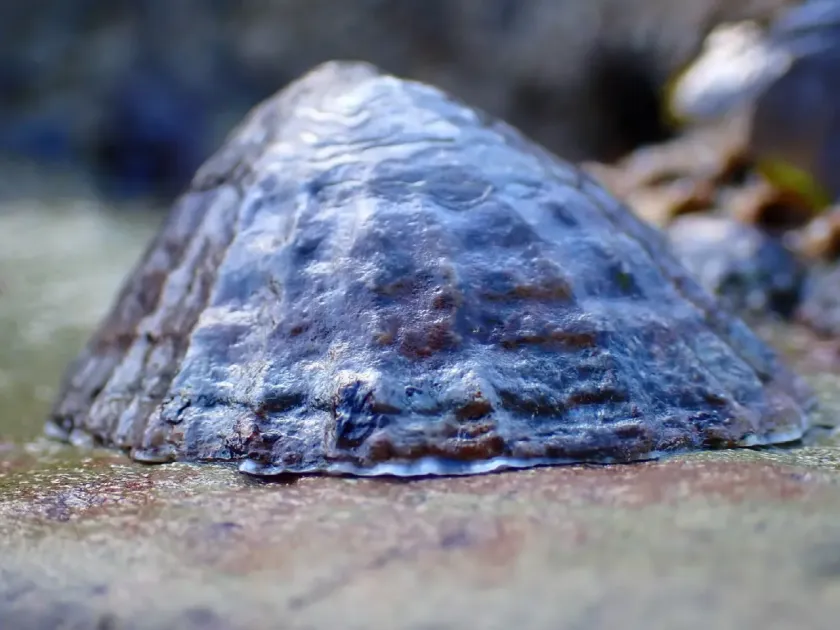
The common limpet (Patella vulgata) is a gastropod mollusk belonging to the family Patellidae. It is characterized by its conical, tent-shaped shell which is highly resistant to wave action.
These mollusks are primarily found in the intertidal zone, where they attach themselves firmly to rocks using a powerful muscular foot. Their shells are typically grey or brownish, blending perfectly with the coastal environment.
Biologically, they are adapted for survival in harsh marine environments. They rely on gills for respiration and move short distances during high tide to feed on algae using a radula.
The life cycle involves a free-swimming larval stage that eventually settles onto a suitable hard substrate. They are sessile animals as adults, showing a strong homing instinct to their preferred attachment sites.
The species plays a significant role in grazing algae from rocky shores, which helps maintain the ecological balance of the shoreline. They are entirely marine and cannot exist in terrestrial soil or plant environments.
What it damages
The common limpet is not an agricultural pest and does not damage crops or garden plants. There is no risk of infestation for fruits, vegetables, or field crops.
The impact is limited to industrial marine infrastructure. Limpets may colonize water intake pipes, cooling systems of seaside plants, or aquaculture equipment, leading to clogging.
In aquaculture, they can attach to nets or floating structures, increasing the weight and maintenance requirements for the farmers. However, this is a technical issue, not a crop loss issue.
There is no evidence of these mollusks damaging land-based produce, as they are physiologically dependent on a salt-water environment and high humidity.
Their activity on shorelines is considered beneficial for maintaining cleaner surfaces in the marine habitat rather than a destructive phenomenon for human activities.
Control measures
Control measures are restricted to marine engineering and infrastructure management. Using anti-fouling coatings is a standard practice to prevent mollusk attachment.
Mechanical clearing and pressure washing of water pipes and submerged equipment are the most common ways to remove settled populations of limpets.
Installing fine filters at water intake points prevents larvae from entering and establishing colonies within sensitive technical systems.
Chemical control, such as specialized biocides in closed-loop industrial water systems, can be implemented to maintain clear passage for water flow.
No agricultural pesticide or agro-technical strategy is required, as the common limpet has no negative interaction with terrestrial farming practices.
Taxonomy
- Latin name
- Patella vulgata
- Order
- Molluscs
- Family
- Patellidae
- EPPO code
- PATLVU
Discussion
No discussions yet — be the first.