
Crazy ant
Paratrechina longicornis
Description
How to identify
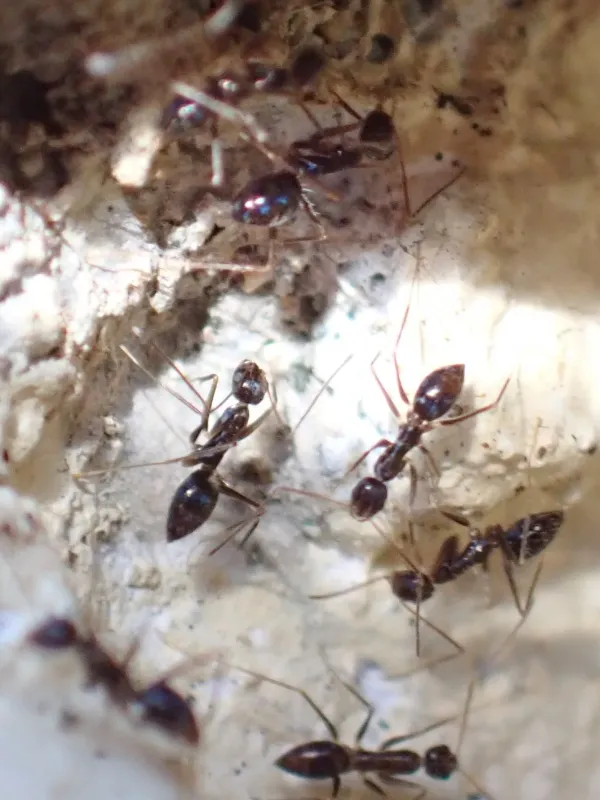
The Crazy ant (Paratrechina longicornis) belongs to the order Hymenoptera, family Formicidae. These are tiny insects, typically measuring 2–3 mm in length.
The common name comes from their characteristic erratic, rapid, and jerky movement patterns that are easily distinguishable from the behavior of other ant species.
Their bodies are dark brown or black with a metallic sheen. They are equipped with disproportionately long legs and antennae, which enable them to travel long distances with great speed.
Colonies of these ants can comprise thousands of individuals with multiple queens, which makes them highly resilient and capable of spreading rapidly to new environments.
They prefer warm and humid conditions, frequently nesting in soil, decaying wood, wall voids, or under leaf litter and debris in agricultural settings.
What it damages
While the Crazy ant does not directly feed on plant tissues, it acts as a significant indirect pest by protecting honeydew-producing insects such as aphids, mealybugs, and scale insects.
By fending off natural predators like ladybugs or lacewings, the ants facilitate the population explosion of these sap-sucking pests, which weakens the host plants.
The excessive accumulation of honeydew on the leaves provides an ideal substrate for the growth of sooty mold, which impairs photosynthesis and reduces crop yields.
In greenhouses and nurseries, these ants are known to interfere with irrigation systems and equipment, occasionally causing electrical failures due to their attraction to sensitive electronic components.
Their presence can lead to plant stress, stunted growth, and the transmission of plant diseases as the sap-sucking insects they protect often carry viral pathogens.
Signs of infestation
The most obvious sign of an infestation is the sight of numerous workers moving in quick, zig-zagging patterns across the ground or plant surfaces.
High numbers of ants congregating around young buds, shoots, or the undersides of leaves—where aphid colonies usually reside—is a strong indicator of their activity.
Sticky residues on plant surfaces, often accompanied by the emergence of black fungal growth (sooty mold), indicate that the plant is infested with sap-sucking pests tended by ants.
The discovery of small mounds of soil or nesting sites under mulch, stones, or garden debris near the base of plants confirms a localized infestation.
Frequent malfunctions in electronic greenhouse equipment or clogged drip irrigation emitters can be a secondary indicator that a colony is nesting nearby.
Control measures
Controlling the Crazy ant is notoriously difficult because contact-based insecticides often eliminate only a small fraction of workers while the colony remains protected.
The most effective strategy involves using slow-acting, poison-based baits that workers carry back to the nest, eventually resulting in the elimination of the queens and the entire colony.
It is crucial to manage the populations of aphids and mealybugs using systemic insecticides, as this removes the primary food source that attracts the ants to the plants.
Sanitation is key; growers should remove unnecessary debris, wood piles, and leaf litter where the ants are likely to establish their nests.
- Apply specialized insecticidal gels along ant trails.
- Conduct regular inspections of the root zones and leaf undersides.
- Use systemic insecticides to eliminate the honeydew-producing pests.
Taxonomy
- Latin name
- Paratrechina longicornis
- Order
- Hymenoptera
- Family
- Formicidae
- EPPO code
- PAATLO
Discussion
No discussions yet — be the first.