
Common house spider
Parasteatoda tepidariorum
Description
How to identify
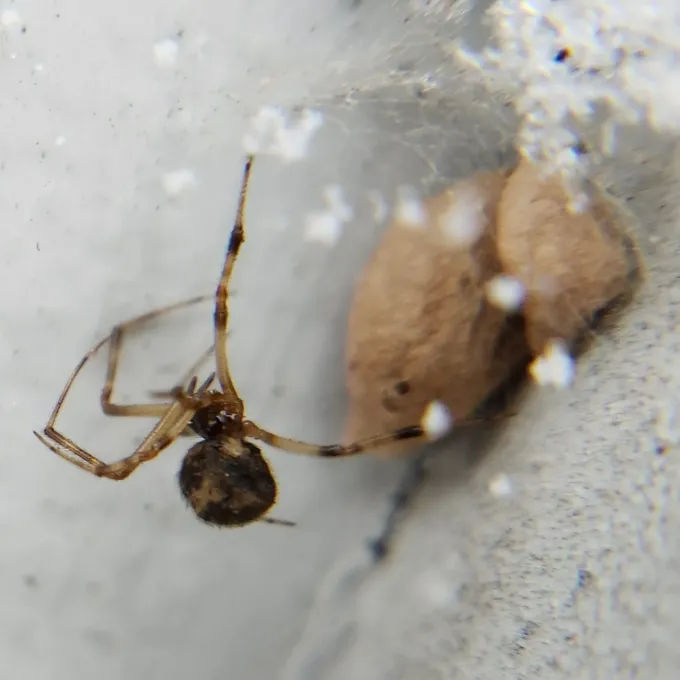
The common house spider Parasteatoda tepidariorum belongs to the family Theridiidae. Adults are typically 5–8 mm long, featuring a globular abdomen and a mottled brown-grey coloration that allows them to blend into the environment.
These spiders are primarily nocturnal and favor dark, humid, and sheltered areas. While they do not consume plant tissues directly, their presence in greenhouse ecosystems is a significant indicator of environmental stability that may require management.
A defining characteristic is their ability to weave messy, irregular webs in structural corners, between leaves, and within plant stems. Females produce brown, pear-shaped egg sacs that are suspended within their webs.
The life cycle is highly adaptable, allowing for year-round persistence in greenhouse environments where temperatures remain stable. This ensures continuous presence if not managed properly.
Although they are often considered household pests, their encroachment into agricultural spaces creates management challenges, as they occupy niches that could otherwise be monitored for phytosanitary risks.
What it damages
The common house spider does not feed on plants, yet it causes indirect harm to ornamental and vegetable crops. The primary issue is the mechanical accumulation of dense webbing across leaf surfaces.
These webs collect dust, fungal spores, and insect debris, which significantly reduces photosynthesis intensity. This stress leads to stunted growth and weakened plant immunity against diseases.
Dense webbing makes it difficult to conduct regular inspections for primary agricultural pests such as aphids, whiteflies, or spider mites. The webs act as a veil, masking early-stage infestations.
For floricultural crops, the presence of webs and debris renders the product commercially unviable. Aesthetics are critical in this sector, and even light webbing can lead to crop rejection.
Accumulated webs trap moisture against the plant surface, promoting the development of secondary infections. Fungal issues like gray mold and powdery mildew are frequently exacerbated by the high humidity trapped within the silk.
Signs of infestation
The most obvious sign of infestation is the presence of tangled, sticky webs located in plant axils, nodes, or greenhouse corners. These webs often appear dirty due to the accumulation of organic particles.
Brown, pear-shaped egg sacs hanging from threads are strong indicators of an established population. Additionally, scattered remains of insect exoskeletons within the webs indicate the spider's hunting success in the area.
Control measures
Effective control starts with routine mechanical removal of webs. Using damp cloths or soft-bristled brushes helps clear structural corners and plant foliage without causing physical damage to the crops.
Maintaining optimal greenhouse humidity and ensuring proper airflow reduces the suitability of the environment for spiders. Dry, well-ventilated greenhouses are significantly less attractive to these arachnids.
In cases of high infestation, localized applications of authorized insecticides may be required. It is essential to select products that are safe for the specific crop and do not induce phytotoxicity.
Sanitation practices, such as removing weeds around the exterior of the greenhouse, are crucial to prevent spiders from using these areas as reservoirs for migration into the growing space.
Installing fine-mesh screens on greenhouse vents provides a physical barrier against invaders. Combining exclusion methods with regular monitoring ensures that populations remain at negligible levels throughout the season.
Taxonomy
- Latin name
- Parasteatoda tepidariorum
- Family
- Theridiidae
- EPPO code
- ARCATE
Discussion
No discussions yet — be the first.