
Flesh fly
Parasarcophaga crassipalpis
Description
How to identify
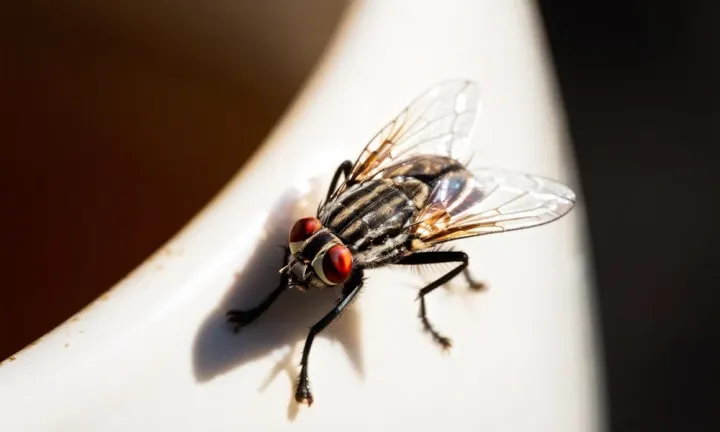
The flesh fly, scientifically known as Parasarcophaga crassipalpis, is a member of the Sarcophagidae family. These flies are relatively large, typically measuring between 10 and 14 mm in length.
The thorax of the adult is grey with three distinct dark longitudinal stripes. The abdomen features a characteristic checkerboard pattern, which is a common diagnostic trait.
Their eyes are prominent and usually reddish-brown. The mouthparts are of the sponging type, adapted for feeding on decaying organic substances and liquids.
Larvae are maggot-like, creamy-white, and tapered in shape. They lack a distinct head and possess specialized posterior spiracles for respiration.
This species is globally distributed and plays a significant role in ecosystems as a scavenger, but it can become a nuisance in agricultural settings.
What it damages
While primarily a scavenger, the flesh fly can cause economic damage by infesting agricultural products that have started to rot or are damaged.
The larvae feed on decaying plant tissues, accelerating the decomposition process and rendering produce unfit for human consumption or storage.
By moving between decaying organic matter and healthy produce, they act as mechanical vectors for bacteria and fungi, inducing soft rot and other diseases.
The presence of larvae in harvested fruits or vegetables significantly lowers the quality and marketability of the product.
Damage is usually more severe in facilities with poor waste management or high levels of accumulated organic debris near production areas.
When it appears
Adult activity begins in late spring and continues throughout the summer when temperatures consistently stay above 15 °C.
Peak populations are reached during hot and humid conditions, which favor the rapid development of larvae in decaying organic substrates.
The species is ovoviviparous, meaning they deposit live larvae onto the substrate, giving them an immediate advantage for survival and growth.
The developmental cycle from larva to adult is quite rapid, often taking less than two weeks under favorable summer conditions.
As temperatures drop in autumn, the flies decrease their activity and enter diapause, overwintering as pupae in the soil or protected areas.
Signs of infestation
The primary sign of an infestation is the visual observation of white, legless maggots within decaying plant materials or fruit piles.
An unusually high density of adult flies buzzing around compost bins, harvest storage areas, or field waste is a clear indicator of a breeding site.
Affected produce shows signs of rapid tissue breakdown, often accompanied by an unpleasant odor caused by larval feeding and bacterial activity.
- Presence of live larvae in vegetable or fruit waste.
- Unpleasant, pungent odors in storage facilities.
- Increased fly numbers around damaged produce crates.
Surface lesions on vegetables that appear soft and moist may also indicate active colonization by flesh fly larvae.
Control measures
Strict sanitation is the most effective management tool; remove all rotting plant matter and organic waste from the vicinity of crops and storage.
Ensure that storage facilities are properly sealed with screens to prevent adult flies from entering and laying larvae on harvested goods.
Deploying baited fly traps around the perimeter of production areas can help monitor and reduce adult population levels.
Proper composting practices, such as turning piles and covering waste with soil, are essential to prevent flies from accessing the organic substrate.
Chemical control should be limited to non-food areas, as direct insecticide application to edible crops is generally prohibited and ineffective.
Taxonomy
- Latin name
- Parasarcophaga crassipalpis
- Order
- Diptera (flies)
- Family
- Sarcophagidae
- EPPO code
- SARCCR
Discussion
No discussions yet — be the first.