
Grey flesh fly
Parasarcophaga
Description
How to identify
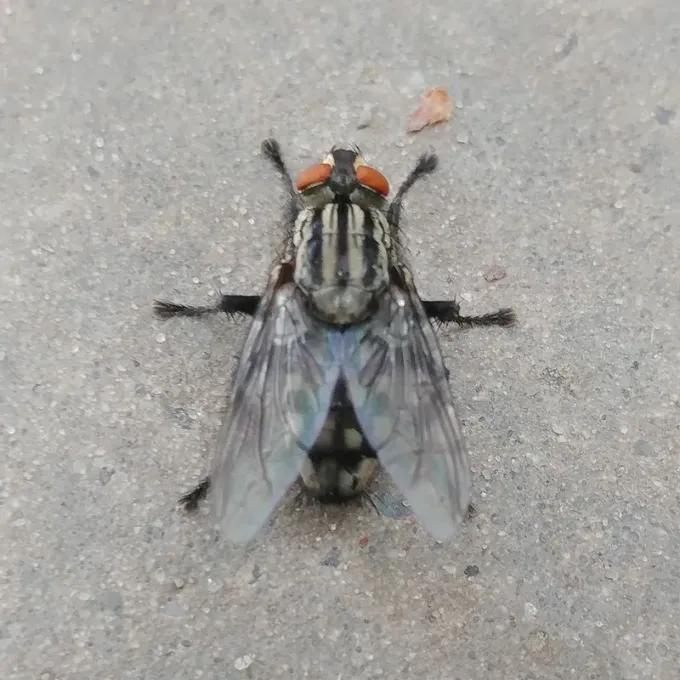
The grey flesh fly, belonging to the Sarcophagidae family, is a large, robust insect with a characteristic grey appearance. Its thorax features three distinct longitudinal dark stripes, while the abdomen shows a clear checkerboard pattern.
The adults have reddish eyes and a mouthpart designed for liquid food. They reach a length of 8 to 16 millimeters, making them highly visible in agricultural ecosystems.
A key biological feature of the genus Parasarcophaga is that they are viviparous. The female gives birth to live larvae directly onto the substrate, which significantly increases the survival rate of the offspring.
The larvae develop very rapidly. While they primarily feed on decaying organic matter, they can damage plant tissues if those tissues are weakened or already bruised.
In nature, these flies are scavengers, but near agricultural facilities, they can become significant pests, contaminating food products and carrying various pathogens.
What it damages
The primary damage from the grey flesh fly occurs in vegetable storage facilities and on crops that have mechanical damage. Larvae penetrate soft fruits and vegetables through skin cracks.
Vegetable crops such as tomatoes, cucumbers, and squashes are most vulnerable, especially if the fruits are in contact with moist soil or have skin abrasions.
In storage environments, the larvae degrade the quality of produce, often rendering it entirely unsuitable for consumption or commercial sale.
Beyond direct feeding, these flies contribute to indirect damage by contaminating plant surfaces with excrement, which serves as a breeding ground for mold and bacterial rot.
The level of damage increases significantly in high-humidity conditions with poor ventilation, which provides an ideal environment for larval growth.
When it appears
Adult fly activity typically begins in late spring when average daily temperatures reach +15 degrees Celsius or higher.
The peak population density occurs during the hot summer months, specifically July and August, which aligns with the ripening period of most vegetable crops.
These flies are diurnal and prefer sunny, warm areas, especially locations near food sources for their larvae.
The lifecycle from larva to adult is quite short, often taking about 15 to 20 days under optimal conditions, allowing for multiple generations per season.
As temperatures drop in the autumn, the activity declines, and the flies enter hibernation as pupae in the soil or protected structures.
Signs of infestation
The first sign of infestation is the appearance of softened spots on fruit surfaces, which quickly develop into rotting centers with an unpleasant odor.
The affected areas attract other insects, accelerating the decay process and leading to complete crop loss if left unchecked.
Upon inspection of the affected parts, one can typically observe active white or yellowish larvae burrowing deep into the fruit pulp.
Small dark specks, which are excrement spots, are often visible on the surface of the fruit where the flies have landed.
Secondary infections, such as bacterial soft rot, are common symptoms following an infestation, quickly turning the fruit into a mushy mass.
Control measures
The primary method of control is strictly maintaining sanitary conditions in storage areas and around the garden to eliminate potential breeding sites.
Proper ventilation and moisture control in storage facilities are essential to prevent the conditions that favor larval development.
Physical barriers, such as fine-mesh screens on windows and doors, are highly effective in preventing adult flies from entering structures.
Recommended strategies include:
- Prompt removal of fallen or rotten fruit from the field.
- Fall tillage to destroy pupae overwintering in the upper soil layers.
- Using sticky traps and attractants to monitor and reduce adult populations.
Implementing good agricultural practices, including timely harvesting and cleaning of storage areas, significantly reduces the threat of this pest.
Taxonomy
- Latin name
- Parasarcophaga
- Order
- Diptera (flies)
- Family
- Sarcophagidae
- EPPO code
- PSCPSP
Discussion
No discussions yet — be the first.