
Glaucous moth
Papestra biren
Description
How to identify
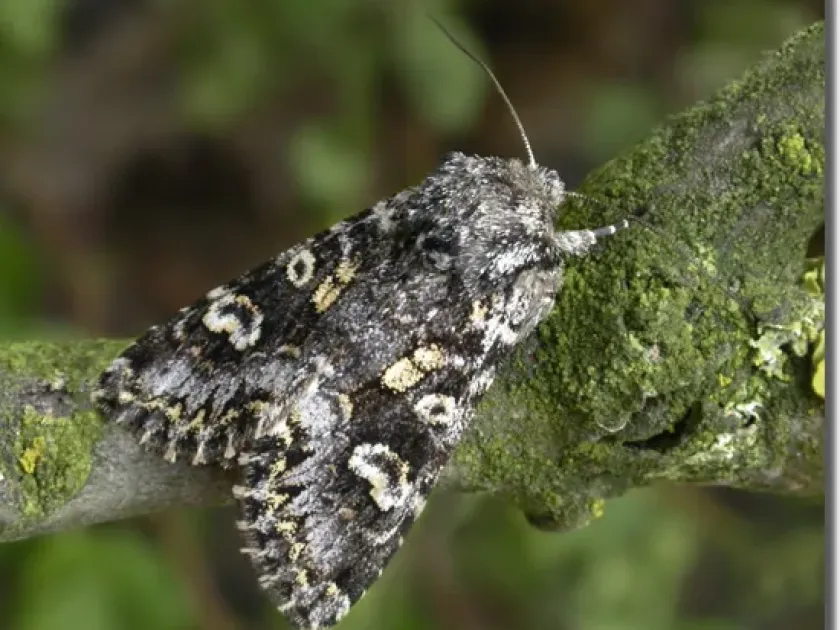
The glaucous moth (Papestra biren) belongs to the Noctuidae family within the order Lepidoptera. Adults are moths with a wingspan of up to 40 mm, exhibiting greyish-brown or glaucous tones that provide excellent camouflage in their natural environment.
The forewings feature a distinctive pattern of dark spots and serrated lines, which help the insect blend in with tree bark or soil surfaces. The hindwings are generally lighter, with a greyish hue and a marked dark margin.
The larvae, or caterpillars, reach 35–40 mm in length during their later instars. Their coloration ranges from greenish to brown, with light longitudinal lateral stripes, a typical appearance for many noctuid species.
The pupa is reddish-brown and glossy. It undergoes its overwintering stage in the upper soil layers, constructing a dense cocoon made of silk mixed with soil particles for protection.
The species biology is closely tied to regional climatic conditions. Primarily a forest and meadow species, it can infest agricultural land en masse if a suitable food source is present.
What it damages
The glaucous moth is a polyphagous pest, meaning it feeds on a wide range of botanical hosts. The most significant damage is caused by the larval stage during the spring and summer periods.
Primary hosts include vegetable crops, particularly brassicas, as well as various berry bushes and ornamental plants. In some instances, the pest may move to surrounding weeds.
Younger larvae feed predominantly on the undersides of leaves, skeletonizing them and impairing the photosynthetic capacity of the young plants.
Mature larvae transition to feeding on tougher tissues, chewing large holes through leaf blades and damaging growing points, which can lead to the total loss of the young crop.
When populations reach high densities, the glaucous moth can significantly degrade the market quality of produce, rendering vegetables unfit for sale or long-term storage.
When it appears
The life cycle begins with the emergence of adult moths, typically occurring in late May or early June. During this time, the insects feed on nectar and begin the egg-laying process.
Females deposit eggs in small clusters on the undersides of host plant leaves. The incubation period is sensitive to ambient temperature and typically lasts between 7 to 12 days.
The active feeding phase of the caterpillars occurs throughout June and July. This period is critical for agronomists to conduct crop monitoring and implement protective interventions.
Pupation takes place in the soil at a shallow depth. The species usually completes one generation per year, though partial second generations may occur under favorable climate conditions.
The overwintering stage is the pupa, which remains in the soil through the cold season, providing protection against adverse environmental factors until spring temperatures rise.
Signs of infestation
The first signs of infestation include the appearance of transparent "windows" on leaves, caused by young larvae feeding on the leaf pulp while leaving the upper epidermis intact.
The presence of frass (excrement) on the leaf surface or around the base of the plant provides clear evidence of intense feeding by older larvae, which are primarily nocturnal.
Damage to apical buds and growing points often results in stunted plant development, abnormal branching, or physical deformation, which directly impacts overall crop yields.
Massive infestations often lead to large-scale wilting or premature yellowing of foliage, resulting from extensive mechanical damage to the plant’s photosynthetic apparatus.
- Irregular holes in leaf blades.
- Feeding marks on leaf margins.
- Presence of frass pellets on foliage.
- Damage to flower stalks and new shoots.
Control measures
Preventive measures include deep autumn plowing of fields, which helps destroy overwintering pupae by disrupting their natural habitat and exposing them to predators.
Maintaining effective weed control on fields and surrounding areas significantly reduces the availability of secondary food sources, preventing population spikes.
The application of biological insecticides based on entomopathogenic bacteria offers a safe and targeted method for controlling young larvae during the early stages of infestation.
In cases of high pest density, chemical insecticides from the pyrethroid or organophosphate groups are utilized, strictly adhering to recommended dosages and pre-harvest intervals.
Monitoring using pheromone traps is highly recommended to determine the onset of adult moth flight, allowing for the precise scheduling of defensive spraying programs.
Taxonomy
- Latin name
- Papestra biren
- Order
- Lepidoptera (butterflies)
- Family
- Noctuidae
- EPPO code
- POLIGL
Discussion
No discussions yet — be the first.