
Papaipema leucostigma
Papaipema leucostigma
Description
How to identify
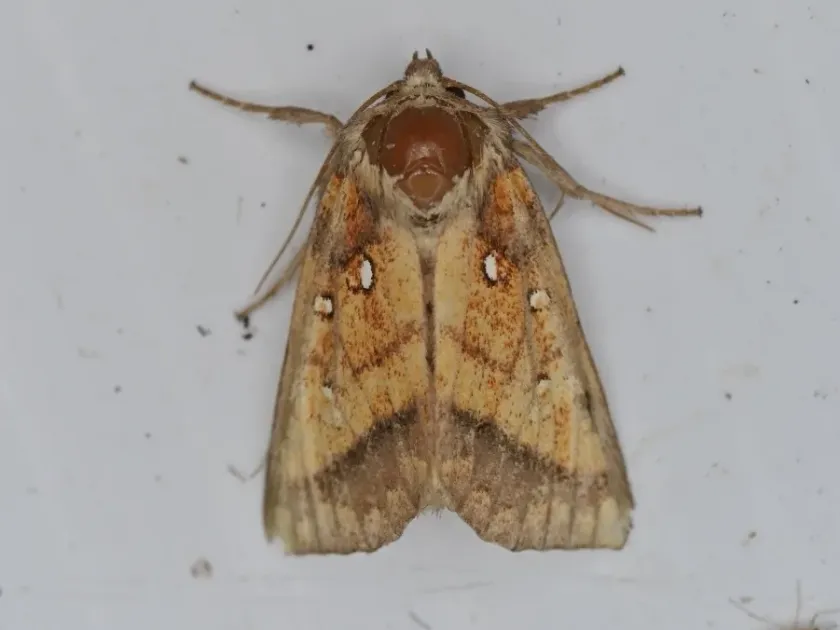
Papaipema leucostigma belongs to the Noctuidae family, order Lepidoptera. The adult is a nocturnal moth with a moderate wingspan, characterized by brownish-gray coloration and a distinct white spot located in the central part of the forewing.
The larvae of this species possess a structure typical of stem-boring moths: the body is cylindrical, often featuring longitudinal stripes, with a prominent head and well-developed thoracic and abdominal legs for active movement.
The insect develops through complete metamorphosis. The life cycle consists of the egg, larval (caterpillar), pupal, and adult stages, with the larval stage being the most destructive to agricultural and ornamental crops.
Identifying the adults is challenging due to their nocturnal behavior, which is why entomologists often use light traps for population monitoring during the active flight period of the moths.
This species is a typical inhabitant of temperate latitudes, where the vegetation provides sufficient nourishment for the development of the larvae.
What it damages
This pest primarily attacks perennial herbaceous plants, including ornamental crops like irises, as well as certain species of vegetable and berry crops.
The caterpillars are typical internal feeders that bore into the stems of plants, consuming the pith, which disrupts the transport of nutrients to the entire above-ground part of the plant.
The list of host plants includes those with succulent stems, where the larva can find sufficient moisture and nutrients to complete its development cycle.
The greatest economic impact is observed in nurseries of ornamental plants and private gardens, where stem damage leads to a loss of commercial value or the total death of the plant.
The severity of the damage is compounded by the fact that the bored stems become entry points for secondary infections—fungal and bacterial rots that spread rapidly through the plant tissues.
When it appears
The flight of the moths typically occurs in late summer or early autumn, when the insects mate and lay eggs on the base of plants or directly into the soil.
The eggs overwinter, remaining in a state of diapause throughout the cold season and maintaining high viability even in freezing temperatures.
In spring, with the arrival of consistently warm days, the eggs hatch, and the larvae immediately begin searching for suitable host plants to colonize.
The active feeding phase of the caterpillars covers the entire spring and early summer period, lasting until the larvae are ready for pupation.
Pupation occurs either directly within the damaged stem or in the soil near the roots, depending on the plant's health and environmental moisture conditions.
Signs of infestation
One of the earliest signs of infestation is the wilting of young shoot tips or entire stems, which cannot be explained by lack of soil moisture.
Upon close inspection of the stem, small entrance holes can be detected, often surrounded by caterpillar frass, which appears as fine, brownish debris.
If the affected stem is cut open lengthwise, a tunnel filled with waste products is revealed, often containing the larva itself.
The external condition of the plant is characterized by stunted growth, leaf chlorosis, and in advanced cases, the complete drying out of the above-ground biomass.
The nature of the injury frequently leads to the bending of the stem or its breakage at the point where the larva has thinned the internal tissues.
Control measures
Agricultural control measures include the mandatory destruction of plant debris in the autumn, as this is where eggs or pupae may be overwintering.
Deep cultivation of the soil around plants during the autumn period is an effective method to disrupt the overwintering environment of the pest.
Upon detection of the first signs of damage, it is necessary to immediately remove and destroy the affected stems along with the caterpillars residing inside.
Chemical control involves spraying plants with systemic insecticides during the peak larval hatching period to prevent them from boring into the stem tissues.
- Regular inspection of plantings at the beginning of the season.
- Timely weeding to eliminate secondary hosts that might attract the pest.
- Use of pheromone traps to reduce the adult population.
- Adherence to crop rotation and adequate spacing when planting susceptible species.
Taxonomy
- Latin name
- Papaipema leucostigma
- Order
- Lepidoptera (butterflies)
- Family
- Noctuidae
- EPPO code
- PAPAPU
Discussion
No discussions yet — be the first.