
Stalk borer
Papaipema
Description
How to identify
The Stalk borer (Papaipema) belongs to the Noctuidae family of the order Lepidoptera. It is a cryptic pest that spends the majority of its larval stage inside the stems of plants.
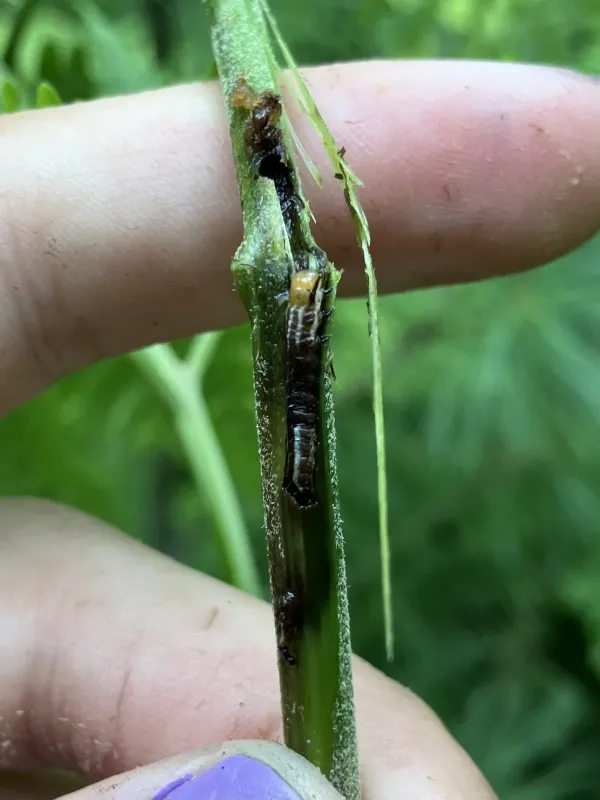
Adult moths are typically brown or reddish-tan with distinctive markings on their wings. The larvae, which cause the primary damage, are characterized by distinct longitudinal stripes and a darker head capsule.
The life cycle is univoltine, meaning there is only one generation per year. The species overwinters in the egg stage, typically deposited on dried grasses and weeds near crop fields.
In spring, larvae emerge and initially feed on grasses, eventually moving to thicker-stemmed crops like corn or potatoes as they grow larger and require more food.
Pupation takes place inside the stem or in the soil near the host plant, with adults emerging later in the season to mate and lay eggs for the following year.
What it damages
Stalk borers are known to infest a wide variety of plants, including corn, tomatoes, potatoes, and peppers. They target plants that provide sufficient internal space for larval development.
The damage begins when a larva bores into the base of the plant stem. As it moves upward, it creates a tunnel, which destroys the plant's vascular tissue.
In corn, early-season infestations are particularly devastating as the larva can feed on the central growing point, leading to "dead heart" where the main stem dies.
In vegetable crops, the tunneling causes wilting, stunted growth, and increased susceptibility to secondary rot infections due to the damaged exterior.
Once the larva is inside the stem, it is shielded from many external environmental factors and most chemical insecticide treatments, making infestation hard to reverse.
Signs of infestation
The most common sign of a stalk borer infestation is sudden wilting of the top leaves or the entire plant without signs of moisture stress.
Entry holes can often be found on the lower stem. These are usually surrounded by piles of frass, which resembles sawdust or fine shavings.
Damaged stems often become brittle or bent at the entry point. A light tug on the leaves of a wilting plant may reveal that the stalk is hollowed out inside.
Affected plants frequently show significant growth retardation compared to surrounding healthy crops, often leading to yield loss if the damage occurs early.
On closer inspection, the presence of the larva inside the stalk can be confirmed by splitting open the damaged plant section, revealing the caterpillar and its internal tunneling.
Control measures
Effective management begins with sanitation. Eliminating grassy weeds and host plants along field edges during the early season significantly reduces the larval population.
Deep plowing in the autumn can destroy overwintering egg sites, while crop rotation helps in breaking the pest's cycle by moving crops away from infested areas.
Chemical control must be applied precisely when larvae are migrating from weeds to crops, as sprays are largely ineffective once the insects have entered the stems.
- Weed management on field perimeters.
- Early season scouting for larvae migration.
- Strategic insecticide application timing.
- Crop rotation practices.
Biological controls such as parasitic wasps or generalist predators can help suppress populations, but integrated pest management remains the most reliable approach for commercial farmers.
Taxonomy
- Latin name
- Papaipema
- Order
- Lepidoptera (butterflies)
- Family
- Noctuidae
- EPPO code
- PAPASP
Discussion
No discussions yet — be the first.