
Panthea furcilla
Panthea furcilla
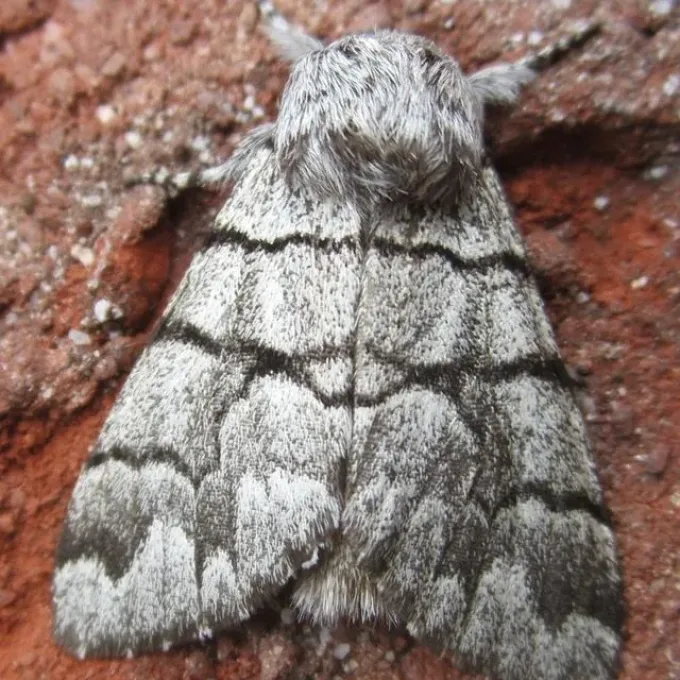
Description
How to identify
Panthea furcilla, commonly known as the tufted pine moth, belongs to the family Noctuidae. The adult moth is a nocturnal insect with a wingspan typically ranging from 35 to 45 mm.
The forewings exhibit a complex pattern of grey, black, and brown scales, which provides excellent camouflage when the insect rests on the rough bark of pine trees.
The larvae, or caterpillars, reach lengths of up to 50 mm. They are visually striking, covered in dense tufts of hair and marked with colourful stripes that vary in intensity.
Their appearance can shift during different larval instars, which is a common adaptive trait in many species of the Noctuidae family to deter potential predators.
The pupal stage is spent within a sturdy cocoon, often hidden in bark crevices or among the leaf litter, where the insect remains throughout the winter season.
What it damages
Panthea furcilla primarily feeds on coniferous species within the Pinaceae family, with a strong preference for various species of pine (Pinus), and occasionally spruce or fir.
The larvae are known to cause damage in forest nurseries, young plantations, and ornamental landscapes, where they feed on needles and developing buds.
While mature forests are rarely threatened with mortality, the defoliation caused by large populations can lead to significant stress, reducing tree vigour and growth rates.
In ornamental settings, the aesthetic impact is severe, as the caterpillar feeding results in sparse, ragged foliage that diminishes the visual appeal of the trees.
Severely stressed trees are more susceptible to secondary attacks from bark beetles and other wood-boring insects, which can eventually lead to tree decline or death.
When it appears
The flight period for the adult moths usually occurs in late spring to early summer, coinciding with the rapid growth phase of the host trees' needles.
Females lay their eggs in clusters on needles or twigs, ensuring that the newly hatched larvae have immediate access to a food source upon emergence.
The larval feeding stage spans the mid to late summer months, which is the period when most visible damage occurs as the caterpillars actively consume foliage.
As autumn approaches, the larvae cease feeding and begin the process of pupation, entering a dormant state to survive the cold winter months.
This species follows a univoltine life cycle, meaning it completes one generation per year, a pattern that allows the population to remain stable in many temperate climates.
Signs of infestation
The most common sign of infestation is needle defoliation, where caterpillars consume the needle tissue while often leaving the central vein or sheath intact.
Droppings, known as frass, appearing as small dark pellets on the ground beneath the tree canopy are a clear indication that a feeding population is present above.
During a visual inspection, the caterpillars themselves can often be spotted on the branches, standing out due to their distinctively hairy appearance and coloration.
Some larvae produce light webbing, which can be seen connecting needles and twigs, serving as a protective retreat or anchoring point during their development.
- Ragged and incomplete needles on the outer branches of the tree crown.
- Presence of colourful, hairy caterpillars actively feeding during June and July.
Control measures
For home gardens and small ornamental plots, manual collection and removal of the larvae is a highly effective and environmentally friendly control method.
Biological insecticides containing Bacillus thuringiensis are highly effective against these larvae while remaining safe for beneficial pollinators and local wildlife.
Chemical intervention should be reserved for severe outbreaks, utilizing targeted insecticides approved for use on ornamental conifers to minimize environmental impact.
Maintaining tree health through proper fertilization, adequate watering, and removing debris can help trees recover from feeding damage more efficiently.
Encouraging biodiversity by providing habitats for insectivorous birds and predatory wasps can naturally keep the population levels of Panthea furcilla in check.
Taxonomy
- Latin name
- Panthea furcilla
- Order
- Lepidoptera (butterflies)
- Family
- Noctuidae
- EPPO code
- PANTFU
Discussion
No discussions yet — be the first.