
Panthea acronyctoides
Panthea acronyctoides
Description
How to identify
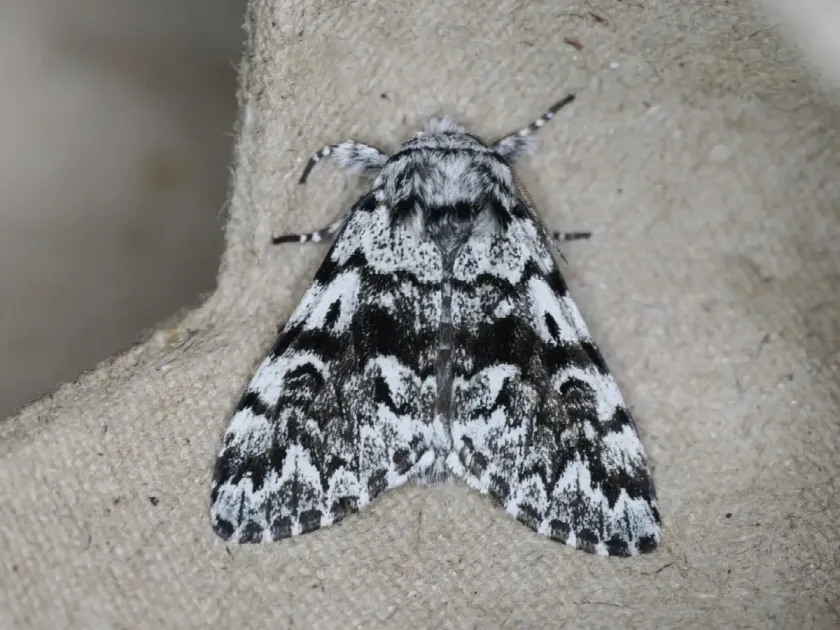
Panthea acronyctoides is a moth species belonging to the family Noctuidae. The adult moth has a wingspan ranging from 40 to 50 mm, featuring cryptic grey and brown patterns that provide excellent camouflage against coniferous bark.
The larvae are distinctively marked, often covered in dense tufts of hair, with coloration ranging from light grey to dark brown or black. This appearance helps them blend in perfectly with needles and small twigs while feeding.
The species undergoes complete metamorphosis. Its life cycle consists of four distinct stages: egg, larva (caterpillar), pupa, and adult. The overwintering usually occurs in the pupal stage, protected by a cocoon hidden in bark crevices.
Taxonomically, it is classified under the order Lepidoptera. While adults are primarily nocturnal, they can be attracted to light sources, which is a common way to monitor their presence in forested areas.
The biology of this species is synchronized with the growth cycles of host trees. Optimal humidity and temperature play a significant role in the success rate of larval development each season.
What it damages
The primary hosts for Panthea acronyctoides are various species of conifers, with a strong preference for spruce and occasionally pine. The damage is caused exclusively by the larval stage.
Caterpillars consume needles with high efficiency, leading to defoliation. In severe cases, they can strip branches entirely, leaving behind only the skeletal remains of the foliage.
Trees affected by this pest suffer from stunted growth and reduced vigor. This weakened state makes the conifers significantly more susceptible to secondary infestations by wood-boring beetles.
In nursery settings, damage to young saplings can be catastrophic, ruining the shape of the tree and its aesthetic value, which is crucial for ornamental forestry and landscape design.
While mature forests are rarely killed outright, repeated annual defoliation by these caterpillars leads to a measurable decrease in timber yield and overall forest health.
When it appears
The life cycle typically involves one generation per year. Adult moths emerge in late spring or early summer, following the warming trends of the season.
Egg-laying occurs shortly after emergence, with females depositing eggs directly onto the needles or bark of the host trees. The larvae hatch and begin feeding during the mid-summer months.
The peak feeding activity of the caterpillars generally occurs between June and August. This is the period when the most visible damage to the canopy is observed by agronomists.
By late summer, the larvae reach maturity, move to a secure location on the tree, and pupate. The pupal stage is the longest part of their life cycle, lasting through the autumn and winter.
Early monitoring in June is essential. Detecting the presence of young larvae allows for timely interventions, preventing the population from reaching epidemic levels in the later summer months.
Signs of infestation
One of the earliest signs of an infestation is the presence of frass (caterpillar droppings) beneath the canopy, appearing as tiny, dark, granular pellets on the ground or lower foliage.
Visual inspection of the needles often reveals patches of discoloration, where needles have been partially chewed or stripped. This gives the canopy a thinned or "ragged" appearance.
The larvae themselves can be found by shaking branches over a white sheet or by performing a close examination of the branch tips where they typically feed in the early stages.
The presence of fine silken webbing on the needles or twigs, used by larvae as they move between feeding sites, is a strong indicator of an active infestation.
Advanced signs of damage include yellowing or browning of the needles throughout the affected branches, often resulting in significant premature needle drop.
Control measures
Effective management of Panthea acronyctoides requires a strategy combining physical, biological, and chemical methods to ensure healthy tree growth.
In smaller landscapes or home gardens, physical removal of larvae by hand or pruning the most heavily infested branches can effectively curb the population without chemicals.
Biological control methods, such as utilizing Bacillus thuringiensis sprays, are highly effective against young larvae while being safe for non-target beneficial insects and the environment.
Chemical control should be reserved for severe outbreaks where the health of the trees is at high risk. Applications should be timed to coincide with the most vulnerable stage of larval development.
- Install pheromone or light traps to monitor adult flight periods accurately.
- Use systemic insecticides for localized control in nurseries.
- Encourage the presence of natural predators such as birds and parasitoid wasps.
- Keep trees well-watered and fertilized to enhance their natural resistance to defoliators.
Taxonomy
- Latin name
- Panthea acronyctoides
- Order
- Lepidoptera (butterflies)
- Family
- Noctuidae
- EPPO code
- PANTAC
Discussion
No discussions yet — be the first.