
Pine beauty
Panolis flammea
Description
How to identify
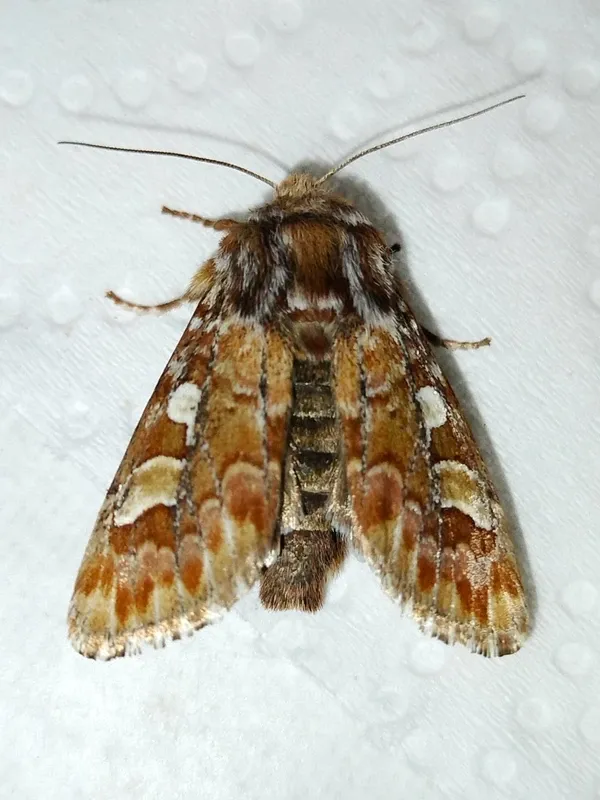
The pine beauty moth, Panolis flammea, belongs to the family Noctuidae. It is a nocturnal moth with a wingspan of up to 35 mm, displaying reddish-brown to grey patterns that act as perfect camouflage against pine bark.
The larvae are bright green with distinct longitudinal white or cream stripes along the back and sides. They can grow up to 45 mm in length and have a smooth body with a brownish head capsule.
The pupae are dark brown to black and glossy. They overwinter in the soil under the forest floor, typically at a depth of up to 10 cm, protected from extreme temperatures.
The life cycle consists of the egg stage, five larval instars, the pupal stage, and the adult moth. There is usually one generation per year, making the seasonal timing of control methods crucial.
Taxonomically, it belongs to the order Lepidoptera, family Noctuidae, characterized by specific physiological and behavioral adaptations to coniferous environments.
What it damages
The primary host for Panolis flammea larvae is the Scots pine (Pinus sylvestris). During outbreak years, they may feed on other coniferous species if present in the vicinity.
The larvae feed primarily on the needles of the current year. Severe defoliation can occur, significantly reducing the tree's ability to photosynthesize and sustain its metabolic processes.
Weakened trees become highly susceptible to secondary attacks from bark beetles and other wood-boring insects, which can lead to rapid mortality within the forest stand.
Chronic infestations result in reduced timber growth and general loss of vitality, making the affected trees more vulnerable to climate stress and pathogenic infections.
Economic impact includes significant timber loss and the high costs associated with emergency sanitation logging and pest control operations across affected hectares.
When it appears
Adult moths emerge in early spring, typically between April and May, depending on local weather conditions and the soil temperature warming up after winter.
Eggs are laid on the needles, and larvae hatch after about two weeks, beginning their active feeding phase during the peak spring growth period.
The most intensive feeding occurs throughout May and June. During this time, the larvae can strip a tree of its needles in a very short period if population levels are high.
By late summer, the larvae descend into the soil to pupate. They remain in the pupal stage throughout the autumn and winter months until the next spring season.
Outbreaks are often triggered by warm and dry spring weather, which improves larval survival rates and leads to a rapid increase in the local moth population.
Signs of infestation
The first sign of an infestation is the presence of frass (larval droppings) on the forest floor, which looks like small dark pellets beneath the tree crowns.
During the larval stage, the caterpillars can be found by examining the canopy; they often drop on silken threads when branches are disturbed.
Feeding damage is characterized by needles being eaten at the base, causing the remaining parts to yellow and fall, creating a sparse appearance in the canopy.
Extensive defoliation turns the tree canopy greyish-brown as needles die off prematurely, making the affected stands visible from a distance.
- Accumulation of larval frass on the soil surface.
- Premature yellowing and dropping of pine needles in early summer.
- Thinning and greyish discoloration of the canopy.
- Increased presence of insectivorous birds in the infested forest area.
Control measures
Forestry management uses pheromone traps to monitor population levels and predict outbreaks, allowing for timely intervention before significant defoliation occurs.
Biological control options include the application of Bacillus thuringiensis, which is effective against young larvae and poses minimal risk to non-target wildlife.
Chemical control involving approved insecticides may be implemented via aerial spraying if the population exceeds critical economic thresholds for damage.
Enhancing natural biodiversity, particularly by protecting parasitoid wasps and other entomophagous species, helps keep the population in check during low-density periods.
Long-term silvicultural practices, such as promoting mixed-species stands, are essential for reducing the risk of large-scale outbreaks in vulnerable pine forests.
Taxonomy
- Latin name
- Panolis flammea
- Order
- Lepidoptera (butterflies)
- Family
- Noctuidae
- EPPO code
- PANLFL
Discussion
No discussions yet — be the first.