
Pine beauty moth
Panolis
Description
How to identify
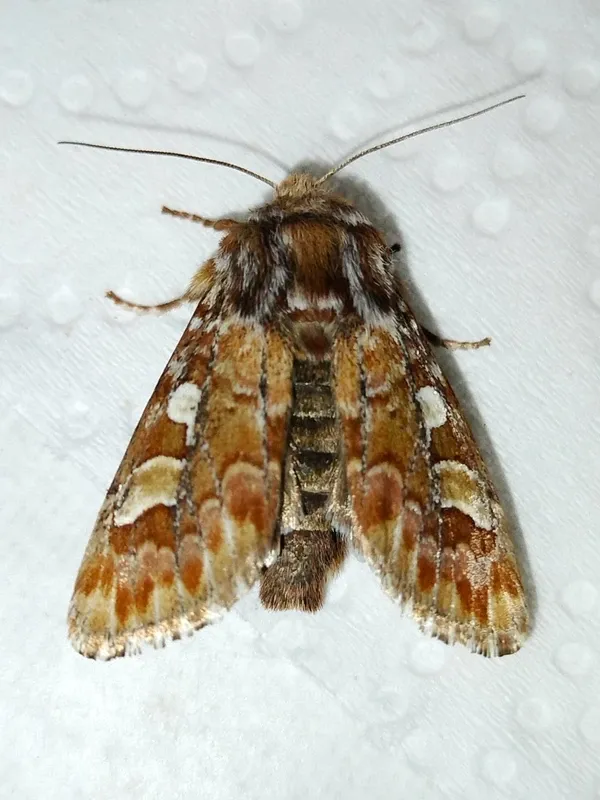
The pine beauty moth (Panolis flammea) is a significant lepidopteran pest belonging to the Noctuidae family. The adult moth has a wingspan of approximately 35 mm, with forewings that display a mottled appearance, ranging from rust-brown to dark reddish-brown, often featuring distinct white markings.
The larvae, or caterpillars, undergo several developmental stages. When young, they are typically green and blend in well with pine needles. As they mature, they develop prominent longitudinal white stripes along their bodies, with the dorsal area becoming reddish-brown, aiding in camouflage among the pine foliage.
Pupation occurs in the soil or leaf litter beneath the host tree. The pupa is a shiny, reddish-brown structure, typically residing at a depth of a few centimeters. This stage allows the insect to overwinter safely, emerging as an adult moth in early spring to initiate the next cycle.
The life cycle is univoltine, meaning there is one generation per year. The timing of adult emergence is closely synchronized with the flowering of Pinus sylvestris, ensuring that larvae have immediate access to high-energy food sources upon hatching, which is critical for their rapid development.
Environmental conditions play a vital role in their biology. Dry and warm springs favor the survival of young larvae, while cool and wet weather during the egg-laying or early larval period can significantly reduce population density due to fungal pathogens and increased larval mortality.
What it damages
The pine beauty moth primarily infests Pinus sylvestris (Scots pine). During periods of outbreaks, the larvae can cause widespread and severe defoliation across entire forest stands, leaving trees stressed and susceptible to further mortality from secondary pests.
Larval feeding begins on the developing buds and young needles. As the larvae grow, their consumption rate increases significantly, and they proceed to feed on older needles. This massive loss of photosynthetic tissue severely weakens the trees, leading to growth suppression and potential death.
Secondary damage occurs due to the weakening of the host tree's defense systems. Pines attacked by the pine beauty moth are highly attractive to secondary pests, such as bark beetles (Scolytinae), which complete the destruction by girdling the phloem, leading to rapid tree death.
Economic damage is substantial in commercial forestry, as the moth can degrade timber quality and cause widespread stand mortality. The loss of growth increment and the costs associated with sanitary thinning and replanting represent significant financial burdens for forest management authorities.
Ecological impacts are equally severe. Large-scale defoliation disrupts the structure of forest ecosystems, alters microclimatic conditions, and reduces the carbon sequestration capacity of the affected forest areas, necessitating long-term recovery efforts.
Signs of infestation
The presence of frass (larval excrement) on the forest floor is the most reliable early indicator of an infestation. Small, dark, granular pellets accumulating beneath the canopy confirm that feeding is underway and provide an estimate of the larval population density.
Needle damage is another critical sign. Initially, needles exhibit small bite marks or partial consumption. As the infestation progresses, needles may appear withered, partially eaten, or brown, creating a visibly sparse and stressed canopy that stands out against healthy trees.
Changes in tree color are noticeable during major outbreaks. The crowns may acquire a reddish-brown or "rusty" hue as damaged needles die before eventually falling. This discoloration can be detected via aerial surveys or routine forest health inspections.
The behavior of birds and other natural predators can signal an outbreak. An influx of insectivorous bird species into a specific pine stand often corresponds with high larval density, as these predators respond to the abundant food source provided by the caterpillars.
During the off-season, pupae can be detected by examining the forest floor or the top layer of soil beneath affected trees. A high concentration of pupal cases in the litter is a strong warning sign of potential adult moth emergence for the following spring season.
Control measures
Biological control, particularly the application of bacterial insecticides like Bacillus thuringiensis, is the primary method for managing outbreaks. These products are highly specific, targeting the larvae while minimizing harm to non-target insect species and ecosystem biodiversity.
Silvicultural management focuses on forest diversification. Increasing the proportion of broad-leaved species in pine-dominated forests creates a more resilient landscape that slows the spread of the moth and supports a wider range of natural predators, such as birds and parasitoid wasps.
Monitoring is facilitated by the use of pheromone traps, which attract male moths. These traps provide crucial data on population dynamics and the exact timing of the flight period, allowing managers to apply control measures only when and where they are most effective.
Sanitary forest practices, including the removal of heavily infested or weakened trees, help maintain overall forest health. By reducing the accumulation of dead wood, foresters minimize the risk of secondary pest colonization following a moth infestation.
Augmentative biological control using egg parasitoids, such as Trichogramma species, has proven successful in localized outbreaks. Releasing these parasitoids in synchrony with the moth's egg-laying period can significantly reduce the number of emerging larvae, providing a sustainable management solution.
Taxonomy
- Latin name
- Panolis
- Order
- Lepidoptera (butterflies)
- Family
- Noctuidae
- EPPO code
- PANLSP
Discussion
No discussions yet — be the first.