
Variable Quaker
Orthosia munda
Description
How to identify
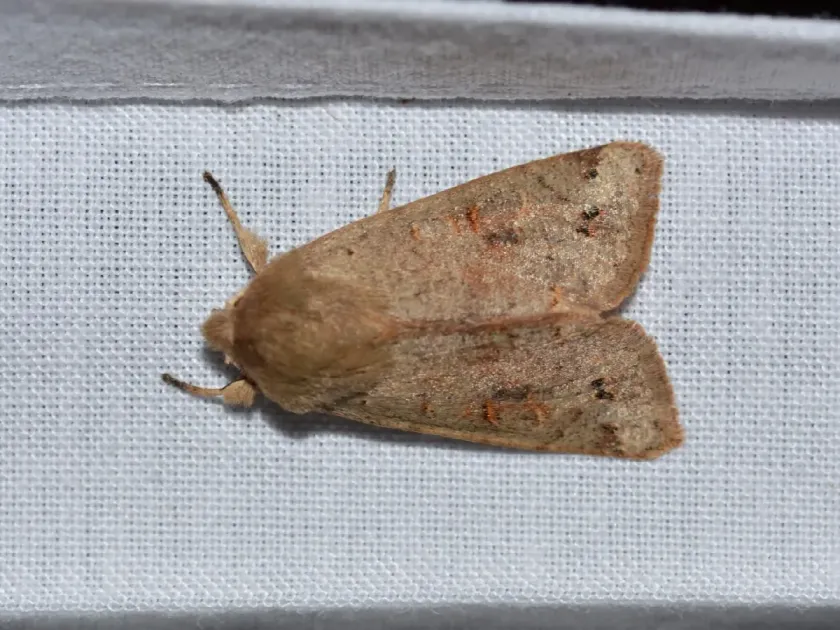
The Variable Quaker (Orthosia munda) is a moth belonging to the family Noctuidae within the order Lepidoptera. The wingspan of the adult moth ranges from 35 to 40 mm, displaying a variable ground color from pale yellow to dark brown with distinct dark spots.
The larvae, or caterpillars, reach lengths of up to 45 mm. Their coloration is typically grayish-green or brown, marked with longitudinal stripes that provide excellent camouflage against the bark and foliage of host trees.
Pupation occurs in the soil, where the insect remains throughout the winter. It has one generation per year, with adults emerging in early spring.
The emergence of moths often precedes or coincides with bud break, making their early lifecycle phase perfectly aligned with the development of orchard crops.
As a nocturnal species, the adult moths are primarily active at night, while the larvae are the destructive stage that feeds throughout the day and night.
What it damages
The Variable Quaker is considered a pest in forestry and horticulture, as its larvae feed on a variety of deciduous trees and shrubs.
In agricultural settings, they primarily attack fruit-bearing trees such as apples, pears, and cherries, causing economic damage during the early spring period.
Signs of infestation
Early signs of infestation include damaged or hollowed-out buds. The larvae bore into the buds, effectively destroying the potential blossom and leading to poor fruit set.
As the season progresses, the caterpillars switch to consuming leaves, leading to severe defoliation and ragged leaf margins on affected trees.
The accumulation of frass (caterpillar excrement) on the leaves or at the base of the branches is a clear indicator that a colony is present and actively feeding.
Control measures
Effective management requires a combination of cultural and chemical practices to keep populations below the economic injury level.
- Cultivating the soil beneath tree canopies in late autumn helps expose and destroy overwintering pupae.
- Applying systemic insecticides during the bud burst stage can protect the developing blooms from larval attack.
- Using biological control agents, such as microbial sprays containing Bacillus thuringiensis, is effective against young larvae.
- Installing pheromone traps is recommended to monitor moth activity and determine the optimal timing for protective interventions.
- Maintaining biodiversity in the orchard to support natural predators like birds and parasitic wasps that feed on the larvae.
Taxonomy
- Latin name
- Orthosia munda
- Order
- Lepidoptera (butterflies)
- Family
- Noctuidae
- EPPO code
- ORTOMU
Discussion
No discussions yet — be the first.