
Speckled green fruitworm
Orthosia hibisci
Description
How to identify
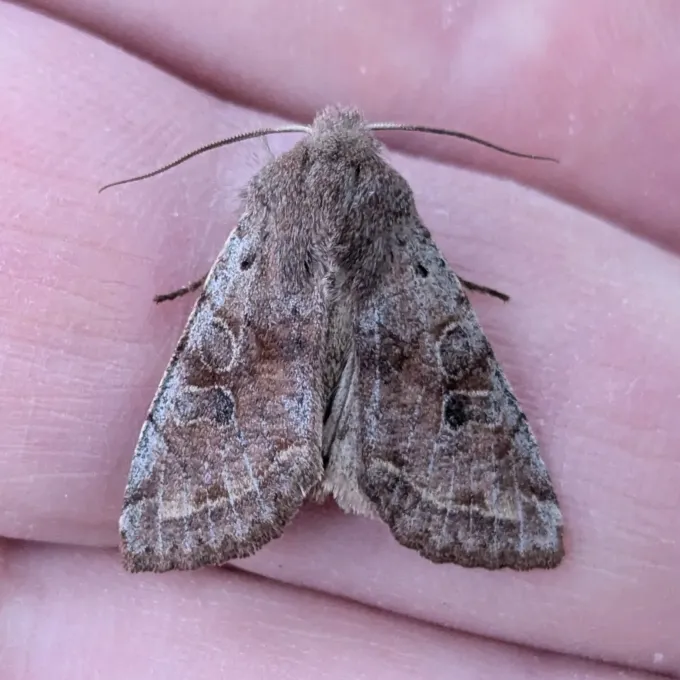
The speckled green fruitworm (Orthosia hibisci) is a moth belonging to the Noctuidae family. The adult moth has a wingspan of approximately 30–35 mm, with forewings varying from pale brown to reddish-grey, marked with distinct dark spots and wavy lines.
The larvae, or caterpillars, progress through several instars. They are generally green with white longitudinal stripes, providing effective camouflage among the foliage of their host plants.
The pupae are dark brown, shiny, and are typically found in the soil beneath the host plant. They remain in the ground throughout the summer, autumn, and winter, waiting for favorable spring conditions.
This species is univoltine, meaning it completes only one generation per year. Its development is perfectly synchronized with the phenological stages of fruit tree bud burst.
These moths are primarily nocturnal, which explains why growers often do not notice the adult stage, but rather focus on the damage caused by the larvae during the day.
What it damages
The speckled green fruitworm is a polyphagous pest that affects a wide range of fruit trees, including apples, pears, cherries, and plums. It is especially damaging during the early spring development phase.
Young larvae initially feed on expanding buds, hollowing them out completely. This prevents the development of leaves and flowers, leading to direct yield loss in commercial orchards.
As the larvae grow, they shift their attention to blossoms and developing fruitlets. By eating into the young fruit, they cause deep holes and scarring, which makes the produce unmarketable.
Defoliation is another concern, as heavy infestations can strip significant portions of the foliage, weakening the tree and reducing its photosynthetic capacity for the entire season.
In high-density orchards, the damage can escalate rapidly if control measures are not implemented during the peak emergence of the larvae.
When it appears
Adult moths emerge from their pupae in early spring, often coinciding with the first warming trends. They begin laying eggs on the branches and bark of host trees.
Larvae typically hatch in April or May, depending on the geographic location and current year's temperature profile. This is the period of highest risk for the orchard.
Feeding activity lasts for several weeks as the caterpillars mature. Once fully grown, they drop to the ground and burrow into the soil to begin their pupation phase.
The summer season is spent as pupae in the soil, protected from extreme heat. This dormant stage continues through the winter until the next year's spring cycle begins.
Because the larvae are active for only a limited time, early monitoring is crucial for successful integrated pest management strategies.
Signs of infestation
The first sign of infestation is the presence of hollowed-out, dried-up buds that fail to open properly. Looking closely, one might see small entry holes on the buds.
Ragged holes in the leaves, often referred to as "shot-holes," indicate that larvae are feeding in the canopy. The edges of the leaves may also appear chewed.
Frass, which looks like small, dark pellets, can often be found on the leaves or in the crotches of branches where the larvae have been feeding.
Fruit damage often appears as deep, irregular gouges. As the fruit continues to grow around the damaged area, it often develops deformities and deep scars.
If you suspect an infestation, inspecting the trees at night with a flashlight can reveal the larvae, as they are most active and visible after the sun goes down.
Control measures
Integrated pest management is essential for controlling this pest. Cultivation of the soil beneath the canopy in late autumn can destroy overwintering pupae by exposing them to predators.
Pheromone traps are highly effective for monitoring the emergence of adult moths, allowing growers to time their insecticide applications for maximum efficiency.
Chemical control should be applied when larvae are small, typically around the petal fall stage, if scouting reveals population levels above economic thresholds.
Biological insecticides, such as products containing Bacillus thuringiensis, provide a selective and environmentally friendly way to manage caterpillar populations without harming beneficial pollinators.
Maintaining a healthy, well-pruned orchard helps reduce the sites available for egg-laying and makes the trees more resilient to minor feeding damage during the spring growth phase.
Taxonomy
- Latin name
- Orthosia hibisci
- Order
- Lepidoptera (butterflies)
- Family
- Noctuidae
- EPPO code
- ORTOHI
Discussion
No discussions yet — be the first.