
Gothic moth
Orthosia gothica
Description
How to identify
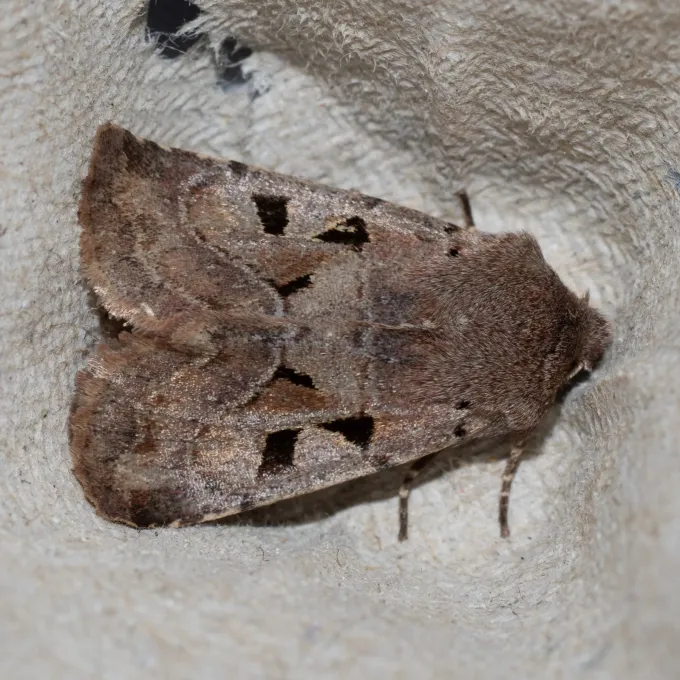
The Gothic moth (Orthosia gothica) is a member of the Noctuidae family within the order Lepidoptera. The adult moth typically has a wingspan of 35–40 mm. Its forewings exhibit a greyish-brown to purplish-brown coloration, featuring a distinct dark marking that resembles a gothic arch, which provides the species with its common name.
The larvae, or caterpillars, are highly variable in color, ranging from bright green to brownish tones, often marked with longitudinal light-colored stripes. They grow up to 40 mm in length and are covered in fine, sparse hairs. The pupa is reddish-brown and typically spends the winter months in a cocoon buried in the soil.
What it damages
This species is a polyphagous pest, meaning it feeds on a wide array of host plants. The Gothic moth poses a particular threat to various agricultural and ornamental trees, as well as several woody shrubs, causing significant damage during its larval stage.
Fruit trees such as apples, pears, plums, and cherries are most frequently targeted. The caterpillars consume emerging buds, tender leaves, and developing blossoms, which can drastically reduce fruit yield and stunt the growth of young trees.
Beyond fruit production, the caterpillars are known to attack various berry bushes and can sometimes be found on different herbaceous plants, including garden weeds and cultivated vegetables when they are available during the early spring.
When it appears
The Gothic moth typically completes one generation per year. Adults are among the first moths to appear in early spring, with flight activity occurring from March through May, coinciding with the bud-break stage of many trees.
After mating, females deposit their eggs directly onto branches, twigs, or newly formed buds. The caterpillar development phase occurs throughout the spring, during which time they feed aggressively to prepare for the pupation process in early summer.
Signs of infestation
The most prominent sign of infestation is the presence of hollowed-out or completely eaten buds in early spring. This destruction prevents normal foliage and floral development, leaving branches looking sparse and damaged.
As the leaves develop, caterpillars leave irregular holes or ragged edges along the leaf margins. In cases of severe infestation, the foliage may become skeletonized, with only the major veins remaining, which significantly reduces the tree's photosynthetic capacity.
Control measures
Effective management begins with cultural practices, such as tilling or cultivating the soil beneath host trees in autumn. This mechanical disruption destroys the overwintering pupae and reduces the next season's population.
Monitoring for adults can be achieved using light traps or pheromone traps, which help identify the onset of the flight period and potential infestation levels. This information is critical for timing any necessary chemical interventions.
When the damage threshold is exceeded, targeted application of insecticides is recommended. It is best to perform these treatments in the evening, when larvae are most active, ensuring better contact while minimizing the impact on beneficial pollinators.
- Autumn soil cultivation to disturb overwintering pupae.
- Installation of light traps for adult moth monitoring.
- Manual collection of larvae in small garden settings.
- Use of biological pesticides or selective insecticides during peak larval activity.
Taxonomy
- Latin name
- Orthosia gothica
- Order
- Lepidoptera (butterflies)
- Family
- Noctuidae
- EPPO code
- ORTOGO
Discussion
No discussions yet — be the first.