
Common Quaker
Orthosia cerasi
Description
How to identify
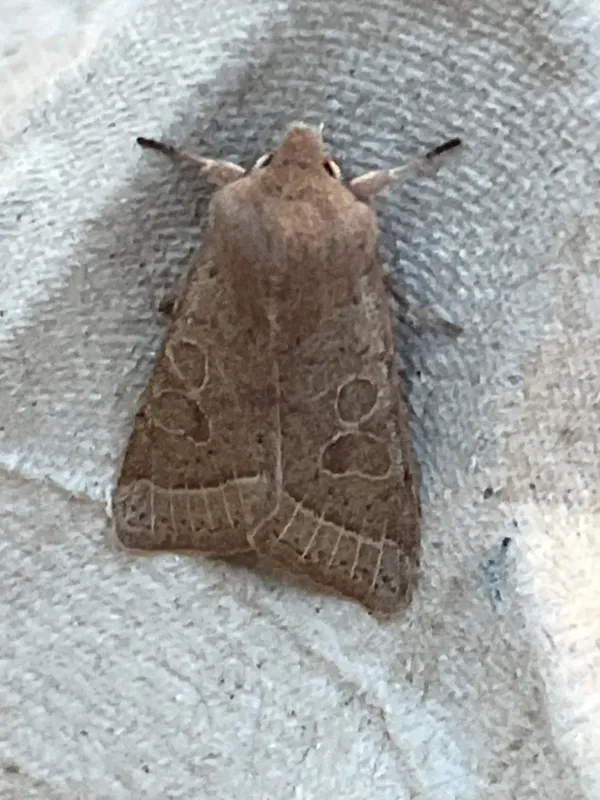
The Common Quaker (Orthosia cerasi) is a moth of the Noctuidae family and the Lepidoptera order. The adult moth has a wingspan of 35–40 mm with a distinctive brownish or ochre-yellow coloration, typical for many early spring species.
The larvae, known as caterpillars, can reach up to 40 mm in length. They are generally light green to yellowish with faint pale longitudinal lines and are covered with numerous small white specks.
The pupae are dark brown and usually overwinter in the soil within a firm cocoon, protected from low temperatures and predators during the colder months.
As a nocturnal species, adult moths are attracted to light, but the larvae are the primary concern for agricultural producers during the early spring season.
Correct identification is crucial, as the Common Quaker larvae can easily be confused with other noctuid species that appear early in the year in fruit orchards.
What it damages
This species is polyphagous and feeds on a wide range of deciduous trees, including apple, pear, cherry, plum, as well as various forest trees like oak and lime.
Larvae cause significant damage by feeding on opening buds, blossoms, and tender young leaves, which can lead to a severe reduction in foliage and photosynthetic capacity.
Young fruitlets are often targeted, with the larvae boring holes into them, leading to fruit drop, rotting, or severe deformation that renders the fruit unmarketable.
In cases of high population density, the larvae can cause significant defoliation of fruit trees, which stresses the plants and reduces their yield potential for the next season.
The economic impact is particularly high when the attack occurs early in the spring, as it directly affects the reproductive parts of the fruit-bearing trees.
When it appears
The flight period of the adult moths begins very early, typically from March to April, often coinciding with the bud-burst stage of most fruit trees.
Females lay eggs on the bark of twigs or the undersides of leaves, and the hatching usually occurs within two weeks, depending on the ambient temperatures.
The larval feeding phase is most active throughout the month of May, during which they consume large amounts of plant tissue to complete their development.
By mid-June, the larvae reach maturity, cease feeding, and drop to the ground to pupate in the soil, entering a dormant state for the remainder of the year.
The species has only one generation per year, which simplifies the planning of protection strategies since the critical period for intervention is limited to early spring.
Signs of infestation
One of the earliest indicators is the presence of hollowed-out buds that fail to develop into leaves or flowers, often resulting in sparse growth on the branches.
Ragged leaf margins and skeletal leaf patterns indicate feeding by older larvae, which are much more voracious than the early instars.
Small, dark, pellet-like frass on the leaves or the ground beneath the canopy is a clear signal of larval activity occurring in the upper foliage.
Damage to young fruitlets, characterized by deep, irregular holes or shallow surface grazing, is a late-spring sign of infestation.
- hollowed or destroyed buds;
- irregular holes on the leaf blades;
- defoliation of the canopy;
- visible larvae or their frass on twigs.
Control measures
Autumn soil cultivation is a highly recommended practice to disrupt the pupation sites, exposing the pupae to frosts and natural predators like birds.
Applying sticky bands to the trunks of fruit trees in the spring can prevent or slow down the migration of larvae from the ground to the upper canopy.
Biological control using Bacillus thuringiensis formulations is effective against young larvae and minimizes the negative impact on the orchard ecosystem.
Chemical insecticides should be used as a last resort and timed carefully to avoid harming beneficial pollinators, which are frequently present during the bloom.
Continuous monitoring using pheromone traps for adult moths can provide valuable data on population levels and help determine if intervention is necessary.
Taxonomy
- Latin name
- Orthosia cerasi
- Order
- Lepidoptera (butterflies)
- Family
- Noctuidae
- EPPO code
- ORTOST
Discussion
No discussions yet — be the first.