
Orthosia carnipennis
Orthosia carnipennis
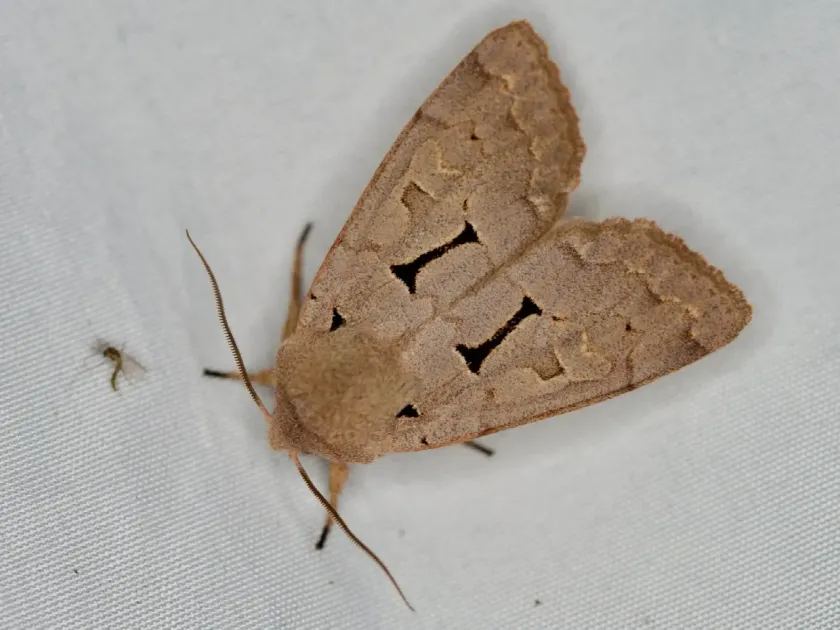
Description
How to identify
Orthosia carnipennis belongs to the Noctuidae family of moths within the order Lepidoptera. The adult moth has a wingspan of approximately 30-35 mm, with a grey-brown to reddish-brown coloration that mimics the texture of tree bark, providing excellent camouflage.
The larvae, or caterpillars, are typical of the noctuid family. They feature a cylindrical body, growing up to 40 mm in length during their final larval stage. Their coloration is usually dull or greenish-brown, designed to blend in with the vegetation during the day.
The species undergoes complete metamorphosis. It passes through the egg, larva, pupa, and adult stages. The pupal stage is the overwintering phase, where the insects remain in the soil inside firm cocoons, well-protected from winter frosts.
Adult moths emerge in early spring, often triggered by temperatures as low as 5-8 degrees Celsius. This early activity makes them one of the first pests to emerge as orchard buds begin to swell.
This moth is widely distributed across temperate regions and thrives in both orchards and wild woodlands, where it finds sufficient food sources for its offspring during the critical spring period.
What it damages
The damage is caused by the caterpillars, which are polyphagous feeders. In early spring, they primarily feed on fruit buds, consuming the internal tissues and preventing the development of blossoms and subsequent fruit.
Once the leaves emerge, the caterpillars extend their feeding to the foliage, often skeletonizing leaves or eating along the margins. High populations can cause significant stress to young trees, affecting their vigor and overall health.
Common host plants include various fruit and ornamental trees such as apples, pears, plums, and cherries. They may also feed on native shrubs located on the periphery of orchards, acting as a reservoir for the population.
The severity of the damage is directly linked to the density of the larval population. In outbreak years, the destruction of reproductive buds can lead to substantial reductions in annual fruit yield.
- Consumption of fruit buds in early spring.
- Feeding on young, tender leaves.
- Reduced vigor in young fruit trees.
- Economic loss due to harvest reduction.
When it appears
Adult moths are active in early spring, typically from March to April. They are nocturnal and are highly attracted to light sources, which is a useful trait for monitoring their presence using light traps.
Eggs are deposited by females on the branches and near the buds of host plants. Embryonic development is relatively rapid, allowing larvae to emerge exactly when the buds start to swell and provide the necessary nutrition.
The larval stage lasts throughout the spring season. By late spring or early summer, the caterpillars descend into the soil to pupate. They remain in this state of diapause through the heat of summer and the cold of winter.
Effective monitoring relies on tracking the emergence of adults and the phenological stage of the host trees. Agronomists use pheromone or light traps to predict the arrival of the pest and prepare appropriate control measures.
Understanding this tight synchronization between the pest's life cycle and the host plant's phenology is critical for minimizing damage in the orchard.
Control measures
The integrated management of Orthosia carnipennis combines mechanical, biological, and chemical strategies. Cultivation of the soil around the base of trees in late autumn is a mechanical method that exposes overwintering pupae to predators and cold.
Chemical control is most effective when targeted at young larvae during the early spring period. Insecticides should be applied during the "green tip" stage of bud development to prevent the caterpillars from destroying the reproductive parts of the tree.
Biological control methods, such as the application of Bacillus thuringiensis or other specific entomopathogenic treatments, are encouraged in sustainable agriculture to reduce reliance on broad-spectrum chemicals.
Maintaining a clean orchard floor by managing weeds helps reduce local habitats that might support or harbor the larvae when fruit tree resources are scarce.
Regular field scouting to check for bud damage is essential. Early detection allows for precise timing of treatments, ensuring that control measures are implemented only when the economic threshold of damage is approached.
Taxonomy
- Latin name
- Orthosia carnipennis
- Order
- Lepidoptera (butterflies)
- Family
- Noctuidae
- EPPO code
- ORTOCA
Discussion
No discussions yet — be the first.