
Straw moth
Oria musculosa
Description
How to identify
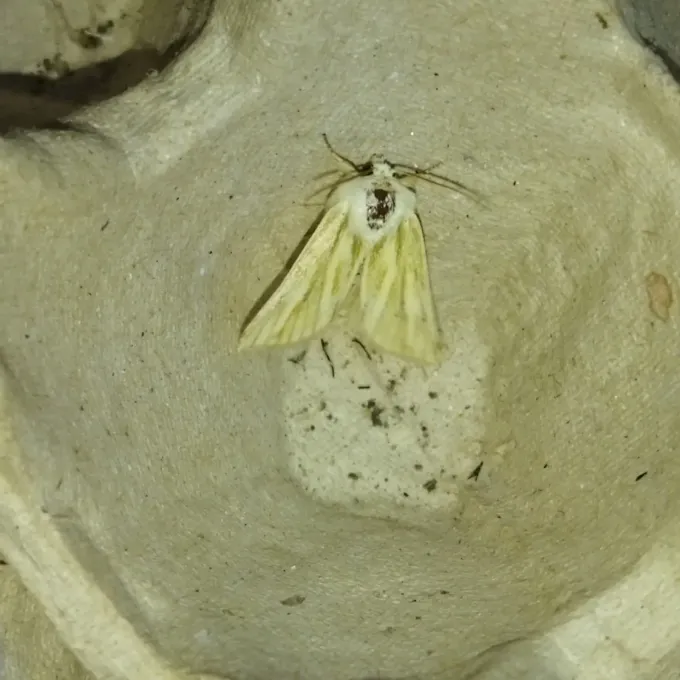
The straw moth (Oria musculosa) is a species of moth belonging to the family Noctuidae. The adult moth typically has a wingspan of 30–35 mm, with straw-yellow forewings characterized by distinct dark longitudinal streaks along the veins.
The larvae, which are the primary damaging stage, are pale grey or greenish caterpillars, growing up to 35 mm in length. They feature light-colored stripes on their back, allowing them to remain hidden within the host plant stems.
What it damages
This pest primarily attacks cereal crops, showing a strong preference for wheat, barley, oats, and rye. In agricultural environments, it acts as a stem-boring pest that can cause significant yield losses.
While cereals are the primary targets, the larvae can also feed on millet and maize. They are also known to sustain populations on various wild grasses when commercial crops are not available.
When it appears
The adult flight period occurs in summer, typically during June and July. During this time, females lay their eggs on the stems or leaf sheaths of host grasses, where the eggs remain dormant throughout the winter.
Larval emergence happens in the spring, coinciding with the rapid growth phase of the cereals. This critical period of development aligns with the stem elongation and heading stages of the host plants.
Signs of infestation
The most evident sign of infestation is the yellowing and wilting of the central leaf, often followed by the development of "whiteheads." This occurs because the larva disrupts the vascular system within the stem.
Farmers can identify the pest by inspecting stems for entry holes. The resulting damage typically leads to the sterilization of the ear, resulting in empty grains and a substantial reduction in final grain quality and yield.
Control measures
Integrated Pest Management (IPM) is essential for controlling this moth. Cultural practices include deep plowing after harvest to destroy overwintering sites and managing weed populations near field borders.
Chemical control should be implemented based on scouting results. Applying systematic insecticides during the early larval stage is most effective, as it targets the pests before they can bore deep into the stems.
Taxonomy
- Latin name
- Oria musculosa
- Order
- Lepidoptera (butterflies)
- Family
- Noctuidae
- EPPO code
- ORIAMU
Discussion
No discussions yet — be the first.