
Flame shoulder
Ochropleura plecta
Description
How to identify
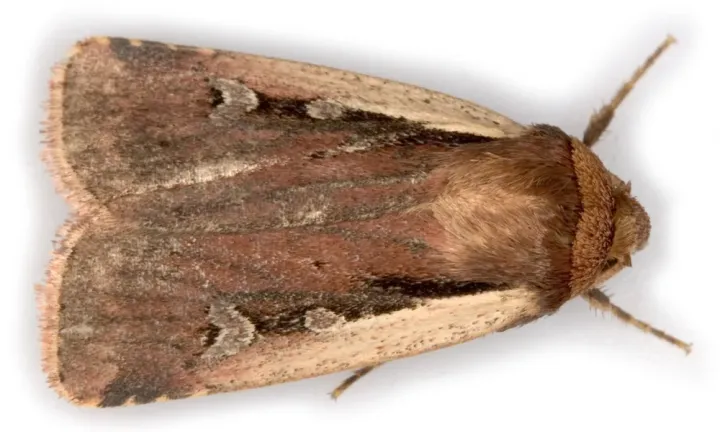
The flame shoulder (Ochropleura plecta) is a noctuid moth characterized by a wingspan ranging from 30 to 35 mm, common in various agricultural environments.
The forewings are distinctively colored with a reddish-brown hue and feature a broad, pale white band along the leading edge, which is its diagnostic mark.
The hindwings are pale and often appear almost white, providing a striking contrast to the darker forewings, especially when the moth is observed at rest.
Larvae, commonly known as cutworms, possess a yellowish-brown or greyish body with a darker dorsal stripe and paler lines running along their sides.
The pupae are glossy, brown, and typically dwell within the upper soil layers, encased in a fragile silk-lined earthen cell that protects them during development.
What it damages
This species is a known polyphagous pest, meaning it feeds on a wide range of vegetable, cereal, and ornamental crops, leading to significant economic losses.
Preferred hosts include crops like potatoes, cabbages, carrots, and sugar beets, as well as various wild grasses that serve as early-season food sources.
Young larvae initially feed by skeletonizing the leaf tissues, which significantly reduces the photosynthetic efficiency of the affected host plants.
As the larvae mature, they consume entire leaf blades, often leaving only the main veins behind, which can severely stunt the growth of young plants.
Feeding at the root collar or stem base can lead to the wilting and eventual death of entire plants, especially during the seedling stage of crop development.
When it appears
Adult moths typically emerge in two overlapping generations, with the first peak occurring in late spring (May to June) after overwintering as pupae.
A second generation of moths emerges in late summer, usually in August, which continues the cycle and prepares the population for the upcoming winter.
The entire development cycle from egg to adult is highly dependent on ambient temperatures and moisture levels, generally spanning about 45 to 50 days.
Overwintering occurs strictly at the pupal stage within the soil profile, providing the species with a high degree of survival during freezing winter months.
Mild and humid weather patterns during the growing season significantly enhance the survival rates of larvae and contribute to higher population densities.
Signs of infestation
Early symptoms of infestation include the appearance of small, irregular holes on leaf surfaces caused by the feeding activity of the first instar larvae.
Careful inspection of the underside of leaves during twilight hours often reveals clusters of eggs laid by the female moths, indicating active colonization.
Frass (larval excrement) found on leaves or at the base of the stem is a strong indicator of the presence of older, more destructive larval stages.
Wilting of plants without obvious signs of drought or disease often suggests that larvae have been feeding on the roots or the succulent stem base.
High capture rates of moths in light traps or pheromone-baited traps serve as a clear warning to implement scouting and protection programs immediately.
Control measures
Deep autumn plowing is an effective cultural control method that physically destroys overwintering pupae and reduces the overwintering population density.
Crop rotation remains a fundamental strategy, preventing the continuous buildup of larval populations by introducing non-host crops to the rotation cycle.
Integrated Pest Management (IPM) should prioritize the use of pheromone traps for population monitoring to ensure that insecticide use is targeted and timely.
Chemical control involving synthetic pyrethroids or organophosphates should be applied only when the economic injury threshold is surpassed in the field.
- Removing weed hosts from field margins.
- Inter-row cultivation to disturb pupation sites in the soil.
- Utilizing bio-pesticides containing entomopathogenic fungi.
Taxonomy
- Latin name
- Ochropleura plecta
- Order
- Lepidoptera (butterflies)
- Family
- Noctuidae
- EPPO code
- OKHRPL
Discussion
No discussions yet — be the first.