
Bulrush wainscot
Nonagria typhae
Description
How to identify
The bulrush wainscot (Nonagria typhae) is a species of moth belonging to the Noctuidae family. It is a specialized insect whose larvae spend most of their life cycle protected within the stems of aquatic plants.
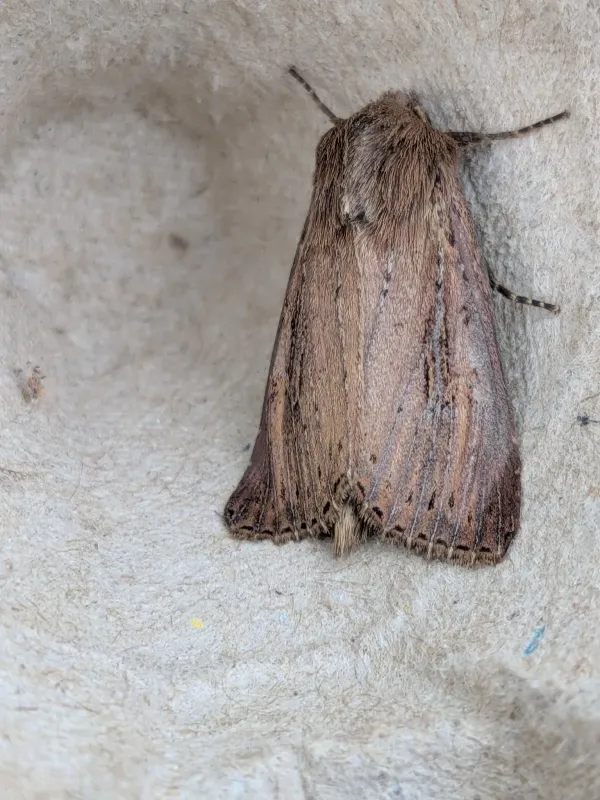
Adult moths typically have a wingspan of 45–50 mm. Their forewings are marked with ochre or brown shades and a distinct dark pattern that provides camouflage against dead foliage.
The larvae are internal feeders, reaching up to 50 mm in length. They possess a pale, smooth body and a hardened head capsule, perfectly adapted for boring into tough plant stems.
The pupal stage occurs within the plant stem itself, where the insect constructs a chamber just before emerging as a moth, effectively hiding from external predators.
The species completes one generation per year, making the seasonal timing of its life stages critical for those involved in habitat management or pest control.
What it damages
This moth primarily feeds on plants in the Typhaceae family, particularly Typha latifolia and Typha angustifolia (bulrush/cattail). It also targets reed species.
Larvae feed by boring into the heart of the stem, consuming the soft inner tissue and destroying the plant's structural integrity and nutrient transport system.
Visible damage includes the sudden yellowing or death of the central leaf (the "spike"), which is a clear indicator that the growing point has been severed by the larvae.
Stems heavily infested by the bulrush wainscot often collapse or show stunted growth, significantly reducing the vigor of the plant cluster.
In addition to physical destruction, the tunnels created by the larvae promote secondary infections, leading to rot and the decay of aquatic plant stands.
When it appears
Adult moths are typically active in late summer, specifically during August and September, when mating and egg-laying occur.
The eggs are the overwintering stage, attached firmly to the stems or leaves of host plants near the base, remaining dormant through the winter months.
Larval hatching takes place in the spring, usually around April or May, when the plants begin their rapid growth phase.
The larvae feed and mature throughout late spring and summer. By mid-summer, they reach their final larval instar and prepare for pupation inside the plant stem.
The pupal stage lasts for several weeks within the plant gallery, with the emergence of the new adult generation completing the annual cycle.
Signs of infestation
The most reliable sign of an infestation is the premature yellowing or wilting of the innermost leaf of the bulrush, commonly referred to as "flagging."
Careful observation reveals small, circular entrance holes on the stem, often marked by a small amount of frass (larval excrement) clinging to the surface.
In cases of severe infestation, the stems may appear deformed or stunted, and pressure on the stem near the entrance hole may reveal a hollow interior.
During the peak of the larval stage, one can hear or find evidence of internal feeding, such as fine plant debris expelled from the boreholes.
Dissecting a suspect stem will reveal the presence of the larva or the pupal casing, confirming the identity of the organism responsible for the damage.
Control measures
Mechanical control involves cutting and removing infested stalks during the winter or early spring to destroy overwintering eggs before they hatch.
Maintaining clear irrigation channels and managing riparian vegetation helps reduce the density of host plants, thereby limiting the population of the pest.
Chemical control is rarely necessary but may be employed in commercial aquatic nurseries using systemic insecticides applied before the larvae burrow deep into the tissue.
Biological monitoring is key; early detection of the yellowing central leaf allows for targeted removal of infested stems to prevent the spread of the moth.
Integrated Pest Management (IPM) practices should focus on site sanitation and the preservation of natural predators to maintain the balance of the aquatic ecosystem.
Taxonomy
- Latin name
- Nonagria typhae
- Order
- Lepidoptera (butterflies)
- Family
- Noctuidae
- EPPO code
- PHRGTY
Discussion
No discussions yet — be the first.