
Nonagria
Nonagria
Description
How to identify
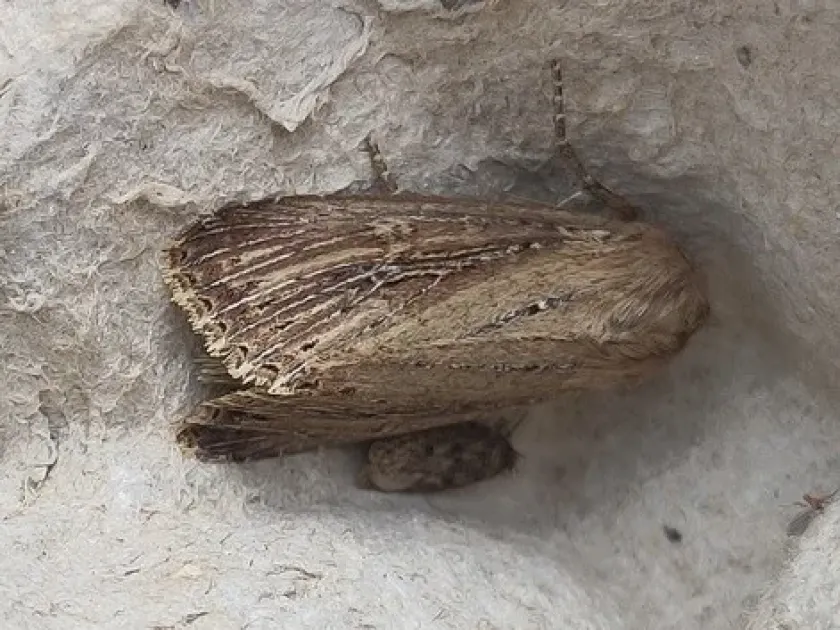
Nonagria is a genus of moths belonging to the Noctuidae family. The adults typically have a wingspan of 30–45 mm, with a coloration ranging from ochre to brownish tones, providing excellent camouflage.
The larvae, or caterpillars, reach 40–50 mm in length. They feature a smooth body, ranging in color from dirty white to yellowish-grey, with a distinctive dark line along the dorsal area.
The head capsule is well-developed and brown, specifically adapted for boring into the fibrous tissues of grass and cereal stems.
Nonagria moths are primarily nocturnal, making them difficult to spot in daylight and requiring specific trapping methods for monitoring population levels.
Taxonomically, they are classified within the Noctuinae subfamily and are well-known as specialized stem-boring pests in agricultural and natural environments.
What it damages
The damage is caused by larvae that bore into the stems of host plants, including wheat, barley, corn, millet, and wild grasses like reeds or cat-tails.
By consuming the internal pith of the stem, the larva disrupts the plant's vascular system, leading to the wilting and eventual death of individual shoots.
Significant economic losses occur during outbreaks, as the infestation affects the formation of the ear or panicle, directly reducing crop yield and quality.
The stems affected by Nonagria become structurally weak and prone to lodging, which complicates harvesting processes and increases field losses.
In addition to direct physiological damage, the entry holes created by larvae can serve as entry points for secondary fungal infections or pathogens.
When it appears
Nonagria generally completes one generation per year. Adult moths typically emerge and fly in late summer to early autumn to mate.
Females deposit eggs on the leaves or under the leaf sheaths of host plants, where these eggs successfully overwinter.
In the following spring, usually in May, the larvae hatch and immediately start feeding on the young, tender tissues of the emerging cereal crops.
The larval feeding phase continues throughout the early part of summer, culminating in pupation within the hollowed stem of the host plant.
The pupal stage lasts several weeks, after which the new generation of adults emerges to repeat the annual life cycle.
Signs of infestation
The first indicator of an infestation is the premature wilting or yellowing of the central leaf of a young plant, often referred to as a "dead heart."
When an infested stem is opened, it reveals hollowed-out tunnels filled with larval frass, which looks like small, dark, granular wood shavings.
Characteristic small, circular exit holes may be visible on the surface of the stem, indicating where the larva emerged for pupation or entered.
Affected plants often show stunted growth, abnormal tillering, or may collapse entirely due to the loss of internal structural integrity.
Proximity to wetlands, marshes, or dense stands of wild reeds is a major risk factor, as these areas serve as primary reservoirs for the pest population.
Control measures
Effective management begins with strict field hygiene, including the destruction of weeds such as wild reeds and couch grass near crop boundaries.
Deep autumn plowing is a crucial agrotechnical method, as it buries the plant residues containing overwintering eggs, significantly reducing spring larval populations.
Crop rotation remains a fundamental practice, as it denies the pest a continuous food source and breaks the localized life cycle of the moth.
When economic thresholds are exceeded, systemic insecticides are required to penetrate the plant tissues and reach the larvae hidden inside the stems.
Monitoring using light traps or pheromone lures is highly recommended to detect the flight period of adults and time preventive spraying accurately.
Taxonomy
- Latin name
- Nonagria
- Order
- Lepidoptera (butterflies)
- Family
- Noctuidae
- EPPO code
- NONASP
Discussion
No discussions yet — be the first.