
Noctua comes
Noctua comes
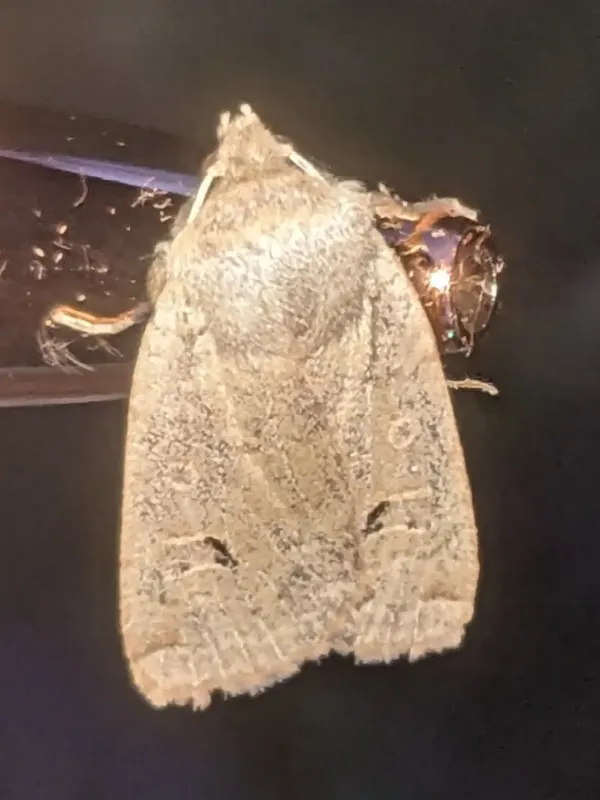
Description
How to identify
The moth Noctua comes, known commonly as the Lesser Yellow Underwing, is a widespread member of the Noctuidae family within the order Lepidoptera.
Adult moths typically have a wingspan ranging from 35 to 45 mm, displaying forewings that vary in shades from ochre to dark reddish-brown with intricate markings.
The larvae, or caterpillars, are recognized by their cylindrical bodies, which can reach 40 mm in length, usually featuring a pale stripe along the back and small dark spots.
As a nocturnal species, the moth is rarely seen during the day, which complicates its identification without the use of light traps or professional scouting.
The life cycle involves four distinct stages: egg, larva, pupa, and adult, with the larval stage being the most critical for agricultural management.
What it damages
This species is highly polyphagous, meaning it feeds on a wide variety of plants, including cereals, potatoes, sugar beets, and several garden vegetables.
The most significant damage occurs when the larvae feed on the stems of young seedlings, often severing them entirely at the soil level.
Besides seedling destruction, larvae may also feed on foliage, which can cause significant reduction in plant vigor and overall crop production.
Field crops often suffer in patches, as larvae are frequently found in groups, leading to localized areas of complete stand loss in affected fields.
The damage is particularly devastating during the early establishment phase of the crops, where replanting is often the only solution to maintain yields.
When it appears
Adult moths are typically active during the summer months, with flight patterns often peaking between June and August in many temperate regions.
Overwintering larvae emerge from the soil in early spring when temperatures rise, initiating their feeding cycle on available early-season host plants.
A second generation of larvae may develop later in the season, extending the risk window to late summer or early autumn for specific crop varieties.
Climatic factors such as soil temperature and moisture levels are primary determinants for the speed of larval development and adult emergence rates.
Successful management requires tracking these seasonal milestones to apply interventions precisely when the pest population is most vulnerable.
Signs of infestation
The primary sign of an infestation is the appearance of cut plants at the base, often with the plant wilting or lying flat on the ground.
Checking the soil surface around damaged plants during the early morning often reveals the presence of larvae hiding just beneath the dirt.
Visible feeding holes or ragged edges on the lower leaves of plants can also indicate the presence of nocturnal feeding activity by the caterpillars.
Increased moth counts in local light traps serve as an early warning system for farmers to start scouting their fields for potential larval presence.
A lack of uniformity in plant emergence and stand density, especially in low-lying or weed-prone areas, is a strong indicator of an underground pest problem.
Control measures
Integrated Pest Management (IPM) strategies for Noctua comes emphasize cultural practices alongside chemical applications when thresholds are met.
Effective tillage, especially deep autumn ploughing, serves to disrupt the life cycle by exposing pupae and larvae to predators and harsh weather conditions.
Maintaining clean fields by removing weeds reduces alternative food sources and prevents the moths from establishing egg-laying sites.
When populations exceed economic damage thresholds, chemical control using systemic or contact insecticides is often required to safeguard the crop.
- Use of pheromone monitoring traps for timing interventions.
- Implementation of diverse crop rotation schemes.
- Application of biological control agents where appropriate.
- Encouraging natural predator populations to help keep pest numbers down.
Taxonomy
- Latin name
- Noctua comes
- Order
- Lepidoptera (butterflies)
- Family
- Noctuidae
- EPPO code
- NOCTCO
Discussion
No discussions yet — be the first.