
Australian lungfish
Neoceratodus
Description
How to identify
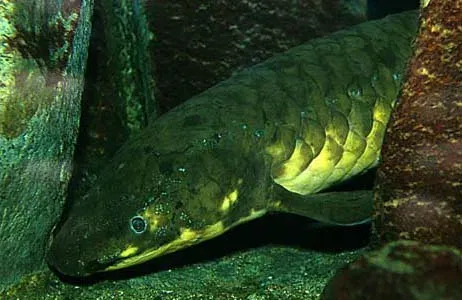
The Australian lungfish (Neoceratodus forsteri) is a relic species of lungfish belonging to the family Neoceratodontidae. It is often described as a living fossil.
The fish features a heavy, elongated body covered with large scales and paddle-like fins. It is unique among lungfish for having a single functional lung.
It is endemic to the Mary and Burnett river systems in Queensland, Australia, where it inhabits slow-moving or still waters.
Adults can reach lengths of up to 1.7 meters and weigh over 40 kilograms, making them one of the largest freshwater fish in the region.
Importantly, this fish is strictly aquatic and has no interaction with agricultural crops or terrestrial vegetation.
What it damages
The Australian lungfish is not an agricultural pest and causes no damage to crops, orchards, or horticultural installations.
Its diet consists primarily of small aquatic invertebrates, such as snails, shrimp, worms, and various benthic organisms.
While it may incidentally encounter aquatic vegetation while foraging, it does not graze on plants in a way that would cause economic damage.
There is no evidence of this species impacting irrigation infrastructure or water management systems used in farming.
As a non-pest species, it poses zero threat to agricultural productivity or plant health.
When it appears
The Australian lungfish does not follow agricultural planting or harvest cycles, but its breeding activity peaks during the spring.
It is highly adaptable, capable of surviving in isolated pools during drought conditions by using its lung to breathe atmospheric air.
Its behavior remains consistent throughout the year, with no migratory patterns that would bring it into conflict with terrestrial agricultural zones.
Seasonal fluctuations in river levels influence its movement between pools but do not affect surrounding crops.
The life cycle of the species is purely aquatic and independent of human land-use practices.
Signs of infestation
The presence of the Australian lungfish can be identified by the sound of the fish surfacing to gulp air, which produces a distinct splashing noise.
There are no indicators of infestation or damage to report, as the species does not feed on plants.
Clear, undisturbed water bodies with healthy aquatic vegetation are preferred habitats for the species.
Observing this fish is a sign of a healthy, biodiverse ecosystem rather than a symptom of pest pressure.
No agricultural inspection methods are required to detect or monitor this animal.
Control measures
No control measures are necessary, as the species is not a pest and is legally protected in Australia.
Attempting to disturb, capture, or harm this protected species is a violation of environmental conservation laws.
Agricultural management should focus on maintaining water quality to support the native ecosystem where the lungfish resides.
Farmers are encouraged to minimize runoff and chemical contamination to ensure the survival of this unique species.
- Maintain riparian vegetation buffer zones.
- Avoid chemical runoff into river systems.
- Follow local environmental legislation regarding protected species.
Taxonomy
- Latin name
- Neoceratodus
- Family
- Neoceratodontidae
- EPPO code
- NKERSP
Discussion
No discussions yet — be the first.