
Nemesia caementaria
Nemesia caementaria
Description
How to identify
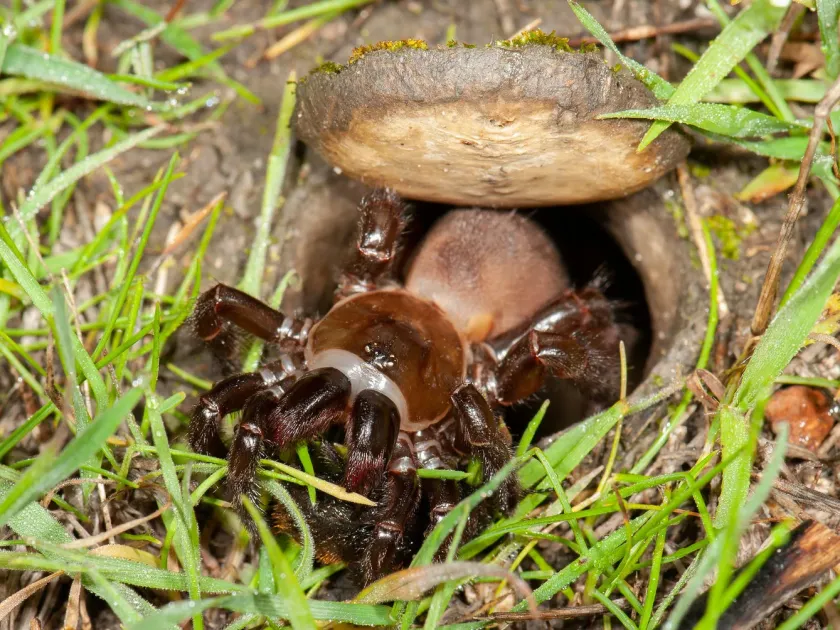
Nemesia caementaria is a species of spider belonging to the Nemesiidae family, commonly known as trapdoor spiders. These spiders are robust, dark-colored arachnids that construct deep, silk-lined burrows in the soil.
The defining characteristic of this spider is the hinged door made of soil and silk that seals the entrance to its burrow. This structure provides excellent camouflage, making the spider nearly invisible to predators and human observers.
As members of the order Araneae, these spiders exhibit distinct sexual dimorphism, where males are typically smaller and more mobile, while females remain primarily inside their burrows.
They are predominantly found in the Mediterranean region, preferring environments with compact soil and sparse vegetation where they can easily construct their dwellings.
While they may appear intimidating, they are essential parts of the local ecosystem, functioning primarily as predators that control populations of various soil-dwelling invertebrates.
What it damages
Nemesia caementaria does not feed on plants or crops. Therefore, it causes no direct damage to agricultural products, root systems, or leaf tissues, and is not classified as an agricultural pest.
There are no recorded instances of yield loss or quality reduction in crops caused by this spider. Its ecological impact is limited to its role as a natural predator of small arthropods.
Any disruption to the soil structure caused by burrowing is negligible and does not interfere with standard agricultural or gardening practices.
Agronomists do not consider this spider a threat to plant health; therefore, no preventive or curative measures are required to manage this species in field or greenhouse conditions.
In fact, the presence of such spiders in an agricultural environment can be seen as an indicator of a diverse and stable soil ecosystem.
When it appears
The activity of Nemesia caementaria is highly dependent on environmental conditions, particularly temperature and soil moisture. They are most active during the warmer months of the year.
The mating season occurs in the autumn when mature males emerge from their burrows to search for females. During this time, they are more frequently observed above ground than at any other time of the year.
During cold winter months, these spiders retire deep into their burrows and enter a period of hibernation, effectively surviving low temperatures by staying below the frost line.
Optimal development depends on stable soil temperatures. When temperatures are appropriate, they maintain their hunting activities throughout the growing season.
In protected greenhouse environments, the period of activity may extend, but this does not alter the spider’s general behavior or its relationship with cultivated plants.
Signs of infestation
The primary sign of a trapdoor spider's presence is the identification of their burrows, which feature the signature trapdoor flap. Identifying these requires careful inspection of the soil surface.
One may notice small remnants of insect exoskeletons near the burrow entrance, which indicates that the spider is successfully hunting in the immediate vicinity.
After rainfall, the soil texture around the burrow might show slight variations, which can help reveal the location of the concealed flap.
Nighttime observation using a flashlight can confirm the spider's presence, as they often sit at the entrance of their burrows at night, waiting for prey to pass by.
Finding a burrow is a curiosity rather than a concern, as these spiders are not pests and do not require intervention.
Control measures
There are no recommended control measures for Nemesia caementaria because it is not a pest. It is generally advised to leave these spiders undisturbed in their natural habitats.
If there is an unwanted presence in greenhouses, simple physical disruption of the soil, such as deep tilling or regular cultivation, will naturally disperse their habitats.
The use of chemical insecticides to control this species is strongly discouraged, as it can harm beneficial arthropods and disrupt the biological balance of the farm.
If necessary, mechanical exclusion methods, such as fine-mesh screens, are sufficient to prevent unwanted migration into sensitive indoor growing areas.
- Regular soil tilling
- Soil compaction management
- Preservation of beneficial predator populations
- Mechanical exclusion through screening
Taxonomy
- Latin name
- Nemesia caementaria
- Family
- Nemesiidae
- EPPO code
- NMESCA
Discussion
No discussions yet — be the first.