
True armyworm
Mythimna unipuncta
Description
How to identify
The true armyworm (Mythimna unipuncta) belongs to the Lepidoptera order and the Noctuidae family, commonly known as a significant agricultural pest.
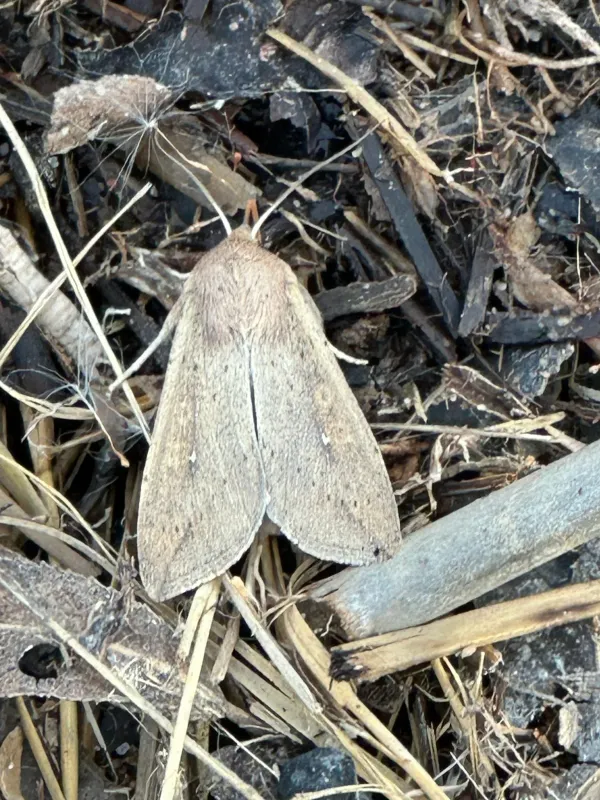
The adult moth has a wingspan of approximately 40–45 mm and is characterized by a brownish-grey coloration with a distinct small white spot on each forewing.
Larvae, commonly known as armyworms, go through several instars, reaching a length of about 40–50 mm when fully developed.
Their bodies often exhibit longitudinal stripes ranging from greenish to dark brown or black, making them look somewhat camouflaged on the host plant.
Pupation typically occurs in the soil, where the insect remains as a reddish-brown pupa until the next stage of its development cycle.
What it damages
The true armyworm is a polyphagous pest that causes severe damage to a wide range of monocotyledonous crops worldwide.
Cereal crops like wheat, barley, oats, and rye are the most frequent targets, leading to significant yield losses in affected fields.
Corn is particularly vulnerable; larvae often feed on the leaves and can even bore into the ears, destroying the developing grain.
Pastures and hay fields can be completely defoliated by large outbreaks, rendering them unsuitable for livestock grazing.
During massive outbreaks, larvae move in large groups, consuming all available vegetation and leaving fields looking like they have been scorched.
When it appears
The life cycle and activity of the true armyworm are highly dependent on spring temperatures and moisture levels.
Adult moths migrate or emerge in early spring, often arriving in regions via wind currents before laying eggs on host vegetation.
Larval activity peaks during the late spring and early summer months, coinciding with the rapid growth phase of cereal crops.
The number of generations per year varies significantly depending on the local climate and temperature conditions of the specific geographic area.
Favorable weather, characterized by high humidity and moderate temperatures, creates optimal conditions for rapid population expansion.
Signs of infestation
The most evident sign of an infestation is the presence of irregular, ragged leaf margins caused by larvae feeding.
Heavy infestations may result in the complete stripping of leaves, leaving behind only the tougher stalks and midribs.
Larvae are primarily nocturnal, so inspecting the fields at night with a flashlight is the most accurate way to confirm their presence.
The accumulation of dark, pellet-like frass (excrement) at the base of plants or on leaves is a definitive indicator of an active infestation.
Thinning or patchy stands of grain crops that appear suddenly are often a result of feeding pressure by large armyworm populations.
Control measures
Managing the true armyworm requires an integrated pest management (IPM) approach to minimize crop damage and economic loss.
Cultural practices, such as maintaining clean field borders and eliminating grassy weeds, help reduce local nesting sites.
Chemical control is necessary when larvae reach established economic threshold levels, ensuring timely intervention.
- Regular monitoring with pheromone traps to detect moth migration.
- Encouraging natural predators such as ground beetles, birds, and parasitic wasps.
- Applying insecticides during the early larval stages when they are most vulnerable.
- Utilizing selective insecticides to preserve beneficial insect populations.
Scouting individual fields frequently during the growing season is crucial to prevent widespread destruction from sudden outbreaks.
Taxonomy
- Latin name
- Mythimna unipuncta
- Order
- Lepidoptera (butterflies)
- Family
- Noctuidae
- EPPO code
- PSEDUN
Discussion
No discussions yet — be the first.