
False rice armyworm
Mythimna loreyi
Description
How to identify
The False rice armyworm (Mythimna loreyi) is a moth species belonging to the Noctuidae family. It is a significant agricultural pest known for its migratory behavior and wide distribution.
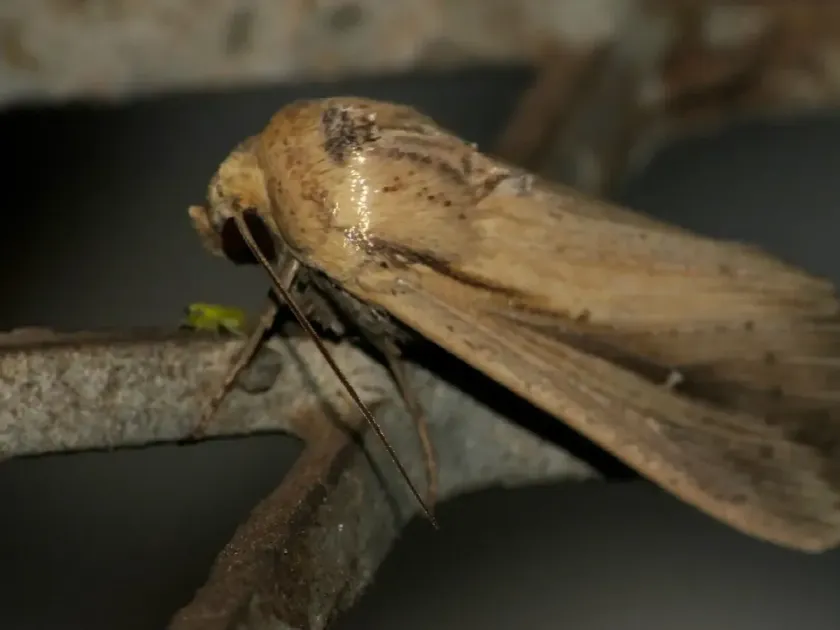
Adult moths feature a wingspan of 35–45 mm. Their forewings are typically ochre-yellow to greyish-brown with a distinct white vein running longitudinally and a small dark spot in the central area.
The larvae, or caterpillars, grow up to 40 mm in length. Their bodies are marked with greyish-brown or yellowish tones and several lighter longitudinal stripes running along the back.
The head of the caterpillar is brown with a reticulated pattern. These larvae are highly active feeders and prefer to conceal themselves during daylight hours.
The life cycle encompasses the egg, larval, pupal, and adult stages. In warm climates, multiple generations can emerge within a single year, making it a persistent threat.
What it damages
As a polyphagous insect, the False rice armyworm causes damage to a wide range of monocotyledonous plants, representing a major threat to cereal production.
Key host plants include rice, corn (maize), sorghum, and sugar cane. They also utilize various wild grasses as primary food sources before migrating to crops.
Larvae feed primarily on leaves, causing ragged edges and significant defoliation. In severe cases, only the midribs of the leaves remain, drastically reducing plant vitality.
Beyond leaf damage, larvae can attack the generative parts of plants, such as the heads of cereals or the cobs of corn, leading to significant yield loss and grain quality reduction.
Large infestations can result in total destruction of young seedlings, necessitating replanting and leading to significant economic losses for producers.
When it appears
Adult activity usually begins in the spring as temperatures rise. The moths are nocturnal and are highly attracted to light sources and pheromones.
Females lay eggs in clusters on the undersides of leaves or within the leaf sheaths of host plants, often covering them with scales to provide protection.
The larval stage is most destructive during the warm summer months. Optimal conditions for rapid development are found in environments with high humidity and warm weather.
The species is known for its long-distance migration, often arriving in new regions on prevailing winds, which makes local monitoring extremely difficult.
Populations tend to peak towards the late summer and early autumn, requiring sustained vigilance from agronomists during the grain-filling stages of the crops.
Signs of infestation
The most immediate indicator of infestation is the presence of irregular, notched leaves. These ragged feeding patterns are characteristic of armyworm activity.
Dark granular excrement found on the leaves or at the base of the plant serves as a clear sign that a population of larvae is actively feeding nearby.
During the day, larvae are often hidden in the soil near the plant base, under debris, or deep within the plant whorl, requiring careful inspection.
Severe infestations manifest as stripped leaves and damaged spikes. Monitoring for larvae at dusk or dawn increases the likelihood of detection.
- notched or shredded leaf margins;
- presence of larval frass on leaves or ground;
- larvae hiding in the soil or plant whorls during the day;
- damaged reproductive structures (ears or tassels).
Control measures
Effective management requires an integrated pest management (IPM) strategy that combines monitoring, cultural practices, and chemical intervention when thresholds are met.
Cultural control measures, such as deep plowing after harvest, help disrupt the pupal stage in the soil, effectively reducing the population for the next season.
Sanitation practices, including the removal of weeds and alternative host grasses around the field perimeter, are crucial to reducing initial infestation sources.
Monitoring with pheromone traps provides early warning of moth flights, allowing growers to time insecticide applications precisely for maximum efficacy against young larvae.
Chemical control options should include selective insecticides that target the larvae while minimizing impact on beneficial insects and natural predators within the agroecosystem.
Taxonomy
- Latin name
- Mythimna loreyi
- Order
- Lepidoptera (butterflies)
- Family
- Noctuidae
- EPPO code
- PSEDLO
Discussion
No discussions yet — be the first.