
European velvet ant
Mutilla europaea
Description
How to identify
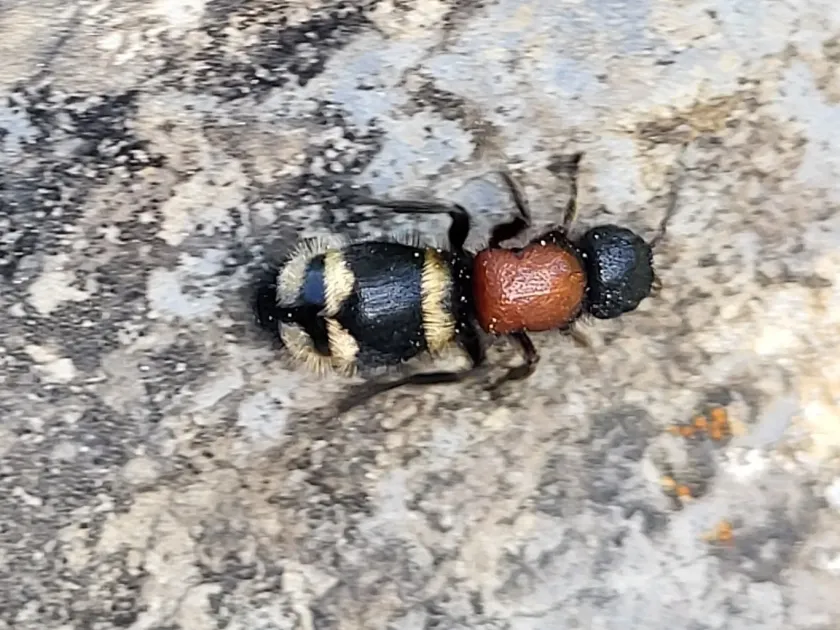
The European velvet ant (Mutilla europaea) is a species of parasitoid wasp belonging to the Mutillidae family. Despite the name "ant," they are wasps; females are wingless and resemble large, hairy ants, while males are winged and resemble typical wasps.
Females are characterized by their striking black and red coloration, which serves as a warning of their powerful sting. Their exoskeleton is exceptionally thick and hard, allowing them to invade the nests of other stinging Hymenoptera.
These insects are solitary in nature. Males are frequently observed feeding on nectar from flowers, whereas females are mostly ground-dwelling, actively searching for host nests.
The species is widespread across Europe and parts of Asia, typically inhabiting warm, dry areas with sandy soils where nesting sites for their hosts are abundant.
They are not social insects and do not possess a colony structure. Their beauty and distinct appearance make them a fascinating subject for entomological study, though caution is required due to their potent sting.
What it damages
The European velvet ant is not a pest to agricultural crops. It does not feed on plant tissues, does not damage roots, leaves, or fruits, and poses zero threat to commercial or home farming.
In agronomic terms, these wasps are considered beneficial or neutral organisms. As parasitoids of other insects, they function as part of the natural regulatory ecosystem, keeping other insect populations in check.
Farmers and gardeners do not need to implement any damage mitigation strategies against this species. There is no economic loss associated with their presence on agricultural land.
The misconception that they are pests often stems from their aggressive appearance and the fear of their sting. However, their biological requirements are completely detached from crop production cycles.
No agricultural machinery, pesticides, or biological control agents are required to manage this insect, as they have no impact on crop yield or plant health.
When it appears
Adult European velvet ants are active during the summer months, typically from June through August. This is the period when they seek mates and suitable host nests for egg-laying.
Females are predominantly active during warm, sunny days. They prefer dry soil conditions, which facilitate their movement across the landscape in search of subterranean nests.
The lifecycle is tightly synchronized with the nesting period of their hosts, such as bumblebees and various ground-nesting wasps. Their emergence timing ensures their larvae have access to host brood.
As autumn approaches, adult activity declines. The insects prepare for overwintering, typically hiding in protected crevices or underground chambers to survive the cold season.
The full development cycle is completed within the host nest, with the next generation of adults emerging in the following summer season.
Signs of infestation
The primary sign of their presence is the visual identification of females wandering on the ground, particularly in areas with loose or sandy soil. They are distinct due to their bright colors and rapid, erratic movement.
Since the species does not feed on vegetation, there are no characteristic feeding signs, leaf damage, or stem boring symptoms associated with their presence.
Observers might notice them patrolling near the entrances of bee or wasp nests. This is a behavioral indicator that the female is seeking a host to parasitize.
During a threat, these insects may produce a stridulatory sound, which serves as a defensive warning. This sound is a unique characteristic but does not signal an infestation in the agricultural sense.
Monitoring for this species is not required, as their presence does not signal any ecological imbalance that would threaten crop health.
Control measures
Control measures are unnecessary for the European velvet ant because it is not a pest. There is no justification for eradication programs in any agricultural context.
To prevent accidental stings, it is recommended to wear protective footwear when working in gardens or fields during the summer. Avoid disturbing them if they are spotted on the ground.
Avoid the use of broad-spectrum insecticides, which would indiscriminately harm essential pollinators and beneficial insects that actually support agricultural productivity.
Education is the best approach to managing these insects. Understanding their ecological role helps reduce fear and prevents the unnecessary destruction of non-pest species.
- Wear sturdy shoes in sandy or open areas during summer.
- Do not handle these insects due to their painful sting.
- Respect the natural ecosystem by avoiding chemical sprays in their habitat.
Taxonomy
- Latin name
- Mutilla europaea
- Order
- Hymenoptera
- Family
- Mutillidae
- EPPO code
- MUTLEU
Discussion
No discussions yet — be the first.