
Kapok pod borer
Mudaria magniplaga
Description
How to identify
The Kapok pod borer (Mudaria magniplaga) is a moth species belonging to the family Noctuidae. It is a specialized pest that has evolved to feed specifically on the reproductive structures of tropical trees, particularly the Kapok tree.
Adult moths are nocturnal with a wingspan ranging from 40 to 50 mm. Their coloration is typically cryptic, featuring shades of brown and ochre that allow them to blend into the bark of the host trees during daylight hours.
The larvae, or caterpillars, undergo several instars during their development. As they grow, their color shifts from a pale hue to a distinct reddish-brown, and their body structure becomes robust to facilitate boring into fruit tissues.
Pupation occurs within the soil, where the larva retreats after finishing its development inside the pod. This life stage is vital for the survival of the pest population throughout the year.
The biological cycle of Mudaria magniplaga is tightly synchronized with the flowering and fruiting phenology of the host plant, making it a challenging pest to manage effectively.
What it damages
The primary host for this pest is the Kapok tree (Ceiba pentandra), also known as the cotton tree. The damage caused by these larvae significantly impacts the production of kapok fiber.
Larvae bore into the developing fruit pods, consuming seeds and the silky fiber inside. This leads to the direct destruction of the harvestable product within the pod.
Feeding activities often result in the premature drop of pods, causing substantial yield loss. If the pods remain on the tree, their quality is severely degraded by internal rot following the larval infestation.
The infestation ruins the fiber quality and destroys the seeds, preventing natural regeneration of the trees in the affected area.
In peak infestation years, the Kapok pod borer can cause yield losses exceeding 60%, posing a major economic threat to plantations producing natural fiber.
When it appears
The activity of the moth begins simultaneously with the formation of flower buds and young fruit. Females lay eggs directly on the surface of young pods.
The generation cycle length varies depending on local temperatures and humidity. Typically, the cycle corresponds with the maturation period of the pods.
Peak population densities are often observed during the rainy season, when environmental conditions favor the emergence of adults from their soil pupation sites.
Once feeding is complete, the larvae exit the pods, often coinciding with the initial natural splitting of the mature pods as they ripen.
Under conditions of continuous fruiting, the pest can produce several overlapping generations throughout the year.
Signs of infestation
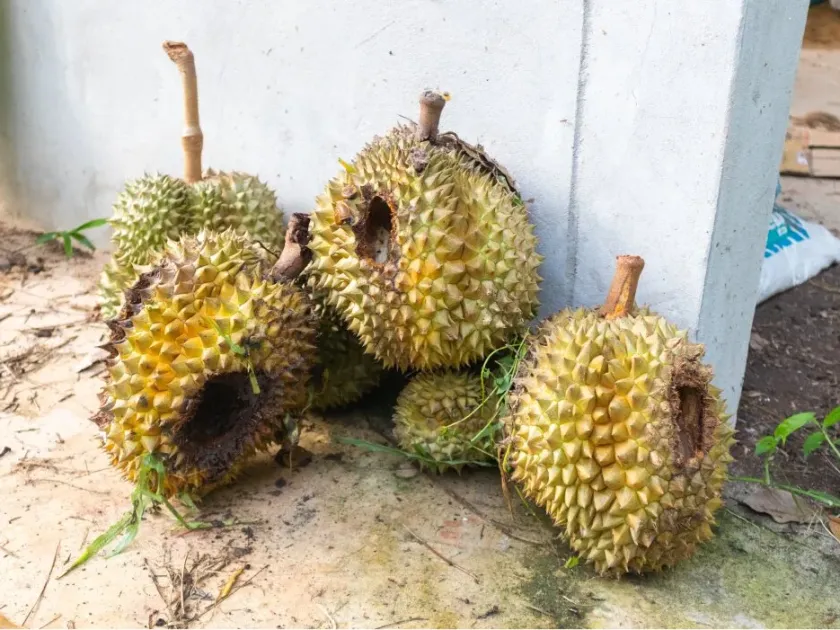
The most visible sign of infestation is the presence of small entry holes on the pod surface, frequently surrounded by larval frass (excrement).
- Yellowing and stunted growth of young pods.
- Premature fruit shedding from branches.
- Internal tunnels filled with damaged fiber and larval waste.
- Presence of sawdust-like frass at the base of the pod stalk.
By opening a damaged pod, one can usually find the larva feeding inside or observe the hollowed-out chambers where seeds once were.
Control measures
Sanitation is a primary management strategy: the regular collection and destruction of fallen pods prevent larvae from reaching the soil to pupate.
Biological control agents, including entomopathogenic fungi and specific bacteria, are effective when applied during the egg-hatching phase, before the larvae bore into the pods.
Chemical control is difficult due to the protected nature of the larvae inside the pods. Applications must be precisely timed with the flight of adult moths to be effective.
Pheromone traps serve as an essential tool for monitoring population dynamics, allowing farmers to optimize the timing of integrated pest management interventions.
Maintaining a distance from wild host populations is recommended to reduce the re-infestation of cultivated plantations from nearby wild reservoirs.
Taxonomy
- Latin name
- Mudaria magniplaga
- Order
- Lepidoptera (butterflies)
- Family
- Noctuidae
- EPPO code
- MUDAMA
Discussion
No discussions yet — be the first.