
Red-winged beetle
Metriorhynchus rufipennis
Description
How to identify
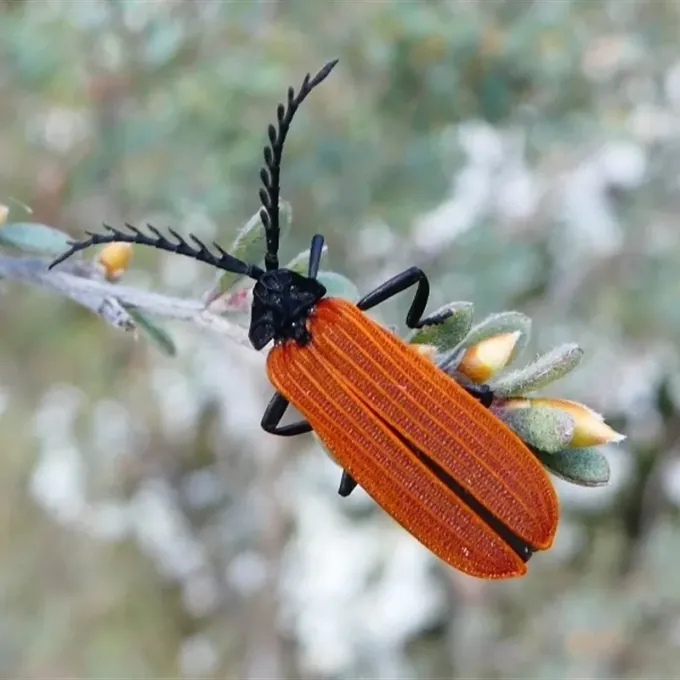
The red-winged beetle (Metriorhynchus rufipennis) is a member of the net-winged beetle family (Lycidae). It is easily identified by its striking bright red or orange elytra, which serve as an aposematic warning signal to potential predators.
The adult beetle has an elongated body with a distinct, often ribbed pronotum. The head, antennae, and legs are usually black, providing a high contrast to the vibrant wings, which is a characteristic feature of this species.
The larvae are typically flattened and dwell in decaying wood or beneath the bark of trees. They possess mouthparts adapted for consuming organic matter and developing in confined spaces.
Adults are diurnal insects and are commonly observed during the daytime on flowering plants, where they feed on pollen and nectar, which aids in their reproductive development.
Correctly identifying this species within an agricultural landscape is crucial, as it is often mistaken for other common beetles, requiring careful observation of its morphology.
What it damages
The primary damage is caused by the adult stage, which feeds on the generative parts of plants, including flowers and buds. This feeding behavior can significantly disrupt the pollination process.
Crops such as fruit trees and berry shrubs are particularly susceptible to this beetle. Damage to flower petals and reproductive structures leads to poor fruit set and potential loss of yield.
In addition to floral damage, adults may consume tender young leaves, reducing the plant's surface area for photosynthesis and impacting overall growth rates during the growing season.
While Metriorhynchus rufipennis is not always a major pest, its presence can weaken the plant, making it more prone to secondary infections from fungi and pathogens.
The extent of the damage varies depending on the population density and the proximity of the crops to natural forest edges where these beetles often thrive.
When it appears
The activity of the red-winged beetle begins in late spring, coinciding with rising temperatures and the onset of the flowering season for many agricultural crops.
The insect undergoes a complete life cycle, consisting of egg, larva, pupa, and adult stages. The adults are most active during the peak of the warm season.
Winter is typically spent in the larval stage, residing within protected woody substrates that offer insulation against freezing temperatures.
The synchronization of the adult emergence with the bloom of key crops ensures that they have ample access to high-energy food sources necessary for successful mating and egg-laying.
As summer approaches its end, the activity of adults gradually wanes, as the focus shifts to the development of the next generation of larvae.
Signs of infestation
The most visible signs of infestation include the presence of adult beetles on foliage and flowers during sunny daylight hours, making them easy to spot due to their coloration.
Look for ragged edges on flower petals and small holes in the buds, which indicate that the beetles have been actively feeding on the plant tissue.
The appearance of damaged blossoms, often accompanied by early wilting, is a strong indicator that beetles are feeding on the reproductive organs of the plant.
Excrement deposits found on leaves or surrounding soil are indicative of prolonged feeding activity by the beetle population in that specific area.
In cases of significant infestation, the overall vitality of the plant may decline, showing signs of stress such as yellowing of leaves or stunted development.
Control measures
Integrated pest management (IPM) is the most effective approach for controlling this pest while preserving the health of the surrounding ecosystem and pollinators.
- Remove decaying wood and debris from the vicinity to eliminate larval habitats.
- Use selective insecticides only when the economic threshold of damage is exceeded.
- Implement light traps during early summer to monitor and reduce adult population levels.
- Encourage natural predators, such as insectivorous birds, to forage in the field.
- Ensure plants are healthy and well-fertilized to increase their resilience to minor damage.
Applying chemical controls requires caution, particularly during the flowering phase, to avoid harming beneficial pollinating insects that are essential for crop productivity.
Regular monitoring of the fields is recommended to identify the beetle's arrival early, allowing for targeted measures that prevent the need for broad-spectrum spraying.
Mechanical removal can be an effective control method in small gardens, especially in the early morning when the beetles are less active and easier to collect manually.
Taxonomy
- Latin name
- Metriorhynchus rufipennis
- Order
- Coleoptera (beetles)
- Family
- Lycidae
- EPPO code
- MTRRRU
Discussion
No discussions yet — be the first.