
Metopia campestris
Metopia campestris
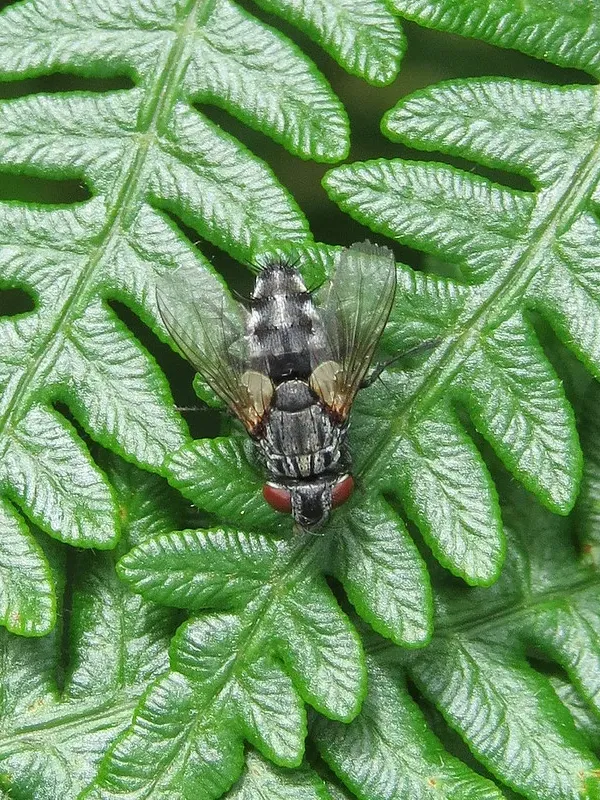
Description
How to identify
Metopia campestris is a fly species belonging to the order Diptera and the family Sarcophagidae. These flies are commonly known as flesh flies, although their specific lifestyle varies significantly within the family.
The adult fly is typically grey in appearance, featuring dark thoracic stripes and a distinct checkered pattern on its abdomen. They possess well-developed sensory organs for locating their hosts in the field.
From a systematic point of view, they are specialized parasitoids. Unlike herbivores, they rely on other insects as hosts for their larvae to complete their development stages successfully.
Identification of the species is complex, as many sarcophagid flies share similar morphological characteristics. Entomologists often rely on the analysis of male terminalia to distinguish M. campestris from related species.
These flies are most active during warm weather, occupying various habitats ranging from open fields to forest edges, often found on flowers where they feed on nectar.
What it damages
Metopia campestris does not cause direct physical damage to crops. It does not feed on plant tissues, stems, roots, or seeds, meaning it is not a primary agricultural pest in the traditional sense.
The potential harm is ecological rather than direct. As a parasitoid, it targets other insects, which may include beneficial species like native pollinators or other entomophagous insects that control crop pests.
By parasitizing beneficial insects, Metopia campestris can indirectly disrupt the natural biological control agents that farmers rely on to maintain the health of their crops.
However, this interaction is a natural component of agricultural ecosystems. In balanced environments, the impact of such parasitoids is usually kept within acceptable limits by natural predators.
Farmers are advised not to view this insect as a target for eradication, as its presence is often an indicator of high biodiversity and the activity of a complex insect community.
Control measures
Specific chemical control programs for Metopia campestris are unnecessary and discouraged, as they may harm non-target beneficial insects that provide essential pollination and pest control services.
Management practices should focus on Integrated Pest Management (IPM) strategies. Maintaining a healthy environment with diverse vegetation supports natural enemies that regulate populations of all insect groups.
Standard agricultural practices, such as proper soil cultivation and crop rotation, help manage the overall insect population density and reduce the availability of breeding sites for many fly species.
Promoting habitat diversity around fields can help maintain a balance between various insect species, preventing any single group, including parasitoids, from becoming dominant.
- Avoid non-selective insecticide applications.
- Encourage natural predator populations.
- Implement diverse crop rotation schemes.
- Monitor beneficial insect activity regularly.
- Maintain buffer zones with native flora.
Taxonomy
- Latin name
- Metopia campestris
- Order
- Diptera (flies)
- Family
- Sarcophagidae
- EPPO code
- MTPOCA
Discussion
No discussions yet — be the first.