
Mesogona oxalina
Mesogona oxalina
Description
How to identify
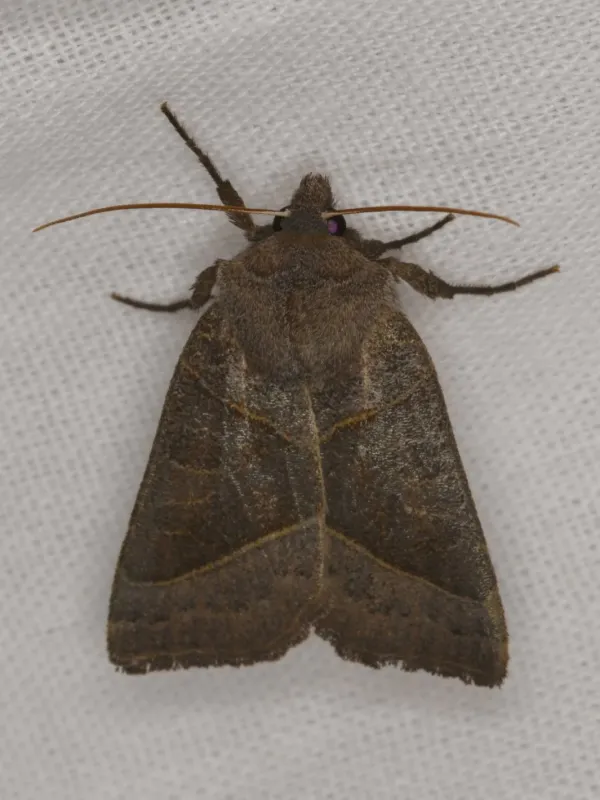
Mesogona oxalina is a moth species belonging to the Noctuidae family. As a nocturnal insect, the adult moth is rarely seen during the day, which often leads to late detection in agricultural and forestry settings.
The adult moth features brown to ochre forewings marked with distinct transverse lines. This camouflage pattern allows the moth to blend seamlessly with tree bark, making it difficult to spot even for experienced observers.
The larvae, or caterpillars, undergo several developmental stages. They have a cylindrical body with well-developed prolegs, allowing them to move efficiently through foliage while feeding. Their color can vary slightly depending on their age and diet.
The life cycle typically involves overwintering as eggs laid on host plant twigs. Upon hatching in the spring, the larvae initiate their feeding cycle, which is synchronized with the bud burst of the host plants.
Identification of this species often requires entomological training. In professional settings, pheromone traps are frequently used to monitor population levels and ensure accurate species identification within the orchard or forest environment.
What it damages
The primary damage is caused by the larval stage, which feeds on buds, leaves, and young shoots. This pest has a preference for various deciduous trees, including species of the Salicaceae and Rosaceae families.
Early spring feeding is the most critical period, as caterpillars consume developing buds. This leads to stunted growth of new shoots and, in severe cases, significantly impacts the overall yield potential of fruit-bearing trees.
Mass outbreaks can result in significant defoliation of trees. While trees may recover from partial defoliation, repeated annual attacks can weaken the plant's physiological state, making it more susceptible to environmental stress and diseases.
Furthermore, damage to the reproductive structures of the plant can lead to reduced flowering and fruit set. This direct impact on the crop cycle translates to economic losses for growers if the pest population remains unchecked.
The feeding activity creates wounds on the plant tissue, which can serve as entry points for secondary pathogens like fungi or bacteria. This complicates the damage profile and necessitates a multi-faceted approach to plant health management.
When it appears
Adult moths are primarily active in the autumn, which marks their mating and egg-laying period. These eggs remain dormant through the winter, ensuring the survival of the species until the next spring.
The larval stage becomes active in early spring, precisely when the host plants begin their vegetative growth. This period of rapid feeding is essential for the larvae to reach their next developmental stage before pupation.
Pupation typically occurs in late spring or early summer, with the pupae residing in the soil or leaf litter. This subterranean or ground-level phase protects the insect from predators and weather extremes during the summer months.
Because the life cycle is tightly coupled with seasonal growth, the active presence of this pest is mostly confined to the spring and autumn periods. Monitoring efforts should be focused on these specific windows.
Agronomists use degree-day modeling to predict the timing of larval emergence. This data-driven approach allows for precise timing of interventions, reducing the need for indiscriminate pesticide applications.
Signs of infestation
One of the earliest signs of infestation is the presence of damaged or hollowed-out buds in early spring. Frass (larval excrement) found near these buds is a definitive indicator of caterpillar activity.
Leaf damage manifests as irregular holes or skeletonized leaves, where only the veins remain. In cases of high larval density, significant portions of the canopy may appear ragged and thin, indicating heavy feeding pressure.
Direct inspection of the canopy can reveal the larvae themselves, often resting on the undersides of leaves or within silk-bound foliage. Due to their nocturnal nature, searching for them is most effective during twilight hours.
Increased activity of insectivorous birds in the canopy can also serve as a behavioral indicator of a pest outbreak. While not a precise measurement, it warrants further investigation by the grower.
- Hollowed-out buds in early spring
- Irregular leaf holes and skeletonization
- Accumulation of frass on leaves
- Silk-bound or rolled leaves
- Reduced shoot elongation and canopy density
Control measures
Cultural control practices, such as autumn soil cultivation beneath the canopy, can disrupt the pupation cycle. By disturbing the soil, growers can expose pupae to winter temperatures and natural predators.
Biological control, including the application of Bacillus thuringiensis-based products, is highly effective against early-instar larvae. These biopesticides are target-specific and preserve beneficial predatory insects.
Chemical control should be implemented only when scouting confirms that pest populations have exceeded the economic threshold. Modern, selective insecticides are preferred to minimize impact on non-target species.
Pheromone traps serve a dual purpose: they act as a monitoring tool to track flight activity and can also be used for mass trapping or male confusion to reduce successful mating events.
An Integrated Pest Management (IPM) approach remains the gold standard for controlling Mesogona oxalina. By combining monitoring, cultural practices, and selective biological or chemical treatments, growers can effectively protect their crops while maintaining ecological stability.
Taxonomy
- Latin name
- Mesogona oxalina
- Order
- Lepidoptera (butterflies)
- Family
- Noctuidae
- EPPO code
- MESOOX
Discussion
No discussions yet — be the first.