
Mesogona
Mesogona
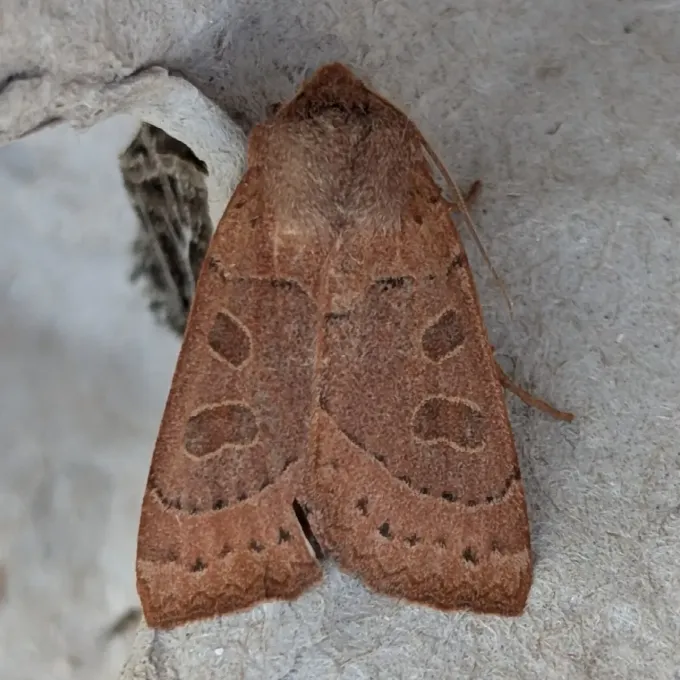
Description
How to identify
Mesogona belongs to the family Noctuidae within the order Lepidoptera. These are typically nocturnal moths that, in their adult stage, possess the classic noctuid appearance: a robust body, a well-developed proboscis, and distinct wing patterns.
Adults often feature cryptic coloration, ranging from yellowish-tan to brown, which provides camouflage against tree bark or dry leaves during the daylight hours.
The larvae (caterpillars) are cylindrical with well-developed thoracic and abdominal legs. Their body coloration is highly variable, often shifting between greenish and brownish tones, sometimes marked with longitudinal side stripes.
The life cycle undergoes complete metamorphosis, including egg, larva, pupa, and imago stages. Pupation typically occurs in the soil or within the leaf litter beneath host plants.
Identifying the exact species within the Mesogona genus often requires specialized microscopic examination of genital structures, as their external adult appearance is remarkably similar across species.
What it damages
Mesogona caterpillars are polyphagous, meaning they feed on a diverse array of vegetation, including various deciduous trees, shrubs, and herbaceous plants.
They cause significant damage in orchards and forestry by consuming buds, young foliage, and occasionally reproductive structures during the plant's peak growth phase.
During outbreak years, these pests can induce severe defoliation, which severely taxes the host plant's immune system and increases vulnerability to secondary diseases and pathogens.
Larvae are generally elusive, feeding primarily at night and hiding in rolled leaves or bark crevices during the day, which complicates early detection and management efforts.
Such damage results in stunted vegetative growth, reduced yields in fruit crops, and unsightly aesthetic damage in ornamental plantings.
When it appears
The activity of Mesogona adults usually peaks in the second half of summer and early autumn, which coincides with the flight period and mating cycles of the moths.
Overwintering occurs primarily in the egg stage, with females depositing eggs on tree branches or within bark fissures to ensure survival during harsh winter months.
Egg hatching generally aligns with the spring budburst, making the early growing season the most critical time for monitoring and defensive intervention.
The larval feeding stage lasts from several weeks to a full month, heavily influenced by prevailing temperatures and the availability of preferred host plants.
By mid-summer, the larval development is complete, and the insect transitions to the pupal stage, effectively closing the cycle before the next season begins.
Signs of infestation
The most common sign of infestation is irregular, notched feeding patterns on leaf margins that gradually progress toward the center of the blade.
Accumulation of frass (larval droppings) on the ground under tree canopies or on lower foliage is a clear indicator of active feeding by the caterpillars.
Damage to buds in early spring, leading to desiccation or uneven branch development, is frequently misidentified as damage caused by late frost events.
The presence of leaves that are curled or bound together with silk threads often reveals the hiding spots of the larvae during the day.
Visible silken trails or remnants on tree trunks and twigs can also serve as indirect evidence of the noctuid caterpillar activity occurring at night.
Control measures
Cultural control strategies include maintaining clean orchard floors by removing decaying plant debris and leaf litter where the pupae frequently overwinter.
The use of sticky bands or physical traps around tree trunks can effectively capture migrating larvae and monitor population density.
Biological control focuses on the release of beneficial entomophages like Trichogramma wasps, as well as the application of Bacillus thuringiensis-based microbial products.
In cases of severe infestation, targeted application of systemic or contact insecticides is justified, especially when caterpillars are in their earlier developmental instars.
- Applying treatments during evening hours to target noctuid activity.
- Encouraging avian and insect predators to inhabit the cultivated area.
- Routine pruning to remove and destroy heavily infested shoots or branches.
Taxonomy
- Latin name
- Mesogona
- Order
- Lepidoptera (butterflies)
- Family
- Noctuidae
- EPPO code
- MESOSP
Discussion
No discussions yet — be the first.