
Common Rustic
Mesapamea secalis
Description
How to identify
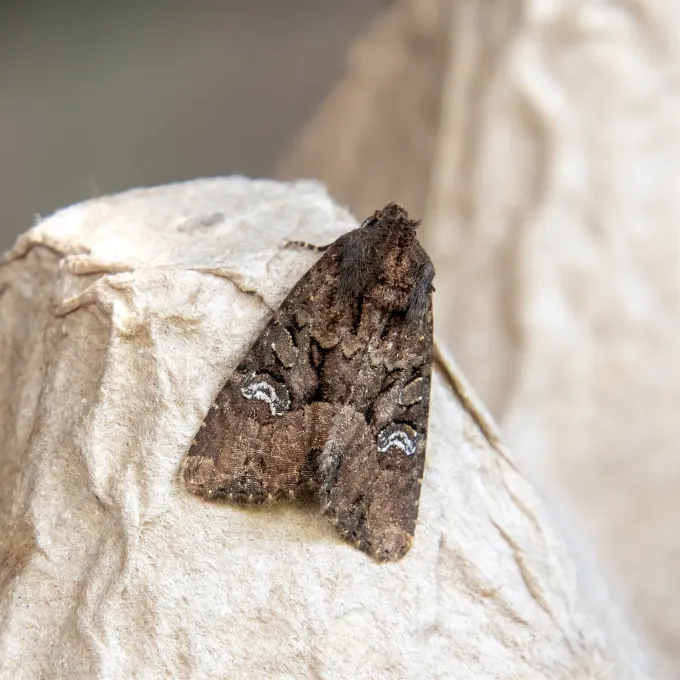
The Common Rustic (Mesapamea secalis) belongs to the family Noctuidae. The adult moth has a wingspan of 30–35 mm, with a grayish-brown color and a distinct central mark on the forewings, which provides excellent camouflage during the day.
The larvae are brownish or yellowish-green caterpillars that grow up to 35 mm in length. They possess a dark head and a body characterized by a faint dorsal stripe, perfectly adapted for a boring lifestyle.
This species is widely distributed across temperate regions of Eurasia. Its biology is strictly tied to graminaceous habitats, where it thrives on both wild grasses and cultivated cereals.
Identifying the pest is challenging due to the secretive nature of the larvae, which spend the majority of their lifecycle inside the stems of host plants, avoiding direct sunlight and predators.
Entomological monitoring requires specific knowledge of moth morphology and larval habits to differentiate this species from other stem-boring insects present in the same field conditions.
What it damages
The damage is caused primarily by the larvae feeding on the inner tissues of cereal crops. Main hosts include winter wheat, rye, barley, and oats, which are vulnerable during the early growth stages.
The pest also utilizes wild grasses, such as Couch Grass (Elymus repens), as alternative hosts and reservoirs. These weeds often serve as the bridge for infestation into crop fields.
Larvae enter the plant at the base, boring into the stem and destroying the central shoot. This results in the "deadheart" symptom, where the main growth point of the plant dies prematurely.
The overall impact of the infestation is a significant reduction in plant density. A single caterpillar can damage multiple tillers, moving from one plant to another within the row.
Economic losses vary depending on the larval density in the spring. In severe cases, the reduction in productive tillers leads to substantial yield gaps in the cereal harvest.
When it appears
The life cycle of this species is univoltine, meaning there is one generation per year. The larvae overwinter in the stems of weeds or within the upper layer of the soil.
In spring, when temperatures rise above 5–8°C, larvae resume feeding on emerging cereal shoots. This feeding phase continues until the early summer period.
Pupation occurs in the soil or at the base of the stems during June. The pupal stage lasts for approximately two to three weeks before the adult moths emerge.
The flight period of the adult moths takes place from July to August. Being nocturnal, they remain active primarily during the evening hours, feeding on nectar and laying eggs.
Females deposit eggs on the leaves of host grasses. Larvae hatch in late summer or autumn and feed on available vegetation until winter temperatures force them into hibernation.
Signs of infestation
The most visible sign of infestation is the yellowing and wilting of the central leaf of the plant. This leaf, if pulled, releases easily because its base has been consumed by the larva.
Close inspection of the stem base reveals small entry holes surrounded by frass, which looks like fine brown sawdust. These entry points indicate where the larva has bored into the plant.
Field observation shows scattered patches of stunted or dying tillers. These patches are more pronounced in areas of the field with higher weed competition or poor drainage.
Tillering disruption is a key indicator of larval activity. If a field shows irregular growth in late spring, stem dissection is required to confirm the presence of the larvae.
In mature plants, severe damage can cause the stem to weaken, increasing the risk of lodging during windy weather or heavy rain before harvest time.
Control measures
Effective management begins with strict weed control. Eliminating Couch Grass and other perennial grasses at field borders reduces the primary overwintering sites for the larvae.
Crop rotation is an essential strategy. Avoiding continuous cereal cropping cycles prevents the population from building up in the same area over multiple seasons.
Deep autumn plowing of stubble helps to expose the larvae or pupae in the soil to freezing temperatures and natural predators, significantly reducing the next season's population.
Chemical control involving insecticides is utilized only when monitoring confirms that the population exceeds economic injury thresholds, typically in early spring.
- Maintain weed-free field margins.
- Perform deep plowing after harvest.
- Use crop rotation to disrupt the life cycle.
- Monitor adult flight using pheromone traps.
- Apply authorized insecticides based on scouting results.
Taxonomy
- Latin name
- Mesapamea secalis
- Order
- Lepidoptera (butterflies)
- Family
- Noctuidae
- EPPO code
- PARISE
Discussion
No discussions yet — be the first.