
European bee-eater
Merops
Description
How to identify
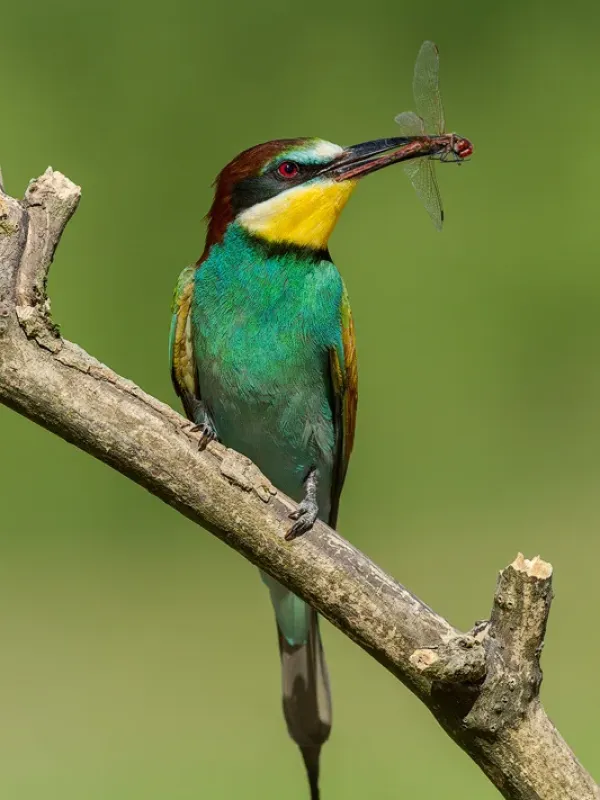
The European bee-eater (Merops apiaster) belongs to the Coraciiformes order and the Meropidae family. It is known for its vibrant plumage, featuring yellow, blue, and chestnut colors.
The bird possesses a long, slightly decurved black beak, which is evolutionary adapted for catching insects mid-air with high precision.
These birds are highly social and nest in colonies, excavating long tunnels into sandy banks, river cliffs, or quarry walls.
They are visually acute hunters capable of spotting moving insects from long distances and performing complex aerial maneuvers.
During the day, they are often seen perching on exposed branches or power lines near open fields, waiting for prey to pass by.
What it damages
Their primary diet consists of bees, wasps, and hornets, making them a significant nuisance for beekeepers during the active season.
A single bird can consume hundreds of honey bees daily, which leads to the depletion of colony strength and reduced honey production.
The predation pressure is most severe when birds intercept worker bees returning to the hive, disrupting the foraging flow.
Bee-eaters often target virgin queens during their mating flights, which can lead to colony collapse or failure to raise new brood.
Constant predation causes high stress levels in honey bee colonies, leading to defensive behavior and cessation of normal foraging activities.
When it appears
European bee-eaters are migratory birds, arriving at their breeding grounds in late spring, typically in May or early June.
The period of highest risk for apiaries coincides with the hatching of the nestlings in June and July when food demand is critical.
Weather patterns significantly influence their hunting activity: they are most effective in warm, sunny weather and less active on cloudy or rainy days.
In late summer, usually by September, the birds begin their migration back to African wintering grounds, reducing the threat to local apiaries.
Beekeepers must monitor their local environments for arrival patterns to implement protective measures before the peak predation starts.
Signs of infestation
One of the most obvious signs is the sudden drop in honey bee activity around the hive entrances as bees become wary of flying.
Beekeepers can find small pellets on the ground near the hives, consisting of indigestible insect chitin parts regurgitated by the birds.
Constant high-pitched calls and the sight of small groups of birds circling the apiary are clear indicators of active predation.
Visual identification of nesting holes in nearby sandy cliffs or embankments is a definitive sign of an established colony in the vicinity.
The absence of returning foraging bees and repeated failure of young queens to return to the hive are strong indicators of severe predation.
Control measures
Since the European bee-eater is a protected species in many countries, control measures must focus on deterrence rather than extermination.
- Installing visual deterrents like flash tape, spinning disks, or mirrors to confuse the birds.
- Using acoustic devices that broadcast predator calls or distressed bird sounds to clear the area.
- Placing mesh screens over hive entrances to allow bees to move safely while preventing direct bird attacks.
- Using mobile scarecrows or hawk decoys that are moved regularly to prevent birds from habituating.
- Locating apiaries away from traditional nesting sites such as steep slopes and gravel pits.
Taxonomy
- Latin name
- Merops
- Family
- Meropidae
- EPPO code
- MROPSP
Discussion
No discussions yet — be the first.