
Mermis subnigrescens
Mermis subnigrescens
Description
How to identify
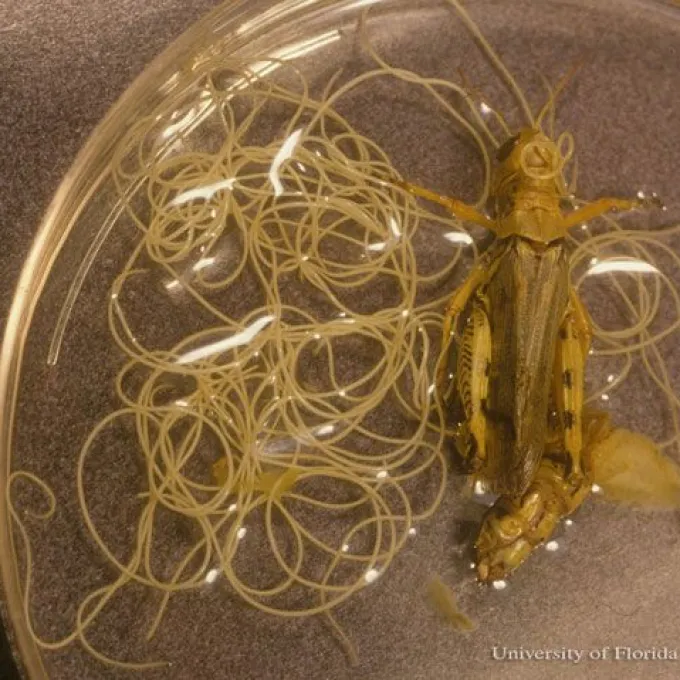
Mermis subnigrescens is a species of nematode belonging to the order Mermithida. These organisms are highly specialized parasites that spend their larval stages within the bodies of terrestrial insects.
Adult worms are significantly large, often reaching lengths of 10 to 20 centimeters. They possess a thread-like, slender body structure, typically ranging in color from whitish to dark brown.
These nematodes are most frequently observed on the soil surface or vegetation after heavy rainfall, which triggers their emergence for reproductive activities.
The morphology of the nematode is adapted for its parasitic lifecycle, and they rely heavily on environmental moisture for survival and movement.
Although they are often confused with root-feeding nematodes, Mermis subnigrescens is purely an animal parasite and does not directly consume plant tissues.
What it damages
The primary damage caused by Mermis subnigrescens is the mortality of insects, including grasshoppers and other orthopterans, which are often classified as agricultural pests.
While their impact on pest populations might seem beneficial, the non-discriminatory nature of their parasitism can also affect beneficial insects, leading to an ecological imbalance in the field.
They do not cause mechanical or chemical damage to plants, meaning they are not considered primary crop pests in the traditional agronomic sense.
However, an overabundance of these worms can be an indicator of persistently high moisture levels, which might lead to secondary problems like fungal diseases in crops.
The ecological impact is centered on the disruption of the insect population structure, which can indirectly affect pollination and natural predation rates within the field.
When it appears
The activity of Mermis subnigrescens is strongly seasonal and closely tied to rainfall patterns throughout the summer months.
Eggs are deposited onto foliage during moist periods, where they remain until they are accidentally ingested by a host insect while feeding.
The larvae develop inside the host for several weeks, eventually emerging to continue the cycle in the soil once they have reached maturity.
They overwinter in the soil, emerging as adults in the spring when soil temperatures and moisture levels reach the optimal threshold for reproduction.
Monitoring for these nematodes is most effective during the peak summer rainy season when their emergence on the soil surface is at its highest.
Signs of infestation
The most visible sign is the sudden appearance of long, thin, worm-like organisms on leaves or soil after a rain event, which is often mistakenly interpreted as a pest outbreak.
Finding deceased or sluggish insects with ruptured abdominal sections is a clear indicator that a mermithid nematode has completed its development within the host.
Clusters of microscopic eggs may be present on the leaves of plants during the egg-laying season, appearing as tiny, dark, or brownish spots.
A noticeable decline in insect populations in highly saturated areas of the field can indicate the presence of these nematodes acting as a biological limiting factor.
Persistent wet soil conditions in combination with the absence of surface-dwelling insects are common markers of the habitat preferred by Mermis subnigrescens.
Control measures
Management of Mermis subnigrescens is generally unnecessary because it acts as a biological control agent against some agricultural insect pests.
If population control is needed, the focus should be on managing field moisture, which is the primary driver of the nematode's reproductive success.
- Improve soil drainage to prevent surface water pooling after irrigation or rainfall.
- Switch from overhead sprinkler irrigation to drip irrigation to keep foliage dry.
- Maintain proper field sanitation to discourage large aggregations of host insects.
Cultural practices such as deep tillage are generally ineffective due to the deep migration patterns of the nematodes in the soil profile.
Biological balance is maintained by the natural predation of these worms by soil-dwelling fungi and other microbes, which should be encouraged through healthy soil management.
Taxonomy
- Latin name
- Mermis subnigrescens
- Order
- Nematodes
- Family
- Mermithidae
- EPPO code
- MERMSU
Discussion
No discussions yet — be the first.