
Black mermis
Mermis nigrescens
Description
How to identify
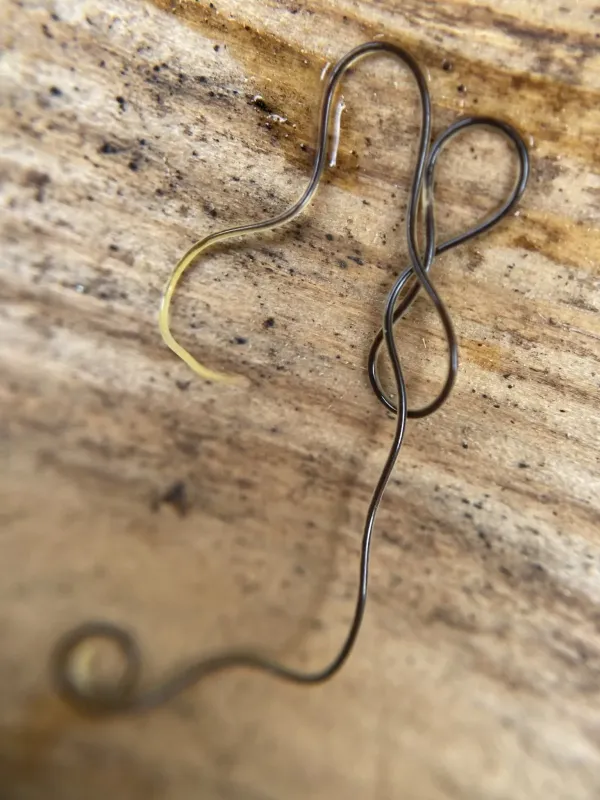
The black mermis (Mermis nigrescens) is a large parasitic nematode species belonging to the order Mermithida and the family Mermithidae. Adults are remarkably long, sometimes reaching up to 20 centimeters in length.
The body of this nematode is filiform, smooth, and typically whitish to yellowish, though it may darken as the individual matures. Females are generally larger than males, which is a distinguishing feature used for identification.
The lifecycle of this organism is intricately tied to soil environments and insect hosts. After mating, females emerge from the soil to lay eggs on the surfaces of plants, often triggered by rainfall or high humidity.
Upon hatching, larvae actively crawl over plant foliage in search of suitable insect hosts, such as grasshoppers or beetles. They penetrate the host cuticle using a specialized stylet to enter the body cavity.
Development within the insect host takes several weeks, after which the parasite emerges into the soil, causing the inevitable death of the host. The emerged nematode then continues its maturation process in the soil.
What it damages
The black mermis is not considered a direct pest of agricultural crops in the sense of consuming plant tissues, as it is an obligate parasite of insects.
The primary impact on agriculture is indirect, as these nematodes act as biological control agents by parasitizing insects like grasshoppers and various beetle species that feed on crops.
However, the presence of these long nematodes on crops can cause aesthetic damage or consumer concern, particularly in vegetable and berry production where fresh produce is harvested.
While not feeding on plants, their lifecycle requirements often overlap with periods of high crop growth, leading to frequent encounters by farmers in the field.
Essentially, the presence of Mermis nigrescens can be viewed as an indicator of local ecosystem health and a natural mechanism for regulating pest populations.
When it appears
The activity of the black mermis is highly dependent on environmental moisture levels, as the species is extremely sensitive to desiccation.
Adults are most commonly observed at the surface of the soil or on plants during late spring and early summer, typically following periods of heavy rain.
High relative humidity and wet soil surfaces facilitate the female's emergence from the soil to deposit eggs, which coincides with the active growing season of many crops.
During dry conditions, the nematodes retreat deeper into the soil layers to avoid dehydration, effectively slowing down their life cycle.
Agricultural monitoring programs should account for these seasonal activity patterns, as they influence the dynamics of insect pest populations throughout the year.
Control measures
Specific chemical control measures against the black mermis are generally unnecessary because the organism does not damage plant tissues directly.
Effective management focuses on agrotechnical practices that improve soil drainage and reduce moisture retention, creating less favorable conditions for the nematode's emergence.
Deep autumn plowing is a recommended cultural practice that disrupts the soil environment, limiting the survival of developing larvae and the maturation of adult nematodes.
Maintaining balanced crop rotations helps stabilize the ecosystem and prevents the overpopulation of insects that act as hosts for the parasite.
The use of broad-spectrum insecticides should be avoided to preserve beneficial insect populations and the natural regulatory role played by entomopathogenic organisms like mermithids.
Taxonomy
- Latin name
- Mermis nigrescens
- Order
- Nematodes
- Family
- Mermithidae
- EPPO code
- MERMNI
Discussion
No discussions yet — be the first.