
Zebra caterpillar
Melanchra picta
Description
How to identify
The zebra caterpillar (Melanchra picta) is a moth belonging to the family Noctuidae, order Lepidoptera. The adult moth has a wingspan of approximately 35–40 mm.
The forewings are deep reddish-brown or dark brown with a distinct pattern. The hindwings are paler, typically grayish-white with a darker border.
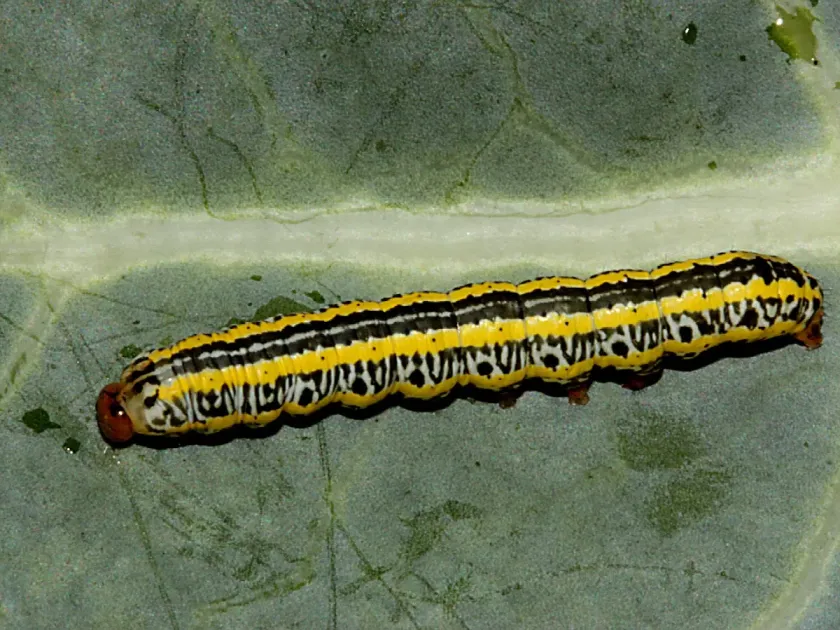
The larva of this species is highly recognizable, which gave the insect its common name. The body is bright yellow with broad black stripes on the back and sides, resembling a zebra's coat.
Mature caterpillars reach a length of 35–40 mm. The head and thoracic legs are reddish-brown, helping them blend into the base of the host plants.
The pupa is reddish-brown, shiny, and about 15–20 mm long. It typically resides in the soil, where it spends the overwintering stage.
What it damages
This pest is a polyphagous insect, meaning it feeds on a wide range of plants from different botanical families, including vegetables, field crops, and ornamentals.
The zebra caterpillar causes significant damage to cruciferous crops, such as cabbage, broccoli, cauliflower, and radish. It also frequently attacks beets and spinach.
In gardens, these caterpillars can damage asters, gladioli, and other flowering plants by actively devouring the foliage.
The damage is characterized by young larvae skeletonizing the leaves, eating the soft tissue while leaving the veins. As they grow, they chew large, irregular holes in the leaves.
During heavy infestations, the pest can completely defoliate plants, leading to a drastic reduction in crop yields or even total plant death.
When it appears
The zebra caterpillar typically undergoes one or two generations per year, depending on local climatic conditions and the seasonal temperature profile.
Adult moths emerge in late May and remain active throughout June. During this time, females lay eggs on the undersides of host plant leaves.
The embryonic development takes 5 to 10 days, followed by the hatching of larvae. The peak period of larval feeding occurs in July and August.
Pupation occurs in the soil. The pupae overwinter in the topsoil layer, encased in cocoons made of soil particles held together by silk, until the following spring.
High population densities are usually observed in years with moderately wet and warm weather, which favors the survival of eggs and young larvae.
Signs of infestation
The first sign of a zebra caterpillar infestation is the presence of clusters of small, yellowish or creamy-colored eggs on the undersides of leaves.
A second indicator is the discovery of skeletonized leaf patches, which appear as translucent "windows" on the leaf surface.
The presence of the caterpillars themselves is the most definitive sign. Due to their bright, high-contrast coloration, they are easy to spot on cabbage or beet leaves during early morning or evening hours.
Caterpillar frass (excrement) accumulating in leaf axils or on the ground beneath the plant is also a clear indication of active pest presence.
Severe infestations result in extensive leaf edge feeding, which prevents the plant from performing photosynthesis efficiently, leading to stunted growth.
Control measures
Cultural control methods include deep autumn plowing of the soil, which helps destroy overwintering pupae residing in the upper soil layers.
Regular monitoring of plantings and manual removal of caterpillars are effective for small vegetable gardens, especially during the early larval stages.
The use of biological control agents based on Bacillus thuringiensis allows for effective pest management without leaving chemical residues on the produce.
In cases of high pest pressure, contact-stomach insecticides may be used, provided that pre-harvest intervals are strictly observed to ensure safety.
- Maintain field hygiene by removing weeds that serve as alternative hosts for the pest.
- Encourage natural predators such as predatory bugs and parasitoid wasps that attack moth eggs and larvae.
Taxonomy
- Latin name
- Melanchra picta
- Order
- Lepidoptera (butterflies)
- Family
- Noctuidae
- EPPO code
- MLNHPI
Discussion
No discussions yet — be the first.