
Tomato moth
Melanchra
Description
How to identify
The tomato moth (Melanchra brassicae) belongs to the Noctuidae family within the order Lepidoptera. Despite its name, it is a significant pest of brassicas, including cabbage, broccoli, and cauliflower, alongside various other crops.
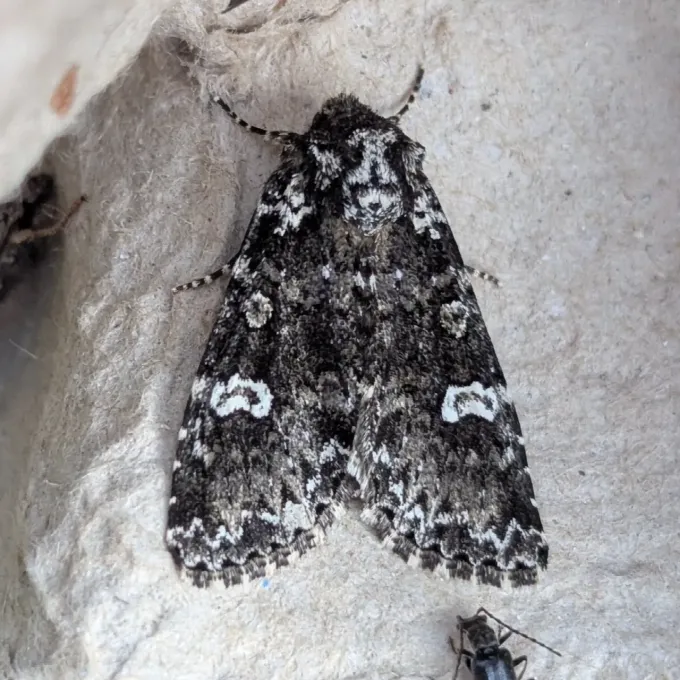
Adult moths have a wingspan of approximately 40–50 mm. Their forewings are dark brown, often displaying a distinctive white, kidney-shaped mark which serves as a key identification feature for field diagnostics.
The larvae progress through several instars. Early instars are often light green, darkening to a mottled brown or black-green as they mature. Their skin is smooth but marked with characteristic longitudinal stripes.
Pupae are deep brown, shiny, and approximately 20 mm long. They overwinter in the soil at a depth of several centimeters, encased in a simple cell made of soil particles and silk.
These moths are strictly nocturnal, resting during the day on the underside of leaves or in crevices, which allows them to remain undetected until significant population levels are reached.
What it damages
Larvae are the primary cause of crop damage. Initially, they feed on the underside of leaves, causing superficial grazing, but as they grow, they consume entire leaves, leaving only thick veins.
In addition to brassicas, this pest damages crops such as tomatoes, lettuces, sugar beets, and various ornamental plants. The larvae possess strong mandibles capable of consuming large amounts of plant biomass.
One of the most destructive aspects is the larvae burrowing into the heart of cabbage heads or tomato fruits. This not only destroys the market value of the crop but also promotes bacterial rotting.
Accumulated frass (excrement) within the plant tissue accelerates the decay process and contaminates the harvested product, making it unsuitable for human consumption or storage.
Economic damage is exacerbated by the fact that multiple generations can occur in one season in warmer climates, leading to a cumulative negative impact on plant vigor and yield.
When it appears
Adult moths typically emerge from overwintering pupae between May and June. The timing is strongly dependent on soil temperature and the accumulation of degree-days in the local area.
Egg-laying begins shortly after adult emergence, with females placing clusters of dozens to hundreds of eggs on the underside of leaves. Incubation typically lasts for about one to two weeks.
The peak feeding activity of larvae usually occurs throughout July and August. Gardeners should be most vigilant during this mid-summer period when caterpillars reach their third and fourth instars.
As temperatures begin to drop in autumn, larvae prepare for pupation. They move into the soil, where they remain in a state of diapause throughout the winter months.
Monitoring using pheromone traps can provide early warning of adult activity, which is crucial for timing potential biological or chemical interventions effectively.
Signs of infestation
The earliest signs of infestation are small batches of pale, spherical eggs found on the lower surface of leaves. These are often difficult to spot without thorough inspection.
Irregular, skeletonized patches on leaves indicate the presence of young larvae. These small «window» marks are a classic indicator that the eggs have recently hatched.
The presence of dark, granular fecal pellets on leaves or near the base of the plant confirms that larger caterpillars are actively feeding nearby. This is often the first visible sign of damage to the casual observer.
Visible boreholes in the hearts of vegetables such as cabbage or within fruits like tomatoes are clear indications of advanced larval presence and severe damage.
Wilted or yellowing leaves can sometimes point to hidden larvae damaging the stem or root crown, particularly in younger, more vulnerable plants.
Control measures
Cultural control is highly effective; fall and spring soil tillage helps to expose overwintering pupae to the surface, making them susceptible to frost and natural predators.
Encouraging natural enemies such as parasitic wasps and ground beetles can provide significant levels of biological control in sustainable garden systems.
For smaller infestations, manual removal of egg clusters and young larvae is recommended. This is a labor-intensive but highly targeted and safe method of population management.
Biological insecticides based on Bacillus thuringiensis are effective against young larvae and represent an environmentally friendly option that protects beneficial pollinators.
If population thresholds are exceeded, targeted applications of approved insecticides can be used, provided that pre-harvest intervals are strictly observed to ensure safety.
Taxonomy
- Latin name
- Melanchra
- Order
- Lepidoptera (butterflies)
- Family
- Noctuidae
- EPPO code
- MLNHSP
Discussion
No discussions yet — be the first.