
Cabbage moth
Mamestra
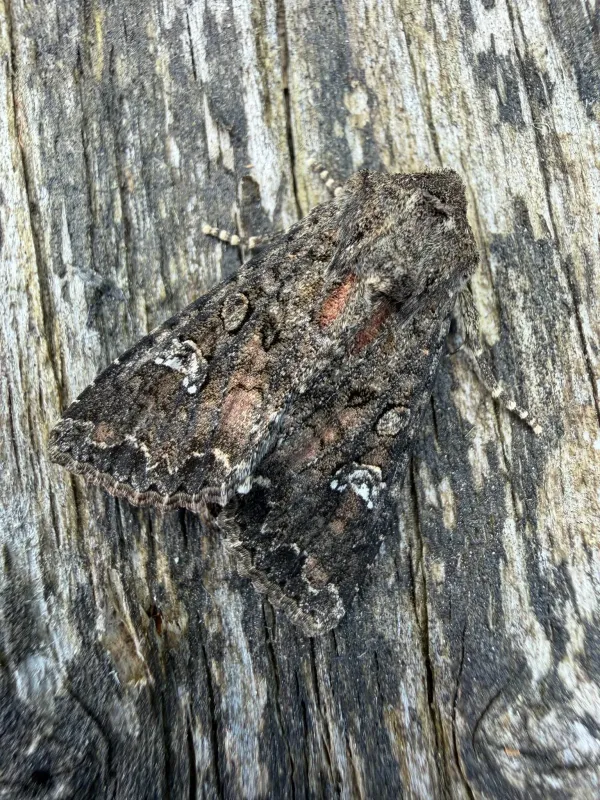
Description
How to identify
The cabbage moth (Mamestra brassicae) is a member of the Noctuidae family. The adult moth has a wingspan of approximately 40–50 mm, with mottled brown and grey forewings marked by a characteristic white, kidney-shaped spot and a zigzag line.
The larvae, or caterpillars, undergo several instars. Young caterpillars are typically light green, while mature ones become darker, often greenish-brown or even grey-black with a distinct yellowish lateral stripe and fine white mottling on their backs.
The pupae are dark brown, glossy, and about 20 mm in length. They overwinter in the soil at a depth of 10–15 cm, forming a protective cocoon which helps them survive lower temperatures and soil moisture.
Eggs are laid in clusters on the underside of host plant leaves. They are hemispherical and pale yellow, transitioning to a darker grey-blue as the larvae inside develop, just before they hatch.
Morphologically, the larvae are distinguished by their robust mandibles and the ability to feed extensively on both soft foliage and dense vegetable tissues, which is typical for this species.
What it damages
This pest is a polyphagous insect that feeds on a wide array of crops including cabbages, broccoli, cauliflower, Brussels sprouts, sugar beets, lettuce, and various legumes. It causes significant damage to both commercial and garden crops.
Early-stage larvae feed on the undersides of leaves, creating small irregular holes and "windowing" the foliage, while leaving the upper cuticle intact. This damage can stress the plant during its critical growth phase.
As the larvae mature, they consume the entire leaf lamina, leaving only the primary veins. They frequently bore into the center of heads in cabbage-like plants, causing severe structural damage.
The presence of larval frass (excrement) inside the cabbage head is a major issue. It often contaminates the vegetable and acts as a substrate for secondary fungal and bacterial rot infections.
Heavy infestations can lead to total crop failure. Even moderate damage often renders the produce unmarketable due to the unsanitary state of the vegetables and the presence of feeding tunnels.
When it appears
Adult moths emerge in late spring when soil temperatures reach 10–12°C. The timing of emergence is often spread out, with activity continuing through the peak of the summer season.
Depending on the climatic zone, the cabbage moth typically completes one to two generations per year, though in warmer southern regions, a third generation may occasionally develop within a single season.
The total life cycle duration is highly dependent on ambient temperature, generally taking between 30 to 45 days. Warm, humid conditions significantly accelerate the development of all life stages.
Larval activity is most intense during the mid-summer months when crops are forming their yields. The caterpillars are nocturnal feeders, remaining hidden during the brightest parts of the day.
Overwintering occurs in the pupal stage within the soil. By the end of autumn, larvae of the final generation move into the ground to enter diapause, ensuring survival through the winter months.
Signs of infestation
The earliest sign of infestation is the discovery of egg masses on the lower surface of leaves. Monitoring these clusters allows for early intervention before the caterpillars hatch and disperse.
Skeletonized leaf patches and small holes are clear indications of early larval feeding. Checking the plant base for these symptoms is essential for effective early-stage management.
Accumulated dark larval droppings found in leaf axils or on the surface of developing heads are unmistakable signs of active infestation by older, more damaging caterpillars.
Wilting of individual leaves or a softening of the head structure often indicates that larvae have already bored into the vegetable, which can be difficult to manage once they are inside.
Increased moth activity in the evening hours, especially near vegetable fields, serves as an alert that the pest is laying eggs and that proactive protective measures should be initiated.
Control measures
Cultural control is primary, emphasizing deep autumn plowing to expose pupae to freezing temperatures and natural predators, which significantly reduces the population for the following year.
Biological control using Bacillus thuringiensis (Bt) products is highly effective against young larvae. These products are environmentally friendly and safe for beneficial insect populations.
Chemical control should rely on registered insecticides applied during the early instars. It is crucial to rotate chemical modes of action to prevent the development of resistance in moth populations.
The use of pheromone traps provides valuable data for monitoring, allowing farmers to predict the peak moth flight and time their treatments for maximum effectiveness during the growing season.
- Hand-picking larvae in small garden plots.
- Using fine-mesh netting to prevent egg-laying by moths.
- Promoting the presence of parasitic wasps like Trichogramma in the fields.
Taxonomy
- Latin name
- Mamestra
- Order
- Lepidoptera (butterflies)
- Family
- Noctuidae
- EPPO code
- MAMESP
Discussion
No discussions yet — be the first.