
Iris borer
Macronoctua
Description
How to identify
The Iris borer (Macronoctua onusta) is a nocturnal moth in the Noctuidae family. The adult moth has a wingspan of about 40–50 mm, featuring brownish-grey wings with subtle patterns that help it blend into natural surroundings.
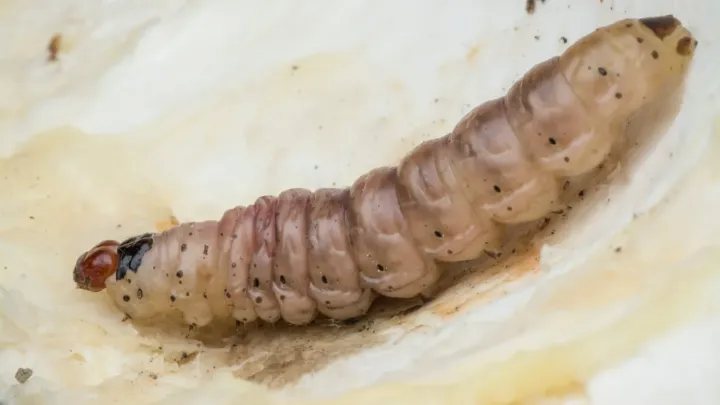
The larvae, or caterpillars, are the primary life stage causing damage to plants. These larvae can reach up to 5 cm in length and are generally pinkish or greyish-white with a distinct dark head, making them identifiable upon close inspection.
The species completes one generation per year. Adults are rarely seen during the day, as they hide and are active only at night, focusing on mating and egg-laying on the foliage of host plants.
Overwintering occurs in the egg stage. These eggs are laid by females in the autumn on the lower leaves or debris surrounding the base of the host plant, where they remain until the following spring.
As temperatures rise in the spring, the eggs hatch into small larvae. These larvae immediately begin their feeding cycle, first mining the leaves and then tunneling downwards into the main stem and rhizome.
What it damages
The primary host plants for the Iris borer are species of the Iris genus. Bearded irises are particularly susceptible due to their thick, fleshy rhizomes which provide abundant food and shelter for the larvae.
While irises are the main targets, the larvae may occasionally attack lilies and other perennial plants, especially when grown in close proximity to infested iris beds or in dense horticultural plantings.
The damage starts with the larva tunneling into the stem. As it moves downward, it destroys the plant's vascular tissue, preventing water and nutrient uptake, which eventually leads to the collapse of the plant.
The tunnels created by the larvae serve as entry points for soft rot bacteria (Erwinia carotovora). This secondary infection often causes the entire rhizome to liquefy, leading to a foul-smelling, mushy mess.
The economic and aesthetic damage caused by this pest is significant. Because the larvae operate internally, they often remain hidden until the plant is already severely compromised or dying.
Signs of infestation
The earliest symptom of an infestation is the yellowing and wilting of the center leaves in the iris fan. This indicates that the larva is actively feeding inside the stem and disrupting nutrient flow.
Upon closer examination, one might see small pinholes on the leaves or moist, sawdust-like frass (excrement) around the base of the plant, which is a clear indicator of larval activity inside the tissues.
If you pull lightly on the central leaves of an infested iris, they will often detach easily. At the base of these leaves, you will find signs of tunneling or chewed tissues, sometimes accompanied by a decaying odor.
Severe infestations reveal extensive tunneling within the rhizome itself. If you dig up such a plant, the rhizome will feel soft, hollowed out, and may be visibly populated by the plump, fleshy caterpillars.
Monitoring during the late spring to early summer is crucial, as this is when the larvae are most active and the symptoms of their feeding become most apparent to the gardener.
Control measures
Mechanical control is highly effective for smaller gardens. Digging up infested rhizomes to manually remove the larvae and cutting away the damaged, rotted sections can save the plant if caught early enough.
Systemic insecticides are recommended for preventative care. Applying these during the early spring, when the young larvae are just starting to mine the leaves, can successfully prevent them from entering the rhizome.
Cultural practices play a key role in management. Thoroughly removing and destroying all garden debris, dead leaves, and weeds in the autumn eliminates overwintering sites for the eggs, reducing the next year's population.
If infestations are widespread, chemical interventions using products labeled for borer control should be employed, ensuring that applications coincide with the period of peak larval migration.
- Practice rigorous garden sanitation by removing dead iris foliage in late autumn.
- Monitor plants for the first signs of wilting in May and June.
- Apply systemic insecticides early in the growing season.
- Destroy heavily infested rhizomes to prevent the spread of bacteria.
Taxonomy
- Latin name
- Macronoctua
- Order
- Lepidoptera (butterflies)
- Family
- Noctuidae
- EPPO code
- MACNSP
Discussion
No discussions yet — be the first.