
Scarce Silver Y
Macdunnoughia confusa
Description
How to identify
The Scarce Silver Y (Macdunnoughia confusa) is a moth belonging to the Noctuidae family, often recognized by its distinct appearance and markings.
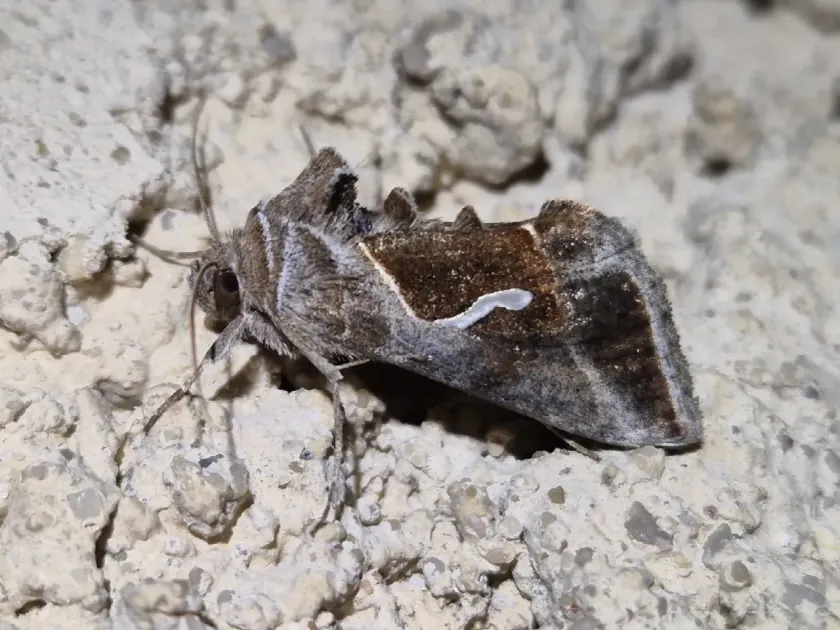
The adult moth features forewings with a metallic sheen and a prominent, silvery-white droplet-shaped mark located in the center of each wing.
Larvae are typically green in color with thin white stripes along their bodies, often blending in well with the foliage of their host plants.
Like many members of the Plusiinae subfamily, the caterpillars move with a looping gait, as they possess fewer prolegs than typical noctuid larvae.
The pupal stage occurs within a thin, white silken cocoon, which is usually spun on the underside of a leaf or hidden amongst decaying plant debris.
What it damages
The Scarce Silver Y is a polyphagous pest, meaning its larvae feed on a wide range of both wild plants and commercially significant crops.
Common host plants include sugar beet, potato, tomato, and various legumes, where the larvae can cause substantial foliar damage during their development.
Larval feeding typically occurs during the night or twilight hours, leading to significant defoliation if the population density is high.
By consuming leaf tissue, these pests reduce the photosynthetic capacity of the plant, which ultimately results in stunted growth and lower crop yields.
In addition to direct tissue loss, the damage can weaken the plants, making them more susceptible to subsequent attacks by secondary pathogens and pests.
When it appears
These moths overwinter in the pupal stage, typically buried in the soil or protected within plant litter near the base of host plants.
Adult moths emerge in late spring or early summer, depending on local temperatures and the arrival of favorable meteorological conditions.
Depending on the latitude and climate, the species can produce multiple generations per year, leading to overlapping life cycles.
The most intense feeding activity by caterpillars is generally observed during mid-summer when the larval populations reach their peak numbers.
As autumn approaches, the final generation of larvae pupates and enters diapause to survive the winter, restarting the cycle the following spring.
Signs of infestation
Early signs of infestation include small, irregular "window-pane" holes on the leaves, created when young larvae graze the leaf surface.
As the larvae mature, they consume larger sections of the foliage, resulting in ragged edges and extensive irregular holes throughout the leaf blade.
Heavy infestations may lead to near-complete skeletonization of leaves, leaving behind only the thicker, fibrous veins of the host plants.
The presence of larval frass (droppings) on the ground beneath the plants or on the leaf surfaces is a clear indicator of active feeding in the vicinity.
Disturbed caterpillars often react by curling their bodies or dropping from the leaves, a defensive behavior that helps them avoid predators.
Control measures
Effective pest management begins with cultural practices, such as deep autumn plowing, which physically disrupts the overwintering pupae in the soil.
Maintaining clean fields by removing weeds is essential, as these plants often serve as early-season food sources and breeding grounds for the moths.
Biological control using microbial insecticides, such as those containing Bacillus thuringiensis, is highly effective against younger larval instars.
Chemical control with systemic or contact insecticides should be applied only when monitoring reveals that populations have exceeded economic thresholds.
Using light traps or pheromone monitoring can provide early warnings, allowing growers to target applications during the peak flight of the adult moths.
Taxonomy
- Latin name
- Macdunnoughia confusa
- Order
- Lepidoptera (butterflies)
- Family
- Noctuidae
- EPPO code
- PYTOCO
Discussion
No discussions yet — be the first.