
Fungus gnat
Lycoriella solani
Description
How to identify
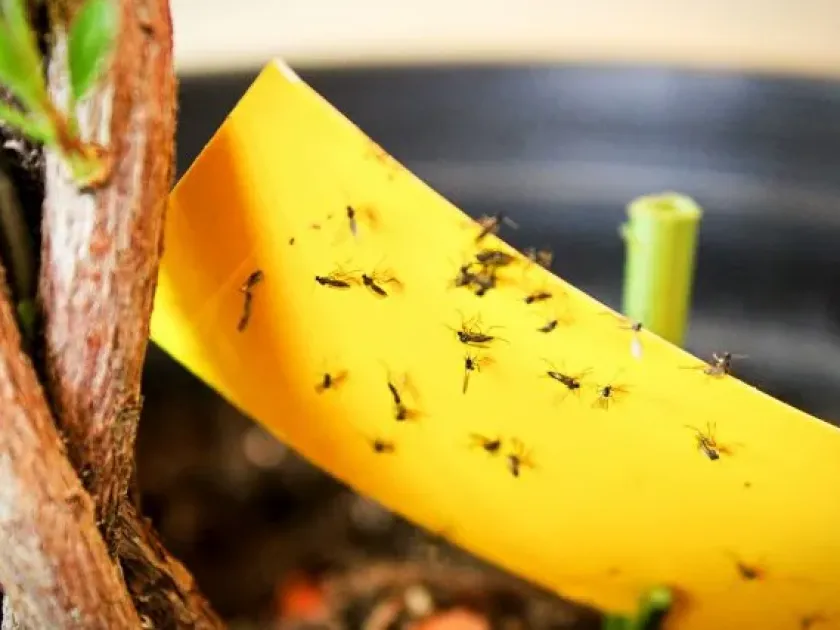
The fungus gnat (Lycoriella solani) belongs to the family Sciaridae (sciarids) of the order Diptera. Adult insects are small, measuring 2–4 mm, with dark bodies and translucent wings, often resembling tiny mosquitoes.
Larvae are worm-like, 5–7 mm long, and translucent with a distinct shiny black head capsule, which is their most recognizable feature during inspection.
These insects thrive in moist, shaded environments, commonly infesting container-grown plants, nurseries, and mushroom production facilities.
The life cycle typically takes 20–30 days depending on environmental temperature. Adults move slowly and are most active in warm, humid air conditions.
A single female can lay up to 200 eggs in damp soil or organic debris, allowing the population to explode rapidly in ideal conditions.
What it damages
Fungus gnats primarily damage seedlings, young ornamental plants, and commercial mushrooms such as white buttons and oysters. The larvae inhabit the top layer of the substrate.
While feeding on organic matter, larvae often switch to healthy plant roots when their primary food source is depleted, leading to stunted growth or total plant collapse.
In mushroom farming, larvae tunnel through the fruit bodies, causing significant quality loss and making the harvest unmarketable due to boreholes.
Feeding damage to roots also serves as an entry point for various plant pathogens, such as Pythium and Fusarium, which cause damping-off disease.
Heavily infested young plants show signs of yellowing and wilting, often losing their root system entirely if the larvae population is dense.
Signs of infestation
The most obvious sign of an infestation is the presence of adult flies hovering around plant bases or running across the soil surface after watering.
Stunted plant growth and sudden wilting despite adequate watering are strong indicators that larvae are feeding on the roots below the soil line.
Presence of fine, irregular tunnels in the stipe or cap of mushrooms is a definitive sign of sciarid larvae damage in mushroom beds.
Observing tiny, clear-bodied larvae with black heads when examining the root zone or stirring the topsoil confirms an active infestation.
Withered seedlings that detach easily from the soil often indicate that the primary root system has been consumed by the fungus gnat larvae.
Control measures
The most important cultural practice is to avoid overwatering. Allowing the top 2-3 cm of soil to dry out between waterings disrupts the larval habitat.
Yellow sticky traps are highly effective for monitoring adult populations and reducing their numbers, which helps break the reproductive cycle.
- Use pasteurized soil or soilless media to ensure the absence of eggs and larvae.
- Dispose of decaying plant material promptly to eliminate food sources.
- Apply biological control agents like Steinernema feltiae nematodes to the soil.
- Use systemic insecticides as a last resort in strictly controlled environments.
- Place sand or fine gravel on the soil surface to make it less attractive for egg-laying.
Systemic management involving both cultural practices and targeted biological agents is the most sustainable approach for greenhouse environments.
Consistent monitoring and early intervention are crucial to prevent small infestations from becoming severe outbreaks that threaten entire crop yields.
Taxonomy
- Latin name
- Lycoriella solani
- Order
- Diptera (flies)
- Family
- Sciaridae
- EPPO code
- LYCLSO
Discussion
No discussions yet — be the first.