
Fungus gnat
Lycoriella mali
Description
How to identify
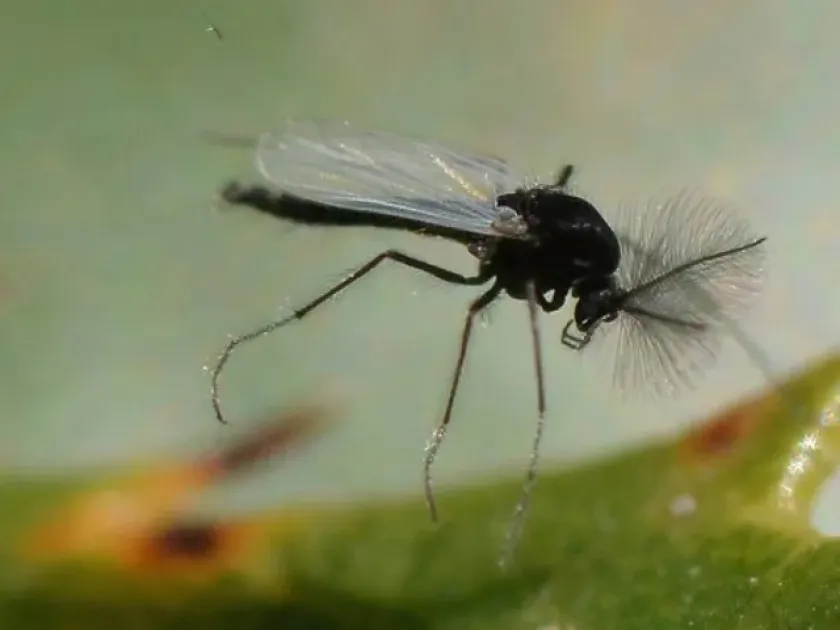
The fungus gnat (Lycoriella mali) belongs to the order Diptera and the family Sciaridae. Adult insects are tiny, slender flies measuring approximately 2–4 mm in length, characterized by a dark body and clear wings.
The larval stage is the most damaging one; these larvae are legless, white-translucent, and grow up to 5–7 mm. They possess a distinct shiny black head capsule, which is the most reliable identification feature.
The life cycle encompasses eggs, four larval instars, pupae, and adults. Females lay their eggs in moist, organic-rich soil, where the larvae hatch and begin their development.
Adult gnats themselves do not feed on plant tissues, but they are notorious for spreading spores of plant pathogens like Fusarium and Botrytis within growing areas.
Larvae primarily reside in the upper layers of the soil, feeding on organic matter, fungi, and, when populations are high, the delicate root systems of living plants.
What it damages
Lycoriella mali is a common pest in nurseries, greenhouses, and homes, affecting a wide variety of ornamental plants, vegetable seedlings, and commercial mushroom crops.
By feeding on roots and root hairs, larvae stunt plant growth and can cause severe wilting, especially in young seedlings that have not yet established a strong root system.
In mushroom production, larvae create tunnels within the fruiting bodies, rendering the produce unmarketable and vulnerable to bacterial rots.
The destruction of root tissues weakens the plant’s overall vigor, making it much more susceptible to secondary infections and environmental stresses.
Heavy infestations can lead to mass seedling loss, significantly impacting the economic viability of greenhouse production cycles.
Signs of infestation
The most common sign of an infestation is the presence of small, dark flies hovering around pots or flying up when the plant is disturbed or watered.
Close observation of the soil surface may reveal tiny, worm-like larvae squirming in the damp substrate, particularly after irrigation.
Plants affected by larval feeding often show unexplained chlorosis, loss of turgor, and a general failure to thrive despite appropriate light and watering conditions.
The use of yellow sticky traps is a standard and effective diagnostic tool; catching a large number of adults indicates an immediate need for intervention.
One might also notice a decline in soil quality, as larvae break down the organic components of the potting mix, leading to rapid compaction.
Control measures
Managing soil moisture is the primary preventive measure; allowing the top layer of soil to dry out between waterings significantly hinders larval survival and egg development.
Yellow sticky cards are highly effective for capturing adult flies, which helps break the reproductive cycle by reducing the number of eggs laid in the soil.
Biological control agents, such as entomopathogenic nematodes (e.g., Steinernema feltiae), are widely used to target and eliminate larvae in the root zone.
For more severe cases, chemical insecticides formulated for soil application can be used, ensuring they are applied according to the specific manufacturer's guidelines.
- Sterilize potting media before planting to kill any eggs or larvae.
- Remove any decaying plant matter from the soil surface.
- Apply a layer of sand to the soil surface to deter egg-laying.
- Avoid over-fertilizing with organic amendments that attract gnats.
Taxonomy
- Latin name
- Lycoriella mali
- Order
- Diptera (flies)
- Family
- Sciaridae
- EPPO code
- SCIAMA
Discussion
No discussions yet — be the first.